UPS confirms this gap is structural. Its Save as You Grow program sorts accounts into six weekly volume bands, from 1-10 packages up to 51+, with larger bands receiving larger base-rate incentives. Ship less, pay retail. Ship more, pay less. That's the entire model.
For a growing business, this translates directly into thinner margins, an inability to match competitors offering free shipping, and cash that should be reinvested instead sitting in freight invoices. Shipping itself isn't expensive. Fragmented volume, weak negotiating leverage, and zero visibility into rate structures are what make it expensive.
This article breaks down how those costs quietly accumulate, what actually drives your rate, and the specific strategies that unlock volume-tier pricing — no matter your shipment count.
Key Takeaways
- Shipping costs compound with each shipment, invisible until benchmarked against larger shippers' rates
- Volume consistency, carrier relationships, and package traits all shape your baseline rate
- Real savings come from consolidated decisions, active discount management, and pooled platform volume
- The right partnerships give any shipper access to Fortune 500-level rates, regardless of volume
How Shipping Costs Typically Build Up
Shipping isn't one expense. It's hundreds or thousands of tiny transactions, each priced at whatever rate happens to be active at that moment. A five-cent gap per package looks trivial in isolation. Multiply it across 3,000 shipments a year, and it's a real budget line.
That's the trap: each individual shipment feels normal. There's no red flag on a single invoice telling you it's overpriced. The only way to see the gap is to compare your actual rate against what a high-volume shipper pays for the same lane and service. Most businesses never make that comparison.
The Gap Widens as You Scale
Here's where it gets worse. Businesses that grow shipment volume without renegotiating keep paying introductory rates long after they've earned better ones. UPS calculates its volume bands from a trailing eight-week average: your pricing tier is supposed to move with your growth. If nobody's tracking that, it doesn't.
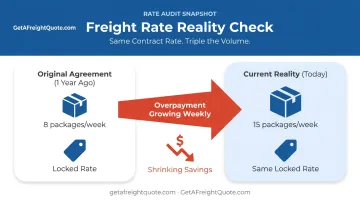
Consider a business that ships 15 packages a week today but shipped only 8 a year ago. If nobody revisited the rate agreement, the numbers stop adding up:
- Priced today as if still shipping 8 packages a week
- Overpaying on every shipment above that original volume
- Losing more each week the gap goes unnoticed
Key Cost Drivers Behind Shipping Rates
Not all cost drivers carry equal weight, and which one matters most depends on what you actually ship. Four factors control your baseline rate before any discount enters the conversation.
Volume and Consistency
Carriers build pricing around predictability. A shipper who moves 200 packages every single week is a lower-risk, higher-value partner than one who moves 200 packages some weeks and 20 the next, even if the annual totals are similar.
UPS's published bands illustrate how this plays out in practice:
| Weekly Volume Band | Relative Discount Position |
|---|---|
| 1-10 packages | Lowest tier |
| 11-20 packages | Modest incentive |
| 21-30 packages | Moderate incentive |
| 31-50 packages | Deeper incentive |
| 51+ packages | Highest published tier |
Note: these discount tiers apply to base transportation rates only (not surcharges, accessorials, or other fees), according to UPS's own program documentation. Don't assume a headline discount reflects your total invoice savings.
Carrier Relationship Type
The same package, same weight, same zone can cost three different prices depending on how you're buying:
- Retail/no-account rates: the sticker price, no leverage applied
- Business account rates: modest built-in discounting for having an account
- Negotiated contract rates: customized pricing based on your volume, lanes, and history
Volume alone doesn't guarantee the best price. Relationship structure matters independently.
Package and Freight Characteristics
Before any discount touches your rate, physical characteristics set the floor:
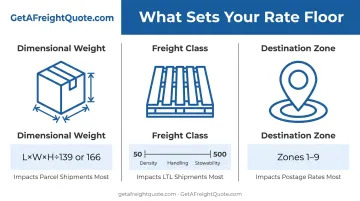
- Dimensional weight: UPS calculates this as length × width × height divided by 139 (Daily Rates) or 166 (Retail Rates), rounding up fractional measurements
- Freight class (LTL): NMFTA assigns classes from 50 to 500 based on density, handling, stowability, and liability; denser, easier-to-handle freight gets a lower class and lower cost
- Destination zone: USPS defines distance in Zones 1 through 9, with more zones crossed meaning higher postage
A small parcel-only ecommerce seller lives and dies by dimensional weight and zone. A business shipping pallets cares far more about freight class. The "best" lever genuinely depends on what's in the box.
Cost-Reduction Strategies for Unlocking Volume Discounts
Businesses that meaningfully cut shipping costs usually aren't doing one thing right. They're changing decisions made before shipping happens, actively managing the discounts they already have, and changing the broader context their shipping operates in. Most real savings come from combining all three.
Strategies That Change Decisions Before You Ship
- Consolidate volume with fewer carriers. Splitting shipments thin across five carriers means none of them ever reach a meaningful discount tier. Concentrate volume where it counts.
- Match shipping mode to shipment profile. Choosing parcel when a shipment profile actually fits LTL (or vice versa) is a common hidden cost driver. Decide the mode before locking into a contract.
- Set an internal speed policy. Accepting ground instead of air, where the business allows it, often unlocks much deeper discount tiers.
- Decide direct negotiation vs. aggregator early. Below certain volume thresholds, working through a reseller or aggregator typically delivers far more value than trying to negotiate directly.
Strategies That Actively Manage Existing Discounts
Getting a good rate once isn't the finish line. Discounts erode without maintenance:
- Track volume and spend data continuously so tiers can be renegotiated as the business grows, instead of staying locked into outdated introductory pricing
- Audit carrier invoices regularly to confirm negotiated discounts and surcharge waivers are actually applied, not just promised
- Document shipment consistency, since carriers use this history to justify deeper discounts for reliable, long-term partners
- Centralize shipping across departments or locations under one account so total volume counts together, instead of fragmenting into smaller, lower-tier totals
Strategies That Change the Context Around Your Shipping
This is where the biggest structural gains happen, because it changes your negotiating position instead of just improving the deal within a weak one.
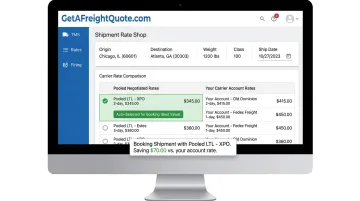
Partner with a freight technology platform that pools volume. This is the mechanism behind GetAFreightQuote.com's TMS platform: the platform aggregates shipment volume across hundreds of businesses into a single purchasing bloc, rather than leaving one small business to negotiate alone.
Carriers respond to that pooled volume the way they'd respond to a single large enterprise shipper. The resulting rates get passed down to each individual user, regardless of personal shipment count.
The platform also lets businesses add their own existing carrier accounts alongside these negotiated rates, so every shipment gets rate-shopped against both sources and booked at whichever is cheaper.
Other context-shifting options worth exploring:
- Shipping cooperatives or trade associations, such as the United Shippers Alliance, aggregate member volumes specifically to negotiate collective LTL discounts
- Multi-carrier comparison platforms with pre-negotiated bulk rates already built in, removing the need to independently hit volume thresholds
- Regional carriers for regional lanes, since national volume thresholds don't apply the same way and regional networks often price shorter routes more competitively
Conclusion
Cutting shipping costs starts with identifying where the real cost is hiding: fragmented volume, invisible surcharges, or a contract structure that never got updated. Fixing that root cause matters more than chasing the lowest rate on a carrier's website.
This isn't a one-time project. Rates shift, surcharges get added, and volume changes month to month. Platforms that combine negotiated rates, technology, and hands-on support (the model GetAFreightQuote.com operates on) help businesses keep capturing volume-tier pricing as their needs evolve. That means no renegotiating from scratch every time something changes.
Frequently Asked Questions
How can I qualify for volume shipping discounts?
Qualification is typically based on consistent shipment volume tracked over weeks or a year, not a single big order. Partnering with an aggregator or reseller can provide access to discount pricing without independently hitting those thresholds.
Do USPS and FedEx offer volume shipping discounts?
Yes. USPS offers a Business Rate Card and customized Negotiated Service Agreements, while FedEx offers similar business shipping rates and loyalty rewards. Exact thresholds and savings vary by carrier, service level, and account.
How can I get free shipping?
"Free shipping" for customers is usually funded by the business absorbing the actual shipping cost. Securing better carrier rates through account status, negotiation, or aggregation is what makes that absorption sustainable long-term.
What's the difference between a volume discount and a rebate?
A volume discount reduces the rate at the point of shipment, while a rebate returns money afterward, once volume or performance conditions are met. Discounts are immediate; rebates involve a delay.
How much can volume discounts actually save on shipping costs?
Savings vary widely based on volume, consistency, and how the agreement is structured — carrier headline percentages typically apply only to base rates, not surcharges. GetAFreightQuote.com's platform, for example, targets 20-50% below retail rates through pooled volume.
Can a small business access enterprise-level shipping rates without high volume?
Yes. Aggregator platforms, TMS resellers, and marketplace models combine many shippers' volume, giving smaller businesses access to rate levels close to what large enterprises negotiate directly.