This mix-up happens constantly in LTL shipping. Many shippers assume "inside delivery" means the carrier handles placement wherever they need it. In reality, the service has a narrow, tariff-defined scope, and misunderstanding it leads to surprise accessorial fees, redelivery requests, and frustrated receiving staff.
This guide breaks down exactly what inside delivery covers, how much it costs, how it compares to similar services, and how to avoid getting billed for something you didn't expect.
Key Takeaways
- Moves freight past the dock or entrance, not into a specific room or floor
- Base pricing runs $10–$19 per hundredweight, with minimum charges of $100–$200
- Residential deliveries face stricter limits than business deliveries due to liability rules
- Unpacking, placement, and debris removal cost extra beyond inside delivery
- Book inside delivery at quote time to avoid redelivery fees and delays
What Is Inside Delivery in LTL Shipping?
Inside delivery is an LTL accessorial service where the driver moves freight beyond the point directly accessible to the trailer, meaning past the dock, platform, or the spot immediately adjacent to the truck. Standard LTL service stops there. Anything past it counts as "inside."
Carrier tariffs define this consistently. FedEx Freight's rules tariff describes inside delivery as movement beyond a point "directly accessible or immediately adjacent to the trailer," confirming that standard service covers only a consignee's dock, platform, or receiving device. XPO's tariff uses nearly identical language, explicitly excluding assembly, unpacking, and sorting from the service.
Here's the part shippers often miss: inside delivery is always a paid add-on. It's never bundled into standard LTL rates. You have to request it when booking the shipment, not after the truck shows up.
Inside Delivery to Residential Addresses
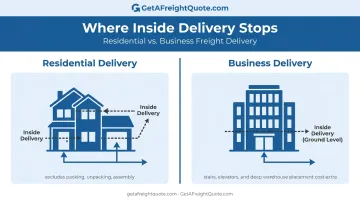
For homes, inside delivery typically stops at the front door, back door, or inside the garage. Drivers generally won't enter living spaces.
- FedEx's residential delivery reaches the front door, back door, or garage interior, but excludes packing, unpacking, assembly, and debris removal
- Delivery to floors above or below ground level only happens if a working elevator is available and no carrier labor cost is required
- Some carriers, like XPO, offer an unattended residential option that leaves freight at the curb, driveway, or porch, excluding inside service entirely
Carriers restrict residential inside delivery because of liability exposure. A driver navigating narrow hallways or stairs inside a private home creates real risk of property damage or injury, and most carrier insurance policies aren't built to cover that.
Inside Delivery to Business Addresses
For commercial addresses, the driver carries freight a short distance past the main entrance. Businesses with a functional loading dock usually skip this service entirely since standard dock delivery already covers their needs.
Moving freight further, like up a staircase, through an elevator, or deep into a warehouse, triggers separate accessorial charges on top of the base inside delivery fee. These aren't automatically included just because you requested "inside delivery" on the bill of lading.
Inside Delivery vs. Curbside, Threshold & White Glove Service
Shippers often confuse inside delivery with three adjacent service tiers. Here's how they actually differ:
| Service Tier | What's Included | Typical Use Case |
|---|---|---|
| Curbside/Dock | Freight lowered via liftgate at the curb or dock; receiver moves it from there | Businesses with dock access and equipment on hand |
| Threshold | Freight moved into the first dry interior space, such as a garage or lobby | Residential deliveries where the receiver needs it just past the weather barrier |
| Inside Delivery | Freight carried past the entrance to a general interior point, not a named room | Offices or facilities without dock access needing basic interior placement |
| White Glove | Unpacking, placement in a specific room, debris removal, sometimes assembly | High-value, fragile, or complex items requiring full-service handling |
Curbside is the baseline included in most standard LTL quotes; anything beyond it costs extra. Threshold delivery goes one step further than curbside but stops at the first available interior space. Inside delivery goes further still, but it's not tied to a specific named location the way white glove service is.
White glove sits at the top of that hierarchy. FedEx's Premium tier, for example, adds two-person delivery, room-of-choice placement, and optional packaging removal — services well beyond what basic inside delivery covers.
The key limitation shippers miss: inside delivery does not include breaking down pallets, unpacking boxes, or carrying freight through unsafe or narrow spaces like steep stairwells. If your shipment needs any of that, you likely need white glove service instead.
How Much Does Inside Delivery Cost?
Inside delivery pricing varies by carrier, shipment weight, and access difficulty. Published carrier tariffs give a clear picture of the base cost:
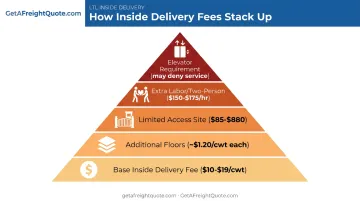
- FedEx Freight's rules tariff lists inside delivery at $18.92 per hundredweight, with a $200 minimum and a $1,999 maximum per vehicle, per shipment
- XPO's published tariff prices the same service at $17.45 per hundredweight, with a $179 minimum and $1,504 maximum
- Estes Express charges roughly $10.25 per hundredweight for first-floor street-level delivery, with higher rates applied in dense urban zones like New York City
What Drives the Price
Three factors determine your final bill:
- Shipment weight — heavier freight costs more per hundredweight, though minimums apply to light shipments
- Doorway and access difficulty — narrow entrances, tight hallways, or limited-access buildings add surcharges
- Distance from the truck — the further the driver has to carry freight, the higher the potential charge
Common Stacking Surcharges
Base inside delivery fees rarely stand alone. Watch for these add-ons:
- Additional floors — Estes charges around $1.20 per hundredweight for each floor above or below street level
- Limited access sites — ranges from $85 flat (Estes) to $180–$880 based on weight (XPO)
- Extra labor/two-person delivery — priced hourly, from roughly $150–$175 per person per hour depending on carrier
- Elevator-only buildings — most carriers only extend inside service to upper floors if a working elevator exists; if not, service may be denied entirely
Residential Pricing and Payment Responsibility
Where the shipment is headed changes the price too. Residential inside delivery typically costs more than commercial: FedEx adds a flat $243 per shipment residential surcharge on top of applicable inside fees, while XPO's residential service runs $16 per hundredweight with an $880 maximum. The higher cost reflects added liability exposure and tighter access conditions at private homes.
Payment responsibility follows the shipper by default. The shipper is typically responsible for accessorial charges like inside delivery unless the shipping terms specify otherwise. Some carrier tariffs, like XPO's, hold the shipper, consignee, and any freight-charge agent jointly liable if the fee goes unpaid. Confirm this in writing before booking so there's no dispute when the invoice arrives.
When Should You Choose Inside Delivery?
The right call depends on what's waiting at the delivery site: dock access, equipment, and staff.
Choose it for residential deliveries when:
- The item is too heavy or bulky to move alone
- No dolly, hand truck, or pallet jack is available on-site
- The delivery address lacks a garage or covered entry point for a threshold drop
Commercial deliveries depend more on building setup than physical strain.
Choose it for business deliveries when:
- The facility has no loading dock
- It's a ground-floor retail or office space without receiving infrastructure
- The building is multi-tenant with limited staff available to handle freight
Not every shipment needs this step.
Skip it when:
- Dock access is already available on-site
- In-house staff and equipment can unload freight without help
- Budget constraints outweigh the convenience of interior placement
How to Avoid Surprise Inside Delivery Fees
Most inside delivery surprises trace back to one problem: the requirement wasn't specified at booking. NMFTA's guidance on bill of lading accuracy confirms that missing accessorial details can delay service and drive up cost after the fact.
Before you book, confirm and communicate:
- Whether the delivery address has dock access
- What floor the freight needs to reach
- Whether stairs or an elevator are involved
- Any known access restrictions at the site
This is where rate transparency matters. A modern TMS platform should show every applicable accessorial, including inside delivery, before you confirm the booking, not after the invoice lands.
GetAFreightQuote.com's negotiated carrier rates and full invoice visibility help small and mid-sized businesses see these charges upfront. That closes a gap that Fortune 500 shippers with dedicated logistics teams rarely have to worry about.

A few practical habits also help:
- Measure doorways and hallways in advance if the freight is oversized
- Confirm someone will be present at the delivery window to avoid redelivery fees
- Communicate access restrictions to the carrier before the truck is dispatched, not when it arrives
Getting these details right at booking is the single biggest lever shippers have to control accessorial costs.
Frequently Asked Questions
What does an inside delivery mean?
Inside delivery means the carrier moves freight past the loading dock or entrance threshold into the building. It does not mean the carrier will carry freight throughout the entire home or facility to a specific room.
What is an inside delivery fee?
It's an LTL accessorial charge added when a driver has to carry freight beyond the standard curbside or dock drop-off point. Cost depends on shipment weight and how difficult the access is.
Is inside delivery the same as white glove delivery?
No. Inside delivery only moves freight past the entrance threshold. White glove includes unpacking, room placement, and debris removal, and it costs considerably more.
Does inside delivery include stairs or elevators?
Basic inside delivery does not include stairs or elevators. Moving freight up stairs or between floors typically requires additional accessorial charges like stair-carry or elevator fees.
Who pays for the inside delivery fee?
The shipper is typically responsible for the fee unless the shipping terms with the receiver state otherwise. Always confirm this before booking to avoid disputes later.
How can I avoid unexpected inside delivery charges?
Specify all delivery requirements, like dock access, floor, and stairs, at the time of booking. Using a transparent rate platform lets you see every accessorial charge before confirming the shipment.