Many businesses struggle with a related challenge: customers expect low-cost delivery, but carriers charge a premium for speed. U.S. consumers now expect free shipping to arrive within just 2.6 days on average, down from 3.5 days five years ago, according to AlixPartners' 2026 Home Delivery Survey. Ground economy shipping sits at the other end of that spectrum. It pairs "ground" transportation (trucks and rail) with "economy" pricing, the slowest, cheapest tier a carrier offers, and it applies whether you're shipping a single parcel or a pallet of freight.
This guide covers what ground economy shipping actually means, how it compares to faster options, realistic transit times, which carriers offer it, and how to lock in the best rate.
Key Takeaways
- Ground economy shipping uses road transport at the lowest cost tier for savings.
- Domestic transit runs 1-5 days for parcels, 3-7 days for LTL freight.
- Parcel and freight rules diverge once shipments exceed roughly 150 lbs.
- Rates vary by carrier and lane, so comparison shopping beats brand loyalty.
- Small businesses often overpay without negotiated freight contracts.
What Is Ground Economy Shipping?
Ground economy shipping is the most affordable way to move a shipment domestically, using trucks (and sometimes rail) instead of air cargo. Carriers prioritize cost over speed with this tier, which makes it the default choice for non-urgent orders.
It costs less for a few concrete reasons:
- No air cargo surcharges or fuel premiums tied to jet fuel pricing
- Shipments get consolidated into truck routes alongside other packages, spreading the cost
- No rush handling, no guaranteed delivery windows, no priority sorting fees
That cost structure explains the pricing, and it also explains why "ground" and "economy" often mean the same thing. UPS Ground is UPS's most affordable domestic option, not a step below some separate "standard" service.
FedEx Ground and FedEx Home Delivery fall under FedEx's own "standard shipping services" category too. When a carrier's cheapest ground option already is its economy tier, the two terms blur together in everyday use, even though they technically describe different things: mode versus price positioning.
Parcel-Level vs. Freight-Level Ground Economy
Most guides stop at small packages. That's a mistake, because ground economy shipping actually operates at two distinct levels:
- Small parcel shipping: individual boxes, typically under 150 lbs, moved through USPS, UPS, or FedEx's ground networks
- Freight shipments: pallets, crates, and bulk loads that exceed parcel thresholds and move through LTL or FTL carriers instead
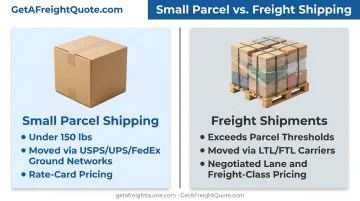
The pricing logic differs completely at each level. Parcel carriers publish rate cards. Freight carriers negotiate by lane, volume, and freight class. Treat these as two separate pricing ecosystems, not one single price sheet.
Regardless of level, the core trade-off stays the same: you accept a longer delivery window in exchange for a meaningfully lower cost per shipment. That works well for restocking orders, non-perishable bulk goods, or B2B replenishment, but a customer expecting next-day delivery won't tolerate a week-long wait.
If you offer ground economy at checkout, tell customers the estimated delivery window upfront. Vague "shipping speed" labels frustrate buyers more than an honest date range does.
How Ground Economy Shipping Compares to Other Methods
Choosing a shipping tier comes down to one question: how much does the delivery date actually matter to your customer?
Ground Economy vs. Standard Shipping
Here's a wrinkle most sellers miss: "standard shipping" is often just ground shipping under a different label. FedEx groups Ground and Home Delivery under its "standard" category. UPS simply calls its cheapest option "UPS Ground."
When a genuinely separate standard tier does exist, it typically shaves only 1-2 days off domestic delivery compared to ground economy, at a noticeably higher price. Unless your customer is watching the calendar closely, that time difference rarely justifies the extra cost.
Ground Economy vs. Expedited/Express Shipping
Expedited and express services flip the priority entirely: speed first, cost second. The price gap can be dramatic.
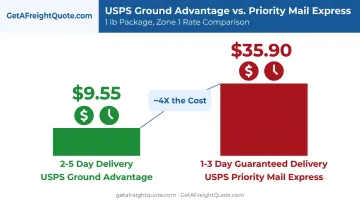
Using USPS's own rate tables as a benchmark, a 1 lb Zone 1 package costs $9.55 via Ground Advantage but $35.90 via Priority Mail Express, according to USPS's Notice 123 rate tables. That's nearly four times the cost for a guaranteed 1-3 day delivery instead of a 2-5 day window. That multiple shifts by weight, zone, and carrier, but the direction never changes: express always costs more.
Ground Economy vs. LTL/Freight Shipping
Once a shipment gets too big or heavy for parcel carriers, generally north of 150 lbs or anything palletized, it crosses into LTL freight territory, according to NMFTA's guidance on parcel vs. LTL shipping.
At that point, "ground economy" no longer means picking a cheap checkbox at checkout. It means securing a competitive freight class rate, and freight class depends on density, handling requirements, and liability, not just weight.
This is exactly where small businesses lose money. Without shipment volume or an existing freight contract, a business gets quoted the same rate structure as a one-time shipper, regardless of which carrier picks up the phone. GetAFreightQuote.com's Managed LTL Services close that gap, pooling shipment volume across clients to secure freight class rates that individual shippers can't negotiate alone.
How Long Does Ground Economy Shipping Take?
Transit time depends on carrier, zone, and whether you're shipping parcels or freight. Here's what to expect domestically:
| Carrier/Service | Typical Domestic Transit |
|---|---|
| USPS Ground Advantage | 2-5 business days |
| UPS Ground | 1-5 business days |
| FedEx Ground/Home Delivery | 1-5 business days (3-7 for AK/HI) |
| LTL Freight (standard) | 3-7 business days |
For example, a shipment moving from Los Angeles to Chicago via ground economy parcel service typically lands within the 3-5 day range. The same shipment moving coast-to-coast, say Los Angeles to New York, often takes the full 5 days.
Those domestic windows only apply within the US, though. Once a shipment crosses into Canada or overseas, cross-border ground-inclusive services actually run tighter than many assume. UPS Standard and FedEx International Ground to Canada both publish a 2-7 business day target. Customs clearance remains the wildcard: incomplete or inaccurate commercial invoices are a leading cause of delay, so paperwork accuracy matters as much as carrier choice.
Factors that push transit times longer or shorter:
- Carrier network density in the origin and destination zones
- Distance between zones
- Weather disruptions along the route
- For freight: dock scheduling, appointment requirements, and consolidation with other loads
Don't rely on a generic zone number to estimate delivery. Check the actual ZIP-to-ZIP or lane-specific transit time through the carrier's own tools or a multi-carrier rate-shopping platform like GetAFreightQuote.com's TMS, which pulls live transit estimates side-by-side. Published ranges are averages, not guarantees.
Ground Economy Shipping Carriers & Options
Each major carrier packages its ground economy option slightly differently:
| Carrier | Service | Weight Limit | Delivery Window |
|---|---|---|---|
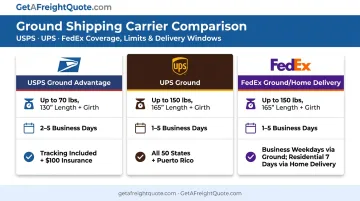
| USPS | Ground Advantage | 70 lbs, 130 in. combined | 2-5 business days |
| UPS | UPS Ground | 150 lbs, 108 in. long | 1-5 business days |
| FedEx | Ground/Home Delivery | 150 lbs, 165 in. length+girth | 1-5 business days |
Each option comes with its own coverage and support details:
- USPS Ground Advantage includes tracking and $100 insurance by default, making it ideal for small, lightweight parcels.
- UPS Ground covers all 50 states plus Puerto Rico, with tracking updates at each scan point.
- FedEx Ground serves business addresses Monday through Friday, while FedEx Home Delivery covers residential addresses seven days a week, which matters if your customer base skews residential.
Once you cross into freight-class shipments, the parcel carriers above stop being your economy option. LTL carriers take over, with more than 300 national, regional, and super-regional providers to choose from.
Rates vary widely by lane. The cheapest carrier on one route might be the priciest on another, so comparing multiple options pays off more than defaulting to whoever you've used before. GetAFreightQuote.com's Managed LTL Services benchmark these carriers for you, matching each shipment to the best-priced lane.
When Should You Use Ground Economy Shipping? Pros, Cons & Best Practices
Ground economy shipping isn't right for every order, but for the right use case, it's hard to beat.
Benefits:
- Lower cost per shipment than any faster alternative
- Supports free-shipping thresholds without eating your margin
- Handles bulky, heavy, non-fragile goods well
- Includes basic tracking in nearly every carrier's version
Drawbacks:
- Delivery windows run longer and less predictable
- Tracking updates are less frequent than expedited services
- Not suitable for perishables, medical supplies, or time-critical orders
- Harder to promise an exact date to customers
Best Use Cases
Ground economy fits naturally with:
- Bulk orders where the customer already expects a longer wait
- Non-urgent B2B replenishment shipments between warehouses or retail locations
- Heavy or oversized freight that would cost a fortune to expedite
- Cost-sensitive ecommerce orders where margin matters more than a fast badge at checkout
The decision comes down to weighing customer expectations against your margin. A buyer told upfront "arrives in 5-7 days" rarely complains. A buyer who assumed 2-day delivery and gets a week-long wait will.
Before defaulting to ground economy across your business, benchmark it. Rates for the exact same lane, weight, and service level can differ widely between carriers, and that gap only grows once you're shipping freight instead of parcels. A rate comparison tool, or a freight quote service pulling live pricing across carriers, removes the guesswork.
Get Better Ground Economy Shipping Rates With GetAFreightQuote.com
Once a shipment moves past small parcels into palletized or bulk freight, the pricing conversation changes completely. Without Fortune 500-level volume, a small business calling an LTL carrier directly often gets quoted the same inflated rate structure as a one-off shipper, regardless of which carrier answers the phone.
GetAFreightQuote.com exists to close that gap. As an authorized reseller of a leading TMS platform, it gives small and mid-sized businesses access to pre-negotiated ground and LTL freight rates across 100+ national, regional, and local carriers. Every quote includes full rate transparency and no hidden fees.
Carrier options include:
- Old Dominion
- Estes Express
- Saia
- ABF Freight
- XPO Logistics
Beyond carrier access, the platform's "Bring Your Own Rates" feature adds flexibility. Already have a UPS or FedEx account with your own negotiated pricing? Connect it directly into the TMS, and the system automatically rate-shops your existing contract against GetAFreightQuote.com's negotiated rates on every shipment, surfacing whichever option is actually cheaper.
Shipment volume determines which pricing tier fits best:
| Tier | Shipment Volume | Cost |
|---|---|---|
| Basic | 4-100 shipments/week | 9 cents per label, plus 20-50% carrier savings |
| QuickShip | Occasional shippers | No label fee |
Compensation on the Managed LTL side runs through an Off-Bill Incentive model, meaning carriers fund the engagement, not your budget. Get started with a rate comparison to see where you actually stand.
Frequently Asked Questions
What is economy shipping?
Economy shipping is the cheapest, slowest shipping tier a carrier offers. Carriers design it for packages that don't need to arrive quickly, trading speed for a lower price per shipment.
How long does economy shipping take?
Domestically, expect 1-5 business days depending on carrier and zone, sometimes up to 7 days for LTL freight. International ground-inclusive services typically run 2-7 business days, though customs can add delays.
Is ground shipping the same as economy shipping?
Not technically. "Ground" is the transportation mode; "economy" is the price tier. Most carriers' cheapest ground option doubles as their economy tier, so the terms get used interchangeably.
Is ground economy shipping trackable?
Yes. USPS Ground Advantage, UPS Ground, and FedEx Ground all include tracking by default. Update frequency can be less granular than expedited services, but you'll still see scan-point movement.
Is ground economy shipping worth it for small businesses?
Yes, especially when paired with clear delivery-date communication at checkout. The cost savings often support free-shipping thresholds or protect margin on bulk and non-urgent orders.
How can I get the best ground economy freight rates as a small business?
Compare rates across multiple carriers rather than accepting the first quote. Platforms like GetAFreightQuote.com provide access to negotiated rates typically reserved for high-volume shippers, without requiring your own freight contract.