Introduction
Diesel prices swung from $5.13 to $5.35 a gallon in just three weeks this summer, and capacity is shifting fast across major freight lanes. If you're still negotiating rates the way you did in 2023, you're likely leaving money on the table.
Many shippers assume freight rate negotiation is a game reserved for companies moving thousands of loads a month. That's a costly myth. Small and mid-sized businesses that skip the negotiation table by default often pay 20% or more above market rate simply because nobody asked for better terms.
This guide walks through the exact steps to negotiate freight rates in 2026, the market forces shaping your leverage, the mistakes that drain margins, and when bringing in outside expertise beats going solo.
Key Takeaways
- Track shipment volume, lane history, and rate benchmarks before negotiating
- Diesel prices and capacity swings directly impact your negotiating leverage
- Accessorials, fuel surcharges, and payment terms often outweigh the linehaul rate
- Aggregated buying platforms give smaller shippers access to enterprise-level pricing
- Get every negotiated term in writing; verbal deals won't hold at invoicing
How to Negotiate Freight Rates in 2026: Step-by-Step
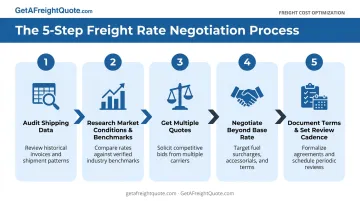
Freight rate negotiation isn't a single conversation. It's a five-step process that starts long before you ever call a carrier.
Step 1: Audit Your Shipping Data
You can't negotiate what you can't measure. Pull together:
- Shipment history covering volume, weight, freight class, and lanes over the past 6-12 months
- All-in cost per shipment and per lane, including fuel, accessorials, and any rebills, not just the quoted rate
- Highest-volume and highest-cost lanes, since these carry the most negotiating leverage
Carriers price based on lane density and predictability. A shipper who can say "we move 40 pallets a week on this exact lane" starts from a stronger position than one guessing at averages.
Step 2: Research 2026 Market Conditions and Benchmark Rates
Walking into a negotiation without current data is like buying a car without checking what others paid for the same model. Before any conversation:
- Check current diesel pricing trends and how they feed into carrier fuel surcharge formulas. The EIA's July 2026 Short-Term Energy Outlook forecasts on-highway diesel averaging $4.61 per gallon for the year, with quarterly swings between $4.05 and $5.38
- Research spot versus contract rate spreads for your key lanes. FreightWaves reported spot rates climbed 23.3% while contract rates rose just 5% from March 2025 through February 2026, a shrinking gap that changes your negotiating posture depending on which side of that spread you're buying
- Set a target rate range using this data, not gut instinct
Step 3: Get Multiple Quotes and Create Competition
Competition is still the single most reliable lever in freight negotiation. Request quotes from three to four carriers or brokers on your key lanes before committing to anyone.
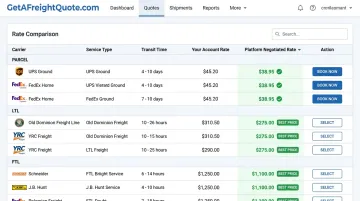
A rate-comparison platform or TMS makes this practical instead of a full-time job. Instead of calling four brokers and juggling spreadsheets, you can view live rates side by side across parcel, LTL, and FTL in one screen.
Platforms like GetAFreightQuote.com that let you add your own existing carrier accounts alongside their negotiated rates give you a true apples-to-apples view. You're not just comparing the platform's price against a guess. You're comparing it directly against what you're already paying.
Step 4: Negotiate Beyond the Base Rate
The linehaul number is often the smallest lever you can pull. Push for clarity on:
- Accessorial charges: liftgate, residential, limited access, and detention/demurrage fees
- Fuel surcharge formulas, including which index they use, how often it adjusts, and the base price
- Payment terms and volume commitments that reflect your actual shipping pattern, not an aspirational number you hope to hit
Consistent, forecasted volume — even modest volume — unlocks tiered discounts that one-off spot shippers never see. Carriers price predictability, not just size.
Step 5: Document Terms and Set a Review Cadence
Get the final agreement in writing. Include the rate, every accessorial fee, the fuel surcharge formula, and service commitments. Nothing should be assumed or left to memory.
From there:
- Set a recurring review, quarterly is reasonable, to compare your rates against shifting market conditions
- Maintain a backup carrier or routing guide so a single carrier's capacity problem doesn't become your problem
- Re-benchmark before renewal, since a rate that was competitive six months ago may not be today
Key Factors That Affect Freight Rate Negotiations in 2026
Understanding what's actually moving the market gives you a stronger position at the table.
Fuel and Diesel Price Volatility
Rising diesel costs inflate fuel surcharges regardless of what base rate you negotiate. The EIA's weekly actual diesel price hit $5.348 per gallon the week of August 3, 2026, well above the annual forecast average. That gap between forecast and actual is exactly why you need the surcharge formula in writing, not just the rate.
Capacity and the Loads-to-Trucks Ratio
Tight capacity favors carriers. Excess truck supply favors shippers. DAT's dry-van load-to-truck ratio hit 10.93 on August 3, 2026, up sharply from 6.64 a year earlier. That shift in carrier pricing power changes week to week and lane to lane.
Shipment Volume and Consistency
Carriers reward predictable, recurring freight over sporadic spot shipments. Consistent volume, even at modest levels, unlocks tiered pricing that occasional shippers simply can't access.
Freight Class, Density, and Accessorials
Misclassified freight or unaccounted accessorials (liftgate, residential, limited access) inflate costs well beyond the quoted rate. NMFTA's 2025 classification update made density an even bigger factor in determining freight class, so accurate weight and dimensions matter more than ever.
Contract Type and Length
| Contract type | Best for | Risk |
|---|---|---|
| Fixed | Budget predictability | Can detach from market if rates drop |
| Index-linked | Balancing stability and market movement | Requires clear index and adjustment terms |
| Short-term/spot | Capturing favorable market swings | Higher procurement workload, exposure to upswings |
Choosing the wrong structure can lock you into above-market rates for a year or more.
Common Mistakes to Avoid When Negotiating Freight Rates
Even well-prepared shippers fall into these traps:
- Fixating on the linehaul rate while ignoring accessorial fees, fuel surcharge formulas, and detention charges that drive up total cost
- Skipping market benchmarks — without current data, you have no way to know if an offered rate is actually fair
- Overcommitting to volume or service levels you can't consistently deliver, which damages your credibility for future negotiations
- Relying on verbal agreements instead of documenting final terms, which leads to disputes when invoiced charges don't match what was discussed
Avoiding these errors takes discipline, not a bigger freight budget: benchmark rates before every negotiation, document terms in writing, and commit only to volumes you can consistently ship.
When DIY Negotiation Isn't Enough: Using Pre-Negotiated Rates and Technology
Here's the uncomfortable truth: no matter how well-prepared you are, solo negotiation rarely closes the gap between small-business rates and Fortune 500 pricing. Carriers price based on aggregate volume across their network, and a business shipping 50 packages a week simply doesn't generate the same leverage as one shipping 50,000.
This is where aggregated buying platforms change the math. GetAFreightQuote.com pools negotiated carrier rates across its full customer base, giving smaller shippers access to pricing tiers historically reserved for high-volume enterprise accounts — without requiring that volume individually.
A few things worth knowing about this approach:
- Rate transparency: rates are visible before booking, with no surprise fees layered on afterward
- Bring-your-own-rates comparison: you can connect your own existing carrier accounts alongside the platform's negotiated rates to see, side by side, which option actually wins
- No volume minimums: even businesses shipping 5-10 packages a month can access pre-negotiated discount tiers
Understanding the market factors covered above still matters here: knowing how fuel surcharges, capacity, and accessorials work helps you evaluate whether the rates you're offered are genuinely competitive, whether you're negotiating solo or through a platform.
Conclusion
Successful freight rate negotiation in 2026 comes down to three things: data-driven preparation, understanding market forces like fuel and capacity, and evaluating total cost rather than just the base rate. Skip any of these and you're negotiating blind.
Avoiding the common mistakes (ignoring fees, skipping benchmarks, relying on verbal agreements) protects margins that are easy to lose and hard to recover.
And if you don't have Fortune 500 volume, that's no longer the barrier it used to be. Platforms like GetAFreightQuote.com pair aggregated carrier rates with purpose-built TMS technology to close that gap for businesses of any size.
Frequently Asked Questions
What is a freight negotiation?
Freight negotiation is the process of agreeing on shipping costs and terms between a shipper and a carrier or broker. It typically covers rate, volume, distance, and service level commitments.
What is the 70/30 rule in negotiation?
There's no formal Harvard or industry standard called the "70/30 rule." It's an informal heuristic suggesting most of your effort should go toward listening and understanding the other party's needs before presenting your position.
What are the four types of negotiations?
Distributive negotiation splits a fixed amount of value, like haggling over rate. Integrative negotiation creates mutual gains by trading across multiple issues. Team and multiparty negotiations describe who's involved, often procurement, operations, and multiple carriers together.
What are the 5 C's of negotiation?
Karrass's well-known framework for avoiding negotiation breakdown includes Communication, Collaboration, Compromise, Calm, and Change. It's specifically designed to help negotiators push through an impasse rather than serving as a universal negotiation checklist.
How much can you realistically negotiate off a freight rate?
Discounts vary widely by volume, lane, and current market conditions, so there's no universal percentage. Benchmarking your current rates against 2026 spot and contract data gives the most realistic expectation for your specific lanes.
Can small businesses get the same freight rates as large companies?
Solo negotiation rarely closes the full gap, since carrier pricing is built on aggregate volume. Platforms like GetAFreightQuote.com bridge that gap by pooling volume across many shippers, unlocking enterprise-level pricing tiers for smaller businesses.