For small and mid-sized shippers, this decision carries more weight than it does for large enterprises. Big shippers have dedicated freight teams and volume leverage. Most SMBs don't — they're guessing based on habit, not data.
The good news: you don't have to guess. Comparing live rates across carriers for both modes turns this from a coin flip into a calculation. This guide breaks down exactly when FTL wins, when LTL wins, and how to know which applies to your next shipment.
Key Takeaways
- LTL costs less for small shipments (1-6 pallets), since you pay only for the space you use
- FTL delivers faster, more predictable transit with sealed trailers and firm appointment windows
- The 4-6 pallet range is a gray zone, so always quote both modes before booking
- Handling frequency and delivery flexibility are the real operational differences, not just price
- Comparing live rates across multiple carriers, not just one relationship, reveals the truly cheaper option
FTL vs LTL: Quick Comparison
Here's how the two modes stack up across the factors that actually affect your bottom line:
| Factor | FTL (Full Truckload) | LTL (Less-Than-Truckload) |
|---|---|---|
| Cost structure | Pay for the whole trailer, regardless of fill | Pay only for space/weight used |
| Best for shipment size | Larger loads, often approaching 26-30 pallets or 15,000+ lbs for full trailer optimization (FreightWaves) | Typically 1-6 pallets, under 12 linear feet, and generally below 15,000 lbs |
| Delivery predictability | Direct point-to-point, firm appointments | Multiple consolidation stops; dates are estimates |
| Handling & damage risk | Loaded once, sealed, delivered | Unloaded/reloaded at multiple terminals |
| Pricing driver | Weight, mileage, equipment type | NMFC freight class heavily impacts rate |
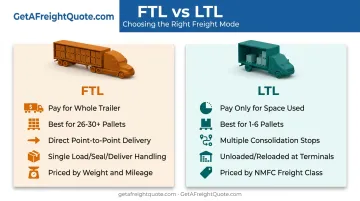
Notice something: 15,000 pounds and six pallets are screening points, not hard rules. Density, dimensions, lane, and carrier-specific policies all shift where the actual crossover lands. Treat these numbers as a starting filter, then confirm with a real quote.
What Is FTL?
Full truckload shipping means your freight, and only your freight, occupies the trailer for the entire trip. Even if you're only filling half the space, nobody else's pallets ride along.
That exclusivity matters operationally. There's no detour to a consolidation terminal, no unloading freight to make room for another shipper's pickup. The trailer seals at origin and stays shut until it reaches destination.
Why shippers pay for unused space:
- Zero intermediate handling means fewer opportunities for damage
- Direct routing means appointment times hold up
- Sealed trailers add a layer of security for high-value or sensitive freight
A middle-ground option exists too. Partial truckload typically covers 6-20 pallet loads that share partial trailer space but skip most of the terminal network LTL relies on (a FreightWaves report on partial truckload services). It's worth asking about if your shipment sits above standard LTL size but below a full trailer.
Use Cases of FTL
FTL tends to dominate in scenarios where timing and product integrity outweigh the cost of unused trailer space:
- Plant-to-plant transfers in manufacturing, where production schedules depend on exact arrival windows
- Big-box retail replenishment, where distribution centers need predictable, large-volume restocking
- Fragile or high-value goods that can't tolerate multiple loading points
Choosing FTL for these scenarios still comes down to cost, and that cost shifts with capacity and fuel. DAT reported dry-van spot rates averaging $2.56 per mile in Q1 2026, up 11.9% quarter over quarter, with fuel accounting for roughly $0.51 of that figure (DAT Freight & Analytics's Q1 2026 report). Rates shift with the market, so locking in a benchmark today doesn't guarantee tomorrow's price. That's why comparing live quotes across carriers, similar to the side-by-side comparisons GetAFreightQuote.com's rate-shopping platform provides, beats relying on last quarter's number.
What Is LTL?
Less-than-truckload shipping consolidates multiple shippers' freight onto one trailer, moving through a hub-and-spoke network of regional terminals. Your pallets share space with someone else's — and that's exactly what keeps costs down.
Carriers maximize trailer utilization by combining partial loads. You pay for the portion of the trailer your freight occupies, based on weight, dimensions, and freight class, not the entire vehicle.
Why this matters for SMBs specifically: you get access to professional freight transport without needing enough volume to fill an entire truck yourself.
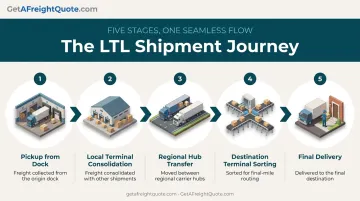
A shipment typically moves like this:
- Pickup from your dock to a local terminal
- Consolidation with other shippers' freight
- Transfer between regional hubs
- Unloading and sorting at the destination terminal
- Final delivery
For larger LTL loads, volume LTL offers a more economical rate structure than standard LTL pricing, generally kicking in around 4,000 pounds or 10+ linear feet depending on the carrier.
Use Cases of LTL
LTL fits naturally into supply chains with smaller, less predictable shipment volumes:
- Replenishing smaller retail locations or service centers
- Supporting e-commerce fulfillment nodes with variable demand
- Serving small manufacturers and wholesalers shipping palletized freight that doesn't justify a full trailer
There's no single industry-wide percentage for how much LTL saves versus FTL on small loads. Lane, class, and accessorials all move that number. What's consistent is the mechanism: shared capacity lowers your per-shipment cost compared to paying for an entire trailer you'd only partially use.
FTL vs LTL: Which Should You Choose?
Before booking, weigh these factors together rather than defaulting to whichever mode you used last time:
- Shipment size and weight
- Budget constraints
- Delivery time sensitivity
- Product fragility or value
- Flexibility on pickup and delivery windows
Choose FTL if:
- Your shipment includes 6+ pallets
- Firm appointment times are non-negotiable
- The freight is fragile, high-value, or can't tolerate multiple handling points
Choose LTL if:
- You're shipping fewer than 6 pallets
- You have flexibility on delivery dates
- Minimizing cost matters more than guaranteed transit windows
The 4-6 pallet range is where most shippers get it wrong. Freight class, accessorial fees, and lane-specific pricing can flip the economics entirely. A load that looks like an obvious LTL candidate might price cheaper as FTL once you factor in liftgate fees, residential surcharges, or reclassification risk.
Shippers without dedicated freight expertise often default to one mode out of habit: always LTL because it feels cheaper, or always FTL because it feels safer. That habit costs money.
Comparing live rates from multiple carriers removes the guesswork and shows you the actual numbers for that specific lane, weight, and class. Platforms like GetAFreightQuote.com make this comparison instant, pulling FTL and LTL rates side by side before you book.
How to Get the Best FTL and LTL Rates
Freight pricing swings significantly by carrier, lane, and freight class. If you're quoting a single carrier relationship for every shipment, you're likely overpaying — especially without Fortune 500-level volume to negotiate leverage.
This is the exact gap GetAFreightQuote.com was built to close. As an authorized reseller of a leading TMS platform, it gives small and mid-sized businesses side-by-side FTL and LTL rate comparison in one place, backed by pre-negotiated carrier rates and full invoice transparency.
What that looks like in practice:
- Tiered access for any shipment volume. QuickShip covers 0-3 shipments per week with no label fee. Pricing then drops as volume grows, from 9¢ per label at Basic (4-100 shipments/week) to 5¢ at Platinum (2,501+ shipments/week).
- Full FTL equipment coverage, including dry van, flatbed, refrigerated, specialized/oversized, and hazmat freight, with access to hundreds of carrier partners across standard and specialty commodities.
- Add your own carrier accounts into the platform alongside negotiated rates, so you're always comparing against the full market rather than one supplier's number.
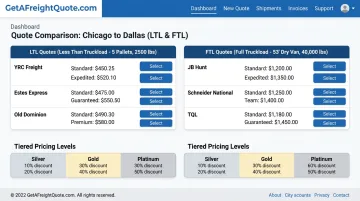
The platform's carrier rate reductions (reported at 20-50% below standard rates) are designed to be self-funding: the savings on your shipping costs typically outweigh the small platform fee many times over.
For businesses shipping a handful of pallets a week or scaling toward full truckload volume, that structure removes the incentive to default to one mode out of convenience.
Conclusion
There's no universal winner in the FTL vs LTL debate. The right call depends on your shipment size, your timeline, and how much risk you're willing to accept on handling and damage. Many shippers use both modes across different parts of their supply chain to match each shipment's needs precisely.
What matters most is comparing rates before you book, not after. GetAFreightQuote.com's platform makes that comparison simple, letting you weigh FTL and LTL options side-by-side before you commit. That habit protects your shipping budget and keeps delivery timelines and freight condition predictable.
Frequently Asked Questions
What is FTL and LTL in trucking?
FTL (full truckload) means one shipper's freight fills an entire trailer exclusively. LTL (less-than-truckload) means multiple shippers share trailer space, with freight consolidated through regional terminals.
Which is cheaper, LTL or FTL?
LTL is typically cheaper for small shipments (1-6 pallets) since you only pay for the space used. FTL can become more economical for larger loads once you factor in accessorial fees and handling risk.
How do delivery times differ between LTL and FTL?
FTL offers direct, point-to-point transit with firm pickup and delivery appointments. LTL involves multiple consolidation stops, so delivery windows are estimates rather than guarantees.
Does LTL freight get damaged more often than FTL?
LTL freight passes through multiple terminals and gets unloaded and reloaded at each stop, increasing handling exposure compared to FTL's single load-seal-deliver process. Proper palletizing and packaging reduce this risk.
How does freight class affect LTL shipping costs?
LTL rates depend on NMFC freight class, which spans 18 classes from 50 to 500 based on density, handling, and liability, according to NMFTA's official freight classification standards. FTL pricing, by contrast, is largely weight- and mileage-based regardless of commodity type.
How can I find the best rate between FTL and LTL for my shipment?
Compare live quotes across multiple carriers using a rate comparison or TMS platform rather than relying on a single carrier's number. This matters most for shipments in the 4-6 pallet gray zone, where the cheaper mode isn't always obvious.