Freight claims are notoriously messy. Every carrier has its own filing quirks, tight reporting windows, and paperwork demands that trip up shippers who don't handle claims every week. Miss one deadline or skip one document, and a legitimate claim gets denied.
This guide covers what a freight claim actually is, the five types you're most likely to encounter, exactly how to file one, and how better shipping technology helps you avoid filing as many in the first place.
Key Takeaways
- Freight claims reimburse lost, damaged, or short freight — never lost profits
- Five claim types cover damage, loss, shortage, concealed damage/shortage, and refused shipment
- Carmack Amendment sets a 9-month minimum filing window; file faster for better odds
- Complete documentation (BOL, POD, photos, invoices) most often decides approval or denial
- TMS platforms and experienced logistics partners centralize records for faster claims
What Is a Freight Claim?
A freight claim is a legal, contractual demand a shipper or consignee files against a carrier for financial reimbursement when freight arrives lost, damaged, or short. You'll also hear it called a cargo claim, shipping claim, or transportation claim; they all mean the same thing.
Legal Basis and Carrier Liability
Every freight claim traces back to the contract of carriage documented on the Bill of Lading. For domestic motor and rail shipments, that contract operates under the Carmack Amendment, specifically 49 U.S. Code § 14706 for motor carriers, with a nearly identical provision for rail carriers under 49 USC 11706.
Ocean freight is different. Shipments moving by sea to or from U.S. ports fall under COGSA, which carries its own rules, deadlines, and liability limits. Don't assume your domestic claims process applies overseas.
Freight Claims vs. Cargo Insurance
Here's a distinction that trips up a lot of shippers: a freight claim recovers the value of the lost or damaged goods, typically measured as the difference between the freight's expected market value and its damaged or missing condition. A freight claim does not cover:
- Lost profits from delayed delivery
- Missed sales windows or contract penalties
- Business interruption costs
Cargo insurance is a separate product entirely. Depending on the policy, it can offer broader protection, including some consequential losses a Carmack claim won't touch. If you ship high-value or time-sensitive freight regularly, insurance is worth layering on top of your carrier claim rights, not a replacement for them.
Common Types of Freight Claims
Identifying the correct claim type upfront speeds up processing, since each one comes with different evidence requirements and different odds of success.
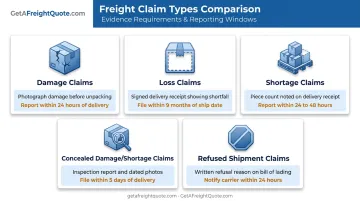
Damage Claims
This is visible damage discovered right at delivery: a crushed box corner, a punctured drum, a bent pallet frame. You must note the damage on the BOL or delivery receipt at the time you sign for it.
A common scenario: a pallet shows obvious crush damage from improper stacking during transit. The driver waits while you document it before you sign.
Loss Claims
Loss claims cover freight the carrier picked up but never delivered. The critical piece of evidence here is the original BOL showing the carrier took possession of the shipment. Without that pickup record, you have no starting point to prove the carrier ever had your freight.
Shortage Claims
A shortage claim applies when only part of a shipment arrives, for example, two pallets delivered out of three ordered. Always verify piece counts against the BOL at the moment of delivery. Signing for "3 pallets received" when only two showed up hands the carrier an easy denial.
Concealed Damage or Shortage Claims
This is the hardest claim type to win, because the damage or missing item is only discovered after unboxing, once the driver has already left. Carriers require prompt notice, and the reporting window is short and carrier-specific.
Published examples range from 5 business days after delivery under the NMFC participant rule, according to the Transportation & Logistics Council, up to 15 days under some individual carrier tariffs. Check your specific carrier's rules: don't assume a standard window applies.
Refused Shipment Claims
Shippers can legally refuse a shipment for a wrong product, wrong delivery address, or severe visible damage. If you refuse freight, document the refusal and the reason directly on the delivery receipt before the driver leaves. Without that paper trail, proving why you refused becomes your word against the carrier's.
How to File a Freight Claim: Step-by-Step
Here's the practical action plan to follow the moment you discover an issue.
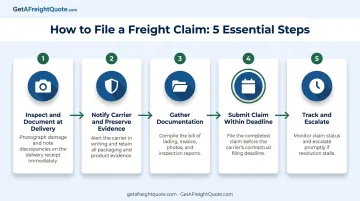
Inspect and document at delivery. Check all freight immediately upon arrival, noting damage or shortages directly on the BOL or delivery receipt. Photograph the overall shipment and close-ups of any damage before you sign anything.
Notify the carrier and preserve evidence. Don't discard damaged goods, packaging, or materials. Carriers reserve the right to inspect or salvage claimed freight, and tossing evidence early can void your claim entirely.
Gather required documentation. Assemble the core paperwork:
- Original Bill of Lading
- Proof of delivery
- Paid freight invoice
- Photos of the shipment and damage
- Inspection reports
- An invoice showing the value of the damaged or lost goods
Submit the claim within the filing deadline. Include shipment ID, loss type, dollar amount claimed, and a formal demand for payment. Under 49 U.S. Code § 14706(e), carriers must allow at least 9 months from delivery for motor and rail claims — file as soon as your documentation is ready.
Track, follow up, and escalate if needed. Resolution can take weeks or months. Federal rules require carriers to acknowledge claims within 30 days and reach disposition within 120 days, with updates every 60 days if still unresolved. Proactive follow-up reduces delays and denials.
Who's Responsible for Filing and What You'll Need
Either the shipper or the consignee can file a freight claim. It typically comes down to whoever owns the goods at the time of loss or damage, often defined by Incoterms or purchase agreement terms.
A 3PL or freight partner can also file on the shipper's behalf as an authorized agent, which is common when volume or complexity makes self-filing impractical.
Whoever files, incomplete documentation is the number one reason claims get delayed or denied outright. Centralize these records from day one of the shipment, not weeks later when you're already scrambling:
- Bill of Lading (BOL) signed at pickup and delivery
- Photos of damaged goods and packaging before disposal
- Invoices showing the value of the shipped goods
- Inspection or weight reports confirming the extent of damage
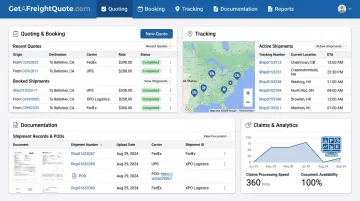
This is where a Transportation Management System earns its keep. GetAFreightQuote.com's TMS platform brings quoting, booking, tracking, documentation, and invoicing together in one dashboard, available 24/7.
Instead of chasing down paperwork across multiple carrier portals when a claim comes up, shippers can pull shipment records, PODs, and rate documentation from a single place. This removes the scramble that often costs claimants their filing window.
How to Reduce Freight Claims and Avoid Future Disputes
Fewer claims mean less time lost chasing reimbursement and lower loss-run impact for shippers who ship frequently. Prevention beats recovery every time. Three fundamentals make the difference: how goods are packaged, which carriers you choose, and how closely you track your rates.
- Packaging and load securement: Poor packaging is one of the few grounds carriers can legally deny liability, since "act or default of the shipper" is a recognized Carmack defense. Proper labeling and securement close that loophole.
- Carrier vetting over price: Choosing carriers based on safety records and service consistency, rather than the lowest quote, correlates with fewer damage and loss incidents over time.
- Rate and invoice transparency: Seeing every rate before booking makes any invoice deviation immediately obvious, creating a benchmark before a billing dispute escalates.
Applying these fundamentals consistently matters as much as understanding them. GetAFreightQuote.com pairs negotiated carrier rates with TMS tools and hands-on support, giving small and mid-sized businesses the same reliable carriers and documented rate history that larger shippers use to prevent claims. Auditing your shipping records regularly, not just after something goes wrong, remains one of the simplest ways to catch inconsistent documentation before it costs you a claim.
Frequently Asked Questions
What is a freight claim?
A freight claim is a legal demand for reimbursement filed against a carrier for lost or damaged freight. It recovers the value of the goods, not lost profits or business interruption costs.
Who is responsible for filing a freight claim?
Typically, whichever party owns the goods at the time of loss or damage — the shipper or consignee, depending on terms. A logistics partner like GetAFreightQuote.com can file as an authorized agent on the owner's behalf.
How long does a freight claim take?
Resolution time varies by carrier and complexity, ranging from a few weeks to several months. Thorough documentation submitted upfront speeds up the process.
How long do you have to file a freight claim?
Federal law guarantees a minimum 9-month filing window under the Carmack Amendment for motor and rail carriers. Even so, filing as soon as possible improves your chances of a smooth resolution.
What documents do I need to file a freight claim?
You'll need the original Bill of Lading, proof of delivery, photos of the damage or shortage, an invoice showing the value of the goods, and any relevant inspection reports.
Can I refuse a damaged shipment?
Yes. Shippers can refuse visibly damaged freight at delivery, provided the refusal and the reason for it are documented on the delivery receipt before the driver leaves.