Introduction
Every business that ships products faces the same dilemma: charge a flat rate and risk losing money on heavy shipments, or calculate every quote by hand and slow down sales. Get it wrong too often, and thin margins disappear fast.
The stakes get even higher for freight shippers. LTL and FTL pricing involves freight class, pallet count, and accessorial charges that a simple parcel calculator can't handle. One miscalculated input can mean the invoiced cost looks nothing like the quote.
This guide breaks down what real-time shipping rates actually are and how the calculation works behind the scenes. It also covers why businesses of any size, not just Fortune 500 shippers, can now access the same dynamic pricing tools once reserved for enterprise logistics teams.
Key Takeaways
- Real-time rates replace static tables with live, accurate shipping costs
- Freight quotes add inputs like NMFC class and accessorials that parcel tools skip
- Automated engines cut freight quote turnaround from hours to seconds
- Small and mid-sized businesses now access negotiated rates once reserved for high-volume shippers
What Are Real-Time Shipping Rates?
Real-time shipping rates are costs calculated instantly using live data: package weight, dimensions, origin, destination, and service level. Instead of consulting a pre-built pricing chart, the system asks a carrier (or multiple carriers) "what does this exact shipment cost right now?" and receives an answer in seconds.
Compare that to traditional flat-rate or table-rate shipping, which estimates one broad average cost for a whole category of shipments. A 5-pound box and an 18-pound box might get charged the same flat fee, meaning businesses either overcharge lighter shipments or absorb losses on heavier ones.
In ecommerce, this is often called "carrier-calculated shipping." Shopify's checkout, for example, pulls live rates directly from connected carrier accounts using order weight, dimensions, and destination, then displays whatever the carrier returns. USPS, UPS, FedEx, and DHL all support this kind of live lookup.
In freight shipping, the calculation becomes more complex. Real-time LTL and FTL rates also factor in:
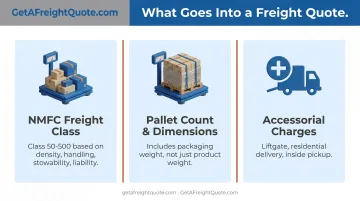
- NMFC freight class: a standardized classification (ranging from class 50 to class 500) based on density, handling, stowability, and liability, as defined by the National Motor Freight Traffic Association
- Pallet count and dimensions, including packaging weight, not just product weight
- Accessorial charges: liftgate service, residential delivery, inside pickup, and similar add-ons
Real-Time Rates vs. Flat Rates vs. Negotiated Carrier Rates
These three terms are often confused, but they answer different questions.
| Model | What It Actually Means |
|---|---|
| Real-time / carrier-calculated | A carrier or platform calculates the price from current shipment details and returns it instantly |
| Flat rate | The merchant sets a fixed price rule (flat fee, free shipping, or weight-based tiers), not a live carrier response |
| Negotiated / account rate | A discounted rate tied to a specific carrier contract, which can still be delivered through a real-time system |
That last row matters. Real-time describes how the rate is retrieved. Negotiated describes which price schedule applies. The two aren't opposites — a well-built platform delivers negotiated rates in real time, which is exactly the gap most small businesses run into.
How Real-Time Shipping Rate Calculations Work
Getting an accurate real-time quote starts with four core inputs:
- Origin address — where the shipment ships from
- Destination address — where it's headed
- Weight and dimensions — for parcels, this includes dimensional weight; for freight, it includes pallet and packaging weight
- Service level — ground, expedited, LTL, FTL, and so on
Once entered, the system sends that data to a carrier's rate engine or API. For parcel shipments, this is typically a single carrier connection at checkout. For freight, a Transportation Management System (TMS) queries multiple LTL and FTL carriers simultaneously, so businesses see every option side-by-side instead of requesting quotes one carrier at a time.
Why Data Accuracy Makes or Breaks the Quote
Rate accuracy depends entirely on what gets entered. Get the weight wrong, misjudge the dimensions, or assign the wrong freight class, and the final invoiced cost can look nothing like the original quote.
This exact scenario played out in a 2025 USPS Office of Inspector General audit. Investigators found that platform calculation errors, including incorrect weight rounding, produced roughly $2.6 million in overpayments and $1 million in lost revenue over a 14-month period.
Speed Gains Are Real
Beyond accuracy, automation also delivers major speed gains. In one documented case, freight distributor Holman Parts used a TMS rating engine to replace manual, carrier-by-carrier quote requests. The result, reported by Inbound Logistics: booking time dropped from eight minutes to just 90 seconds per shipment.
Key Benefits of Real-Time Shipping Rates for Businesses
Real-time rates solve more than a pricing headache. They change how a business operates day to day.
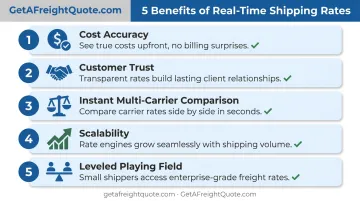
- Cost accuracy — eliminates flat-rate guesswork, so every shipment is charged its true cost instead of an averaged estimate that eats into margins
- Customer trust — transparent, accurate pricing reduces billing disputes and the awkward follow-up call explaining a surprise charge
- Instant multi-carrier comparison — see rates from several carriers at once instead of requesting quotes individually and waiting on replies
- Scalability — rates adjust dynamically as shipment volume or complexity grows, with no need to renegotiate contracts for every new shipment type
- Leveled playing field — small and mid-sized businesses access the same negotiated-rate tools large enterprises use, instead of settling for inflated small-shipper pricing
That last point is where the market has shifted most in the past few years. Rate-shopping technology used to be something only a large logistics department could afford to build or license. Now it's a checkout plugin or a subscription platform away. GetAFreightQuote.com built its rate-shopping platform around this exact shift, giving smaller shippers the same negotiated carrier access that once required Fortune 500-level volume.
Real-Time Rates: Freight Shipping vs. Parcel/Ecommerce Shipping
Not all real-time rate tools are built the same. Most of what's on the market (Shopify, Wix, and Square apps included) is designed for small parcel shipments, pulling live rates from USPS, UPS, FedEx, and DHL for lightweight packages.
That works fine for a 3-pound box heading across the country. It falls apart for freight.
Freight shipments (LTL/FTL) involve variables parcel checkout apps simply aren't built to calculate:
- Freight class determination based on density, handling, and liability
- Pallet count and total shipment weight, including packaging
- Multiple accessorial charges that shift depending on pickup and delivery conditions
FedEx notes that its own LTL rate quoting requires a freight class before generating pricing, and shipment weight must include pallets and packaging — details a parcel tool never asks for. Because of this gap, freight shippers need a dedicated TMS or freight quoting platform, such as GetAFreightQuote.com's rate-shopping software, rather than an ecommerce plugin bolted onto a storefront.
Common Challenges When Implementing Real-Time Shipping Rates
Real-time rates fix a lot of problems, but the technology isn't magic. A few recurring issues show up across both parcel and freight implementations.
Data accuracy dependency. The quote is only as good as what goes in. Incomplete or incorrect weight, dimensions, or freight class data leads to discrepancies between the quoted rate and the final invoice, echoing the USPS overpayment case above.
Limited access to negotiated rates. Many small businesses only see standard published retail rates through basic tools, unless they have existing carrier relationships or enough shipment volume to negotiate discounts directly.
Hidden accessorial fees. Some quoting tools don't surface extra charges (fuel surcharges, liftgate service, residential delivery) until after the shipment books. That gap between quote and invoice is one of the most common sources of billing disputes in freight.
These challenges point to a solvable problem: pick a platform that validates data, discloses accessorial fees upfront, and shows negotiated rates before you book.
How GetAFreightQuote.com Makes Real-Time, Negotiated Freight Rates Accessible to Every Business
Most of the challenges above come down to one root issue: small and mid-sized shippers don't have the volume to negotiate the rates that large enterprises take for granted. GetAFreightQuote.com was built specifically to close that gap.
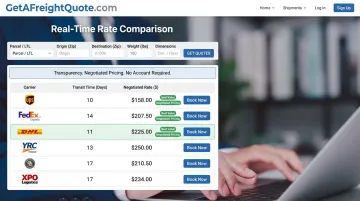
As an authorized reseller of an advanced TMS platform, GetAFreightQuote.com gives businesses instant access to real-time rate comparisons across a network of 100+ national, regional, and local carriers. These rates span parcel, LTL, and FTL — all displayed on one screen.
What this looks like in practice:
- Fortune 500-level rates, no Fortune 500 volume needed. The platform pools volume across its full customer base to deliver 20–50% savings on standard parcel and LTL rates.
- Full rate transparency, no hidden fees. Every rate is visible before booking, and the Bring Your Own Rates feature lets existing UPS, FedEx, or LTL contracts compete directly against these negotiated prices.
- Hands-on support behind the self-service tool. Businesses get accurate, real-time rates without needing to build an in-house logistics team to interpret them.
- No registration friction for parcel and LTL. Quotes are available instantly with no account creation, no contracts, and no shipment minimums required.
For businesses tired of choosing between overpaying on flat rates or losing time chasing manual freight quotes, this combination of live technology and negotiated access solves both problems at once.
Frequently Asked Questions
What are real-time shipping rates?
Real-time shipping rates are costs calculated instantly using live shipment data, including weight, dimensions, and destination, rather than pulled from a fixed pricing table. The rate reflects the true cost of that specific shipment.
How do real-time shipping rates differ from flat-rate shipping?
Flat-rate shipping charges one fixed price across a broad category of shipments, which often leads to overcharging light packages and undercharging heavy ones. Real-time rates calculate the exact cost per shipment instead.
Why does the difference between freight and parcel real-time rates matter?
Freight shipments require additional variables like NMFC freight class, pallet weight, and accessorial charges that parcel-focused checkout tools aren't designed to calculate. Using the wrong tool for freight often leads to inaccurate quotes.
Can small businesses access the same negotiated real-time rates as large enterprises?
Yes. Platforms like GetAFreightQuote.com aggregate shipping volume across their customer base, giving small and mid-sized businesses access to negotiated carrier pricing regardless of their individual shipment volume.
What information is needed to get an accurate real-time shipping quote?
You'll need origin and destination addresses, weight and dimensions, and the desired service level or freight class for LTL/FTL shipments. Missing or inaccurate data is the most common cause of quote discrepancies.
Are real-time shipping rates always the cheapest option?
Real-time rates reflect the accurate cost for each carrier and shipment, but that doesn't automatically mean the lowest price. Comparing multiple carriers side-by-side is still the key step to finding the best rate.