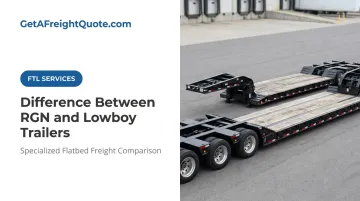
RGN and lowboy trailers both move oversized construction, agricultural, and industrial equipment, but they solve different problems. The trailer you choose affects permit costs, loading time, and your total freight spend on every single haul.
This guide breaks down how RGN and lowboy trailers differ in design, capacity, and cost, then walks through how to match the right trailer to your specific load.
Key Takeaways
- RGN trailers use a detachable gooseneck, dropping the deck to ground level for crane-free, drive-on loading.
- Lowboy trailers have a fixed neck, keeping setup simpler and cheaper, but requiring ramps or a crane to load.
- RGNs scale to higher weight capacities with added axles, while lowboys top out lower.
- Cost, loading access, and permit requirements should drive your final decision.
RGN vs Lowboy: Quick Comparison
Before digging into the specifics, here's how the two trailer types stack up side by side.
| Factor | RGN (Detachable Gooseneck) | Lowboy (Fixed Neck) |
|---|---|---|
| Loading | Neck detaches; deck lowers for drive-on access | Requires ramps or a crane |
| Capacity | Model-specific, roughly 80,000 to 170,000+ lbs with heavier configurations | 40,000 lbs on two axles, up to 80,000 lbs with added axles |
| Deck/well length | Often 28'7" to 49'11" on extendable models | Typically around 29 feet on a 48-foot overall trailer |
| Deck height | Varies by model, generally 18-24 inches | Often 18 inches, with roughly 6 inches of ground clearance |
| Cost | Higher, due to the hydraulic gooseneck mechanism | Lower, simpler fixed-neck design |
A quick note on those capacity numbers: manufacturers don't publish one universal "standard" rating for either trailer type. According to Hale Trailer's breakdown of the two designs, a basic two-axle lowboy handles around 40,000 lbs, while adding axles pushes that closer to 80,000 lbs. RGN capacity climbs much higher because the detachable design supports multi-axle booster configurations built for genuinely massive loads.
The takeaway: always check the specific model's GAWR (gross axle weight rating), tire limits, and legal payload rather than assuming a generic number applies to your shipment.
What Is an RGN Trailer?
RGN stands for Removable Gooseneck. The front section of the trailer, the "neck" that connects to the tow vehicle, detaches from the main deck. Once disconnected, the deck lowers to ground level, and equipment can drive straight onto the trailer under its own power.
That's the entire operational advantage in a sentence: no crane, no forklift, no separate loading equipment. For self-propelled machinery like excavators or wheel loaders, this cuts loading time and labor costs compared to trailers that require rear-loading or lifting.
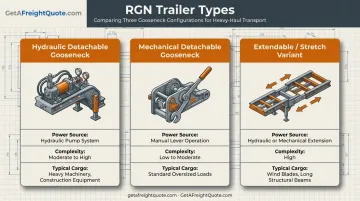
RGN designs fall into three categories:
- Hydraulic detachable gooseneck — uses hydraulic power (often from the tractor's wet kit) to detach, lower, and re-attach the neck
- Mechanical detachable gooseneck — a manually operated version of the same concept, often lighter and less complex
- Extendable/stretch variants — add telescoping deck sections for unusually long cargo like wind blades or girders
The gooseneck's position over the tow vehicle's rear axle also distributes weight more evenly during transport. That makes RGNs more maneuverable on tight job sites and during sharp turns.
Where RGN Trailers Get Used
RGNs show up most often where equipment is self-propelled or exceptionally tall:
- Construction — excavators, scrapers, and dozers that can drive on and off
- Agriculture — combines and other large self-propelled machinery
- Wind energy — XL Specialized identifies wind blades, towers, and turbine components as regular RGN cargo, given the extendable deck options available
- Oil & gas — drilling rig modules and heavy field equipment that drive on without cranes
A rock truck or crawler crane, for example, is a natural fit. Both are tall, heavy, and capable of driving themselves onto a lowered deck rather than needing to be lifted.
What Is a Lowboy Trailer?
A lowboy, sometimes called a low-bed or double-drop trailer, keeps its neck permanently fixed to the main frame. There's no detaching mechanism. Instead, the deck sits low between the front and rear axle groups, typically 18 to 24 inches off the ground.
That low deck height is the whole point. It allows taller cargo to travel under legal height limits without triggering special height permits, which keeps costs down and simplifies routing.
Two variations use different terminology for the same design: the fixed-neck lowboy, the standard configuration with no moving parts at the connection point, and the fixed-gooseneck lowboy, which describes that identical non-detaching connection under different manufacturer branding (Fontaine and XL both use this framing depending on the product line).
Because there's no hydraulic detachment system, the fixed-neck design offers a steadier, unmoving platform. For extremely heavy or awkwardly shaped loads, that rigidity is an asset rather than a limitation.
Where Lowboy Trailers Get Used
Lowboys dominate in industries where cargo is tall but not necessarily self-propelled:
- Oil and gas: drilling rig components and industrial generators
- Construction: bulldozers and excavators that can be loaded via ramp
- Industrial and energy equipment: oversized machinery moving between plants or job sites
Height regulations make the case for lowboys. Most states cap standard legal height around 13'6" to 14', and Texas sets a general maximum of 14 feet.
A bulldozer that would exceed that limit on a standard flatbed often clears easily on a lowboy's low deck. That extra clearance lets it pass under overpasses and through underpasses without triggering extra permitting.
RGN vs Lowboy: Which One Is Right for Your Haul?
The decision usually comes down to five questions:
- How tall is the cargo once loaded?
- How much does it weigh, and does it exceed standard capacity thresholds?
- What loading equipment is available at pickup and delivery?
- What's the budget for this specific move?
- What do state and route regulations require?
Choose an RGN when:
- Equipment is self-propelled and can drive onto a ground-level deck
- Total weight exceeds standard lowboy capacity and needs multi-axle support
- No crane or forklift is available at pickup or drop-off
Choose a lowboy when:
- Cargo is tall but can be loaded via ramp or crane
- Cost efficiency matters more than loading convenience
- The load is heavy but stable enough for a fixed, non-articulating platform
A Common Scenario: Crane Costs vs. Drive-On Access
Here's a pattern that shows up often in heavy-haul logistics. A contractor moving a tracked excavator on a fixed-neck lowboy needs a mobile crane at both ends of the trip, since the machine can't climb a standard ramp safely. That's an added rental cost and a scheduling dependency every single time.
Switch that same load to a hydraulic RGN trailer, and the equipment drives on and off under its own power. XL Specialized's review from Henry Bros LLC documents this exact shift after nine months of using a hydraulic gooseneck trailer, noting how much easier hooking and unhooking became compared to their prior setup.
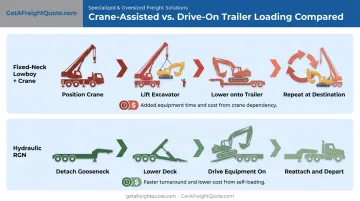
The broader lesson: matching trailer type to loading access directly affects turnaround time and cost per shipment, independent of the equipment being hauled.
If you're not sure which setup fits your load, GetAFreightQuote.com can help. Request a freight quote for specialized and oversized FTL equipment, including RGN and lowboy trailers, and compare carrier options before you commit to a rate.
Conclusion
There's no single "better" trailer between RGN and lowboy. Each serves a distinct role in heavy-haul logistics, and the right pick depends on your cargo's height, weight, loading access, and budget.
The right choice avoids unnecessary permit costs, unneeded crane rentals, and schedule delays for oversized freight. Get it wrong, and those expenses add up fast.
If you're still weighing RGN against lowboy for an upcoming shipment, GetAFreightQuote.com lets you request a quote and compare carrier options side by side before booking your specialized freight.
Frequently Asked Questions
What is the difference between RGN and lowboy trailers?
RGN trailers have a detachable gooseneck that lowers the deck to ground level for drive-on loading. Lowboys have a fixed neck and typically require ramps or a crane, though both scale in capacity with added axles.
How much does an RGN trailer cost?
Costs vary widely based on axle configuration, deck length, and capacity, and generally run higher than lowboys because of the hydraulic gooseneck mechanism. Get a custom freight quote for accurate pricing on your specific load.
What does RGN trailer stand for?
RGN stands for Removable Gooseneck. Talbert Manufacturing's records credit the original removable gooseneck design to 1947, with a non-ground-bearing hydraulic version following in 1962.
Does a 40 ft gooseneck require a CDL?
Length alone doesn't trigger the requirement. Under FMCSA rules, a Class A CDL applies once combined weight reaches 26,001 lbs and the towed unit exceeds 10,000 lbs, though your state DMV may add exceptions.
Can a lowboy trailer also be an RGN trailer?
Yes. RGNs are technically a sub-category of lowboy trailers, meaning every RGN is a lowboy, but not every lowboy has a removable gooseneck.
Do RGN and lowboy trailers require special permits for oversized loads?
Both can require permits once a load exceeds roughly 8'6" in width, 14 feet in height, or 80,000 lbs in weight. California's Caltrans permit program outlines these thresholds, though exact rules vary by state and route.