Introduction
You quoted a shipment at one price. The invoice that showed up two weeks later? Nothing close to it.
If you ship LTL freight, this scenario probably sounds familiar. Freight classification is almost always the culprit.
NMFC codes and freight class work together behind the scenes to determine how much you pay for every LTL shipment. Get either one wrong, and you're looking at reclassification fees, delayed deliveries, and invoices that bear little resemblance to your original quote.
The stakes just got higher. On July 19, 2025, the National Motor Freight Traffic Association (NMFTA) rolled out a new density-based classification scale that changed how thousands of commodities are priced.
This guide breaks down both systems, walks through the new rules, and shows you how to classify shipments correctly so you stop overpaying.
Key Takeaways
- Freight class sets your pricing category; NMFC codes identify your exact commodity
- Four factors, known as SLED (stowability, liability, effort/handling, density), determine classification
- As of July 19, 2025, NMFTA shifted to a 13-tier, density-first scale
- Misclassification triggers carrier reweighs, reclassification fees, and shipment delays
- Getting classification right affects your shipping cost, liability coverage, and handling requirements
What Is an NMFC Code?
An NMFC code (National Motor Freight Classification code) is a standardized number the NMFTA assigns to a specific commodity. Carriers use it to determine how your LTL freight gets priced and handled.
Think of it as a product ID that every carrier in the country recognizes. Without it, shippers and carriers would be negotiating pricing and handling expectations from scratch on every single shipment.
That's the real value of the NMFC system: it creates a common language. A pallet of unassembled office chairs shipped from a warehouse in Ohio gets classified the same way whether it's picked up by one carrier or another, because both are referencing the same code.
One important distinction: NMFC codes apply specifically to LTL freight moving within North America. They don't apply to full truckload (FTL) shipments, which are typically priced by linear footage or flat rate, or to international shipments, which use Harmonized System (HS) codes for customs purposes instead.
The Four SLED Factors Explained
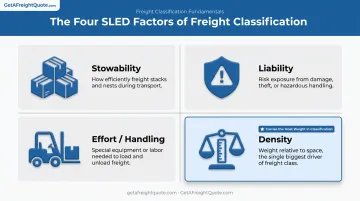
Every NMFC classification comes down to four characteristics, commonly referred to as SLED:
- Density: Freight's weight-to-volume ratio. Denser items typically cost less to ship and land in lower classes.
- Handling: How easily freight moves across a dock and in and out of a trailer. Oversized or hazardous items push toward higher classes.
- Stowability: How well freight loads alongside other shipments. Items that can't stack or have awkward protrusions are harder to stow efficiently.
- Liability: Risk of damage, theft, or perishability. High-value or fragile freight raises both class and insurance considerations.
Under NMFC guidelines, density carries the most weight of these four factors for most general commodities.
Freight Class Explained: The 18 Classes and Where Class 70 Fits
Freight class is the numeric scale, running from 50 to 500, used to price and categorize LTL shipments. Lower numbers mean denser, more durable freight that costs less to ship. Higher numbers mean lighter, more fragile, or higher-value freight that costs more.
There are 18 established classes total: 50, 55, 60, 65, 70, 77.5, 85, 92.5, 100, 110, 125, 150, 175, 200, 250, 300, 400, and 500. Each class corresponds to a density range under the current standard scale.
Here's a simplified reference for common classes:
| Class | Density Range (lb/ft³) | General Freight Type |
|---|---|---|
| 50 | 50+ | Very dense, compact freight (steel parts, machinery) |
| 70 | 15 to under 22.5 | Moderate-density goods (unassembled furniture, canned goods) |
| 100 | 6 to under 8 | Average density (auto parts, boxed goods) |
| 150 | 4 to under 6 | Lighter, bulkier items (auto accessories) |
| 250 | 2 to under 4 | Low-density freight (bulky, lightweight items) |
| 400 | 1 to under 2 | Very low-density freight (bulky, high-value items) |
| 500 | Less than 1 | Lightest, lowest-density, or highest-value freight |
What Is Class 70 in Freight Classification?
Class 70 sits in the middle of the scale. It typically covers moderate-density goods such as unassembled furniture, auto parts, or canned foods. These items aren't dense enough for the lowest classes, but they still stack and handle reasonably well.
Density drives this classification because it reflects how efficiently freight uses trailer space. To find it, divide the shipment's weight in pounds by its total cubic feet.
Under the new 2025 density-based system, Class 70 corresponds to Sub 9 on the standard scale, covering freight with a density of 15 but less than 22.5 lb/ft³. If your shipment falls in that density band and doesn't have unusual handling or liability concerns, it likely falls into Class 70.
NMFC Code vs. Freight Class: What's the Difference?
Here's where a lot of shippers get confused. Every commodity has both a freight class and an NMFC code, but they serve different purposes.
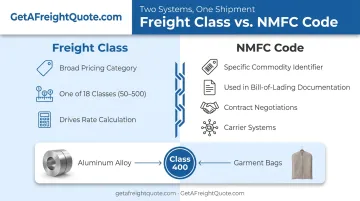
- Freight class is the broad pricing category (one of 18 numbers, 50 to 500)
- NMFC code is the specific identifier for your exact product within that category
Multiple, completely unrelated commodities can share the same freight class while carrying entirely different NMFC codes. A real example from NMFTA's classification docket: NMFC item 12700 (aluminum-manganese-silicon alloy) and NMFC item 20580 (bags for apparel and garment storage) both fall under Class 400, despite being nothing alike.
According to NMFTA's Disposition Bulletin 1371, both commodities share a Sub 1 density classification, meaning each weighs under 1 lb/ft³.
That distinction matters practically:
- Freight class primarily drives your rate calculation on the bill
- NMFC codes are also used for bill-of-lading documentation, contract negotiations, and carrier data systems
If your bill of lading lists the wrong NMFC code, even if the freight class happens to look correct, you can still trigger a carrier audit or dispute down the line.
The 2025 NMFC Overhaul: New 13-Tier Density Scale
Effective July 19, 2025, the NMFTA replaced the older classification structure with a new 13-tier, density-first scale. The goal was straightforward: simplify a system that had grown confusing and standardize how LTL pricing gets calculated.
Here's the full standard scale:
| Sub | Density (lb/ft³) | Class |
|---|---|---|
| 1 | Less than 1 | 400 |
| 2 | 1 to under 2 | 300 |
| 3 | 2 to under 4 | 250 |
| 4 | 4 to under 6 | 175 |
| 5 | 6 to under 8 | 125 |
| 6 | 8 to under 10 | 100 |
| 7 | 10 to under 12 | 92.5 |
| 8 | 12 to under 15 | 85 |
| 9 | 15 to under 22.5 | 70 |
| 10 | 22.5 to under 30 | 65 |
| 11 | 30 to under 35 | 60 |
| 12 | 35 to under 50 | 55 |
| 13 | 50 or greater | 50 |
The update's goals were focused: reduce classification disputes, improve pricing accuracy, and consolidate thousands of individual commodity listings into broader, density-driven categories.
ArcBest reports the change affects density-based classification for nearly 2,000 commodities. The NMFTA also launched ClassIT+ as the new official lookup tool, replacing the legacy ClassIT® system entirely.
Packaging Now Matters More Than Ever
Because density drives classification for most commodities, how you package a shipment directly affects your rate.
NMFTA's own guidance notes that adding excess packaging (an oversized pallet, unnecessary crating) increases cubic footprint without adding weight. That lowers density, which can bump your freight into a higher, costlier class.
The flip side: compact, efficient packaging keeps density higher and can genuinely lower your shipping cost under the new rules. That said, don't strip packaging to the point where you risk damage. A reshipment from damaged freight costs far more than the density penalty you were trying to avoid.
Beyond packaging, the density overhaul creates another risk worth addressing: audit any NMFC codes stored in your TMS, ERP, or WMS. Codes that were accurate under the old scale may now map to a different class.
Left unchecked, that mismatch shows up as a billing surprise on your next invoice. A modern TMS with automated audit checks can catch that error before it hits your bill.
How to Determine and Verify Your NMFC Code
Getting classification right starts with accurate data, not guesswork.
- Capture precise dimensions and weight for every shipment. Since density calculations now drive most classification decisions, even small measurement errors can push freight into the wrong class.
- Use an NMFC lookup tool like ClassIT+, or work with a logistics partner to confirm the correct code and class before you book. Guessing based on last quarter's shipment isn't reliable anymore.
- Confirm the final classification with your carrier before pickup. This is the step most shippers skip, and it's the one that prevents reweigh-triggered reclassification after the fact.
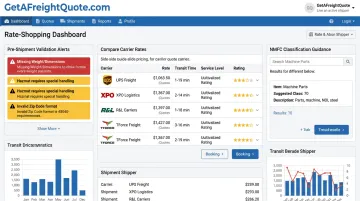
A TMS platform makes this verification process practical at scale. GetAFreightQuote.com gives small and mid-sized shippers access to the same classification tools large enterprises have relied on for years:
- Pre-shipment validation that flags dimension and weight errors before booking
- Freight class determination built on current NMFC data
- NMFC accuracy guidance that helps prevent costly billing surprises down the line
The platform's rate-shopping dashboard shows carrier pricing side by side before you commit, so classification-driven cost differences surface during quoting, not after delivery. Shippers can also use Bring Your Own Rates to compare their existing carrier contracts against negotiated rates, giving a fuller picture of how classification affects pricing across their entire carrier network.
Combined with automated invoice auditing that flags unwarranted accessorial charges, this approach catches classification errors before they turn into disputed invoices weeks later.
Frequently Asked Questions
What is an NMFC code?
An NMFC code is a standardized number assigned by the NMFTA to a specific commodity. Carriers use it to determine how LTL freight is priced and handled across North America.
What are the 18 classes of NMFC?
Freight classes range from 50 to 500 across 18 steps: 50, 55, 60, 65, 70, 77.5, 85, 92.5, 100, 110, 125, 150, 175, 200, 250, 300, 400, and 500.
What is Class 70 in freight classification?
Class 70 covers moderate-density goods like unassembled furniture or canned foods. Under the 2025 scale, it corresponds to a density range of at least 15 but less than 22.5 lb/ft³.
How is freight class determined?
Classification is based on SLED: stowability, liability, handling, and density. Under the 2025 system, density is now the primary factor for most general commodities.
What happens if I use the wrong NMFC code?
An incorrect code can trigger a carrier reweigh, reclassification, additional fees, and shipment delays. It can also cause disputes over your bill of lading documentation.
Where can I look up my NMFC code?
You can use NMFTA's ClassIT+ tool, work directly with a carrier or freight broker, or use a TMS platform like GetAFreightQuote.com for pre-shipment classification validation.