This scenario plays out constantly for small businesses new to freight shipping. The gap almost always comes down to accessorial charges — fees for services the base rate never covered in the first place.
Base freight rates only cover standard dock-to-dock transportation: a driver picks up your pallet from a loading dock and drops it at another loading dock, no extra labor or equipment involved. Real shipments rarely work that cleanly. A residential address, a site without a dock, or a driver stuck waiting at a warehouse all trigger extra fees.
This guide breaks down what accessorial charges are, the most common types you'll encounter, how they differ between truckload and LTL freight, and how to stop them from blindsiding your budget.
Key Takeaways
- Accessorial charges are legitimate fees for extra services, not hidden costs, when disclosed upfront
- LTL shipments typically rack up more accessorials than truckload, due to multiple stops and pallet handling
- Common charges include liftgate, residential delivery, detention, limited access, and pallet fees
- On average, accessorials account for 8.7% of total LTL freight spend, reaching up to 20% in extreme cases
- A transparent quoting platform that discloses accessorials before booking protects your margins
What Are Freight Accessorial Charges?
Accessorial charges are fees carriers apply for services beyond the standard line-haul rate, meaning the cost of moving goods from point A to point B under normal dock conditions. Old Dominion's definition confirms this, describing accessorials as charges for any service that falls outside that standard scope, from special handling to extra dock time.
If someone asks "what does accessorial services mean," the answer is simple: it's any extra labor, equipment, or handling requirement that isn't baked into the base freight rate. A liftgate, an inside delivery, a wait at a dock — none of that is standard, so carriers charge separately for it.
Accessorials differ sharply from hidden fees. When a charge is disclosed in a contract or quote and tied to a specific shipment condition, it's transparent and expected. Hidden fees, by contrast, show up without warning and without documentation. The distinction matters when you're evaluating whether a carrier or broker is being straight with you.
The Three Categories of Accessorial Charges
Most accessorials fall into one of three buckets:
- Administrative charges: triggered by errors on the Bill of Lading (BOL), such as incorrect weight or freight class that a carrier terminal catches and corrects
- Delivery/in-transit charges: triggered by missed delivery windows, detention, redelivery attempts, or overnight layovers
- Equipment charges: triggered by special equipment needs discovered at delivery, like a liftgate or pallet jack nobody mentioned during booking
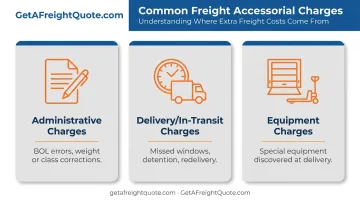
Knowing which bucket applies helps you prevent avoidable charges. Double-check your BOL for accuracy, confirm delivery windows in advance, and flag special equipment needs at booking. Most accessorial fees are preventable with a little upfront diligence.
Common Types of Freight Accessorial Charges
These are the accessorials that show up most often across truckload and LTL freight. Knowing them ahead of time means fewer surprises on your invoice.
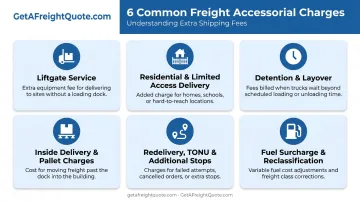
Liftgate Service
A liftgate is required when a delivery site has no loading dock, which makes it one of the most frequently billed LTL fees. If you don't specify a liftgate need at booking, the driver may show up without one, forcing a redelivery attempt and an extra charge on top of the original fee.
Residential & Limited Access Delivery
Residential deliveries cost more because drivers navigate neighborhoods and spend longer unloading without dock equipment or forklifts on-site. Limited access fees apply to locations like schools, military bases, or construction sites, where drivers need extra coordination, security clearance, or specialized access.
Detention & Layover
Carriers build free time into their tariffs, but it varies by mode and even by carrier. LTL free-time windows can run as short as 20-30 minutes for lighter shipments, while truckload tariffs typically allow 1-2 hours before detention kicks in. Once that window closes, per-hour or per-day charges start accruing.
Layover charges work differently: they apply when a driver is forced into an overnight wait due to scheduling or facility delays.
Inside Delivery & Pallet-Related Charges
Inside delivery covers labor when freight has to move beyond the receiving dock, into a building or specific room. Pallet-related charges are common in LTL shipments too:
- Pallet jack use when a dock lacks proper equipment
- Shrink-wrapping to secure freight during transit
- Pallet exchange, where carriers may offer a per-pallet allowance instead
Redelivery, TONU & Additional Stops
- Redelivery applies when the first delivery attempt fails, often due to a closed business or missing information
- Truck Ordered Not Used (TONU) is a cancellation fee charged when a shipment is called off after a truck has already been dispatched
- Additional stop-off charges apply to multi-destination shipments, where a truckload makes partial pickups or drop-offs along the route
Fuel Surcharge & Reclassification/Reweigh
Fuel surcharges adjust weekly based on national diesel price indexes and apply as a percentage of freight charges. Reclassification or reweigh fees kick in when a shipment's actual dimensions or weight don't match what was declared on the Bill of Lading (BOL), a mismatch that carriers typically catch at their terminals before the freight leaves the dock.
Truckload vs. LTL Accessorial Charges
Not all freight accumulates accessorials the same way. The mode you choose changes both how many fees you'll see and what triggers them.
Truckload (TL) accessorials center on time and equipment. Detention, layovers, and stop-offs are the main culprits, and because TL shippers often move higher volumes, these fees get negotiated into contracts more frequently than LTL fees do.
LTL accessorials are more granular. According to ArcBest's comparison of truckload and LTL freight, LTL charges typically stem from location type and handling needs, while TL charges trace back to driver time and equipment.
Multiple stops and palletized handling mean residential surcharges, limited access fees, and pallet handling charges show up far more often.
A practical comparison:
| Scenario | Likely Accessorials |
|---|---|
| Single pallet shipped LTL to a school | Limited access + liftgate + inside delivery |
| Full truckload delivered to a warehouse dock | Detention only (if unloading is delayed) |
Same freight, wildly different fee exposure based on mode and destination.
How Accessorial Charges Impact Your Shipping Costs
Accessorial charges typically aren't baked into your initial quote's base rate. That's exactly why the invoice you receive can look nothing like what you were originally quoted.
Take a roughly 1,000-lb LTL shipment. Base cost depends on freight class, distance, and carrier — there's no single flat number, since class and lane both swing pricing significantly.
What's more predictable is what happens after that base rate. Common accessorial fees include:
- Liftgate fee for shipments without dock access
- Residential surcharge for deliveries to non-commercial addresses
- Limited access charge for hard-to-reach locations like construction sites or schools
These charges can stack if a shipment needs more than one, quickly changing your final invoice total.
The scale of this problem is bigger than most shippers assume. An AFS Logistics analysis of $1.2 billion in annual managed LTL spend found accessorials averaged 8.7% of total LTL spend in 2023. Some shippers saw that share climb as high as 20% in extreme cases. For a business shipping regularly, that's not a rounding error. It's a budget line that deserves real attention.
How to Avoid or Reduce Unexpected Accessorial Charges
Most accessorial surprises are preventable. Here's what actually works:
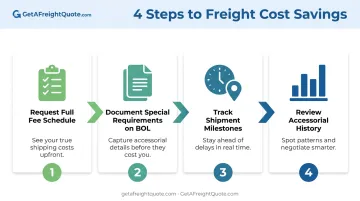
- Request a full accessorial fee schedule from any carrier or broker before signing a contract or booking a shipment. If they can't produce one, that's a red flag.
- Document special service requirements on the BOL, such as dock availability, residential address, or limited access site. Accurate paperwork prevents administrative disputes before they start.
- Track shipment milestones, such as arrival time, wait time, and delivery attempts, so you can verify a charge was legitimately triggered before you accept it.
- Review your accessorial charge history periodically. Recurring high-cost patterns often point to a fixable problem, like switching to scheduled delivery appointments or adjusting packaging.
Small businesses without a dedicated logistics team often don't have the bandwidth for any of this, which is where the right technology partner earns its keep.
GetAFreightQuote.com's TMS platform helps prevent these charges at the source. It:
- Validates shipment weight, dimensions, and freight class before a shipment is committed, catching the exact details that trigger reweigh and reclassification fees
- Runs automated auditing that flags unwarranted accessorial charges before you pay them
- Backs every flagged charge with expert review of the line item
One feature worth knowing about: Bring Your Own Rates (BYOR). It lets shippers connect their existing UPS, FedEx, or LTL carrier accounts directly into the platform and shop those rates side by side with GetAFreightQuote.com's negotiated rates every time a shipment is entered. You always book the cheaper option, whether it's your own contract or theirs.
If you're unsure how a specific charge on your invoice should be handled, GetAFreightQuote.com's team can walk through it with you directly.
Frequently Asked Questions
What does accessorial services mean?
Accessorial services refer to any service beyond standard pickup and delivery, such as liftgate use, inside delivery, or special handling. These are billed separately from the base freight rate because they require extra labor or equipment.
How much does it cost to ship 1,000 lbs?
Cost depends on distance, freight class, and carrier, with accessorials as potential add-ons depending on delivery conditions. Get a personalized quote for accurate pricing, since generic estimates rarely reflect your actual lane and freight class.
Are accessorial charges negotiable?
Yes, especially for high-volume or contracted shippers. Detention and layover fees are the most commonly negotiated, since carriers often build flexibility into these charges for reliable, repeat customers.
Do accessorial charges apply to full truckload shipments?
Yes, but truckload shipments typically incur fewer accessorials than LTL. The most common are detention, TONU, and additional stop-off charges.
How can I avoid surprise accessorial charges on my freight invoice?
Request a full fee schedule upfront, document shipment details accurately on the BOL, and work with a quoting provider that discloses accessorials before you book. These three habits eliminate most invoice surprises.
What is the difference between accessorial charges and hidden fees?
Accessorial charges are legitimate, disclosed fees tied to specific services like liftgates or residential delivery. Hidden fees are undisclosed and added without transparency, making them a very different and avoidable problem.