Small and mid-sized shippers face an additional challenge: traditional freight pricing favors high-volume shippers. Until recently, smaller businesses paid 30-50% more for the same services simply because they couldn't match Fortune 500 shipment volumes. This guide breaks down exactly when each mode makes sense—and how modern freight platforms level the pricing playing field.
Key Takeaways
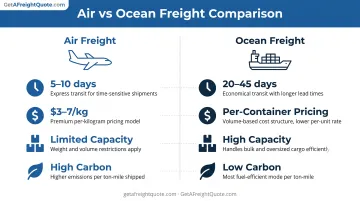
- Air: 5–10 days at a higher cost per kg — best for urgent, high-value, or perishable goods
- Ocean: 20–45+ days at the lowest per-unit cost — best for bulk and planned replenishment
- Weigh urgency, product value, size/weight, budget, and carbon goals before you choose a mode
- Modern TMS platforms give small businesses access to enterprise-level negotiated rates for both modes
- The strongest strategies use both modes together, not one exclusively
Air vs Ocean Freight: Quick Comparison
Scan cost, speed, capacity, and total impact side by side before you commit to a mode.
| Factor | Air Freight | Ocean Freight |
|---|---|---|
| Current Pricing | $3.03–$7.30/kg (lane-specific, Dec 2024) | $4,301–$5,814 per 40-ft container (Asia–US, Dec 2024) |
| Transit Speed | 5–10 days standard; China–US: 1–5 days port-to-port, 4–11 days door-to-door | 20–45+ days standard; China–US: 14–42 days port-to-port, 19–50 days door-to-door |
| Best For | Urgent orders, high-value electronics, perishables, seasonal launches | Bulk inventory, heavy machinery, raw materials, non-urgent restocking |
| Cargo Capacity | Limited by aircraft weight/volume restrictions | Handles oversized, heavy, and high-volume shipments |
| Scheduling | Multiple daily flights, fixed schedules | Weekly sailings, more variability |
| Carbon Impact | ~6 metric tons CO2e per metric ton shipped | ~0.1 metric ton CO2e per metric ton shipped |
| Billing Method | Chargeable weight (higher of actual vs. volumetric: L×W×H cm ÷ 6,000) | FCL: flat rate per container; LCL: per cubic meter |
| Hidden Costs | Fuel surcharges, security fees, airport handling | Port charges, detention/demurrage after free time, local fees |
What Is Air Freight?
Air freight moves cargo via commercial passenger and dedicated cargo aircraft, making it the fastest international shipping method available. Airlines transport over 62 million cargo metric tons annually—representing more than 33% of global trade by value despite being less than 1% by volume. Those figures are why air freight leads on high-value, time-sensitive shipments.
Core business benefits:
- Reaches market in 5-10 days so inventory stays lean and launches stay on schedule
- Lowers holding costs by tying up less capital in goods still in transit
- Delivers predictable ETAs through multiple daily flight options
- Reduces theft and damage with real-time tracking and controlled handling
- Protects pharmaceuticals, biologics, and other temperature-sensitive goods
How air freight pricing works:
Airlines charge by chargeable weight—the greater of actual weight or volumetric weight. Volumetric weight is calculated using the formula:
Length × Width × Height ÷ 6,000 (when dimensions are in centimeters)
This means bulky, lightweight shipments often cost more than their actual weight suggests. A large box of pillows might weigh 50 kg but be charged for 150 kg based on its dimensions.
Additional costs include fuel surcharges (which vary by carrier and market conditions), security fees, airport handling charges, and terminal transfers. Always request all-in quotes to compare true landed costs.
Use Cases of Air Freight
Air freight fits businesses that prioritize speed, product integrity, or market timing over absolute lowest cost:
Strategic use cases:
- Replenish inventory at the last minute to prevent stockouts during demand spikes
- Hit seasonal launch windows for new fashion lines and holiday electronics
- Ship high-margin electronics where a 300% markup can justify about $8/kg
- Move perishables such as fresh flowers, seafood, and short-shelf-life pharmaceuticals
- Keep production lines running when a delayed component would shut them down
Real-world example:
A small electronics retailer importing the latest smartphone accessories before the holiday season chooses air freight to capture peak demand. The $4,000 air shipping cost is offset by $15,000 in additional holiday sales that wouldn't happen if inventory arrived in January via ocean.
Cold-chain example:
A pharmaceutical distributor ships temperature-controlled vaccines that need consistent 2-8°C storage. Four to six weeks in ocean transit under variable conditions is too much risk. Five days in climate-controlled air cargo holds keeps product integrity intact.
What Is Ocean Freight?
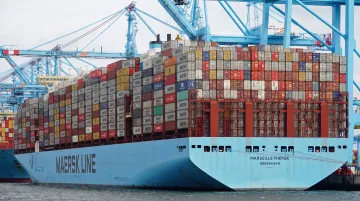
Ocean freight transports cargo in standardized containers via ships, handling over 80% of world trade volume (about 12.3 billion metric tons in 2023). It's the most cost-effective mode for international shipping, with far lower per-unit costs than air.
Core business benefits:
- Costs typically 5-10 times less than air on a weight basis
- Moves oversized and heavy cargo air can't handle, including machinery, vehicles, and bulk materials
- Offers 20ft, 40ft, and 40ft high-cube containers based on volume
- Supports LCL consolidation so smaller shipments share container space
- Produces about 0.1 metric tons CO2e per metric ton shipped versus roughly 6 metric tons for air
Container options and pricing:
Full Container Load (FCL) means you book an entire container at a flat rate, filled or not. It fits best at 15+ cubic meters. The box is sealed at origin and opened at destination, which cuts handling and theft risk.
Less than Container Load (LCL) means your cargo shares a container with other shippers. You pay only for the cubic meters you use, so it works well under about 15 CBM or 2-3 pallets. Expect slower transit from consolidation and deconsolidation, plus more handling points.
Recent transit benchmarks (Dec 2024):
- Asia to US West Coast: ~36 days (factory-ready to destination port departure)
- Asia to US East Coast: ~57 days
- Europe to US East Coast: often ~20-30 days port-to-port, depending on origin and carrier schedule
Use Cases of Ocean Freight
Ocean freight makes sense when cost efficiency and cargo capacity matter more than delivery speed:
- Quarterly or seasonal bulk inventory restocking for retail
- Heavy machinery and construction or manufacturing equipment
- Raw materials (textiles, metals, components) with long production lead times
- High-volume, low-margin furniture and home goods
- Large e-commerce replenishment for Amazon FBA or 3PL warehouses
Cost savings example: A home goods retailer moves a 40ft container of furniture from Vietnam for $5,200 by ocean. The same load by air (about 8,000 kg) would run $48,000–$64,000, more than 10 times the ocean rate. They plan inventory about 10 weeks out to cover a 6-week transit plus port processing.
Manufacturing scenario: A US manufacturer sources bulk raw materials from China on steady 6-8 week production lead times. Ocean runs about $4,500 per container versus $35,000+ by air. With solid demand forecasting, they keep regular supply on ocean and reserve air for emergency part replacements.
Air vs Ocean: What Is Better?
There's no universal answer. The right mode depends on cost, speed, volume, product type, and stockout risk for each shipment.
The Cost-vs-Speed Trade-Off
Using December 2024 benchmarks, China to North America air freight costs $7.30/kg, while Asia to US West Coast ocean freight costs $4,301 per 40ft container. Comparing those figures directly is misleading; you have to run the math on your own shipment.
For a 500 kg electronics shipment:
- By air: 500 kg × $7.30 = $3,650 (plus fuel surcharges, security fees)
- By ocean LCL: ~2 cubic meters × $200/CBM = $400 (plus local port charges)
Air costs roughly 8-9 times more. But if that shipment is needed in 7 days to prevent a stockout, and the stockout would cost $10,000 in lost sales, air freight delivers $6,350 in net value compared to ocean.
Hidden Costs to Consider
Ocean freight hidden costs:
- Inventory holding: Capital tied up for 4-6 weeks longer than air
- Warehousing: Need larger safety stock to buffer for longer transit
- Product obsolescence: Fashion and electronics lose value during 6-week transit
- Detention and demurrage: Daily charges if you don't clear containers within free time (typically 3-5 days)
Air freight hidden costs:
- Fuel surcharges: Vary by carrier and market conditions; can add 20-40% to base rate
- Security fees: Required for international air shipments
- Expedited customs: Some lanes require faster processing, adding fees
The Small Business Pricing Challenge
Large corporations shipping hundreds of containers monthly negotiate preferential rates that small businesses can't access independently. Historically, a small business might pay 30-50% more for identical air or ocean services.
Modern transportation management platforms aggregate volume across hundreds of shippers and negotiate enterprise-level rates. GetAFreightQuote.com gives small businesses access to those rates for air and ocean freight, and lets you compare them side-by-side with your own carrier contracts so you avoid the usual small-shipper penalty.
Decision Framework
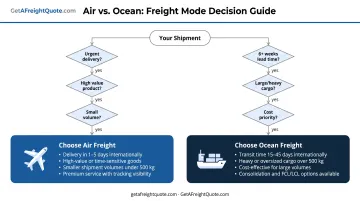
Choose air freight when:
- Product value is high relative to shipping cost (gross margin >200%)
- Delivery deadline is within 2 weeks
- Stockout risk is significant (lost sales >5x shipping premium)
- Product is time-sensitive, perishable, or temperature-controlled
Choose ocean freight when:
- You have 6+ week lead time flexibility
- Shipping large volumes (15+ cubic meters) or heavy items
- Product value is low relative to shipping cost (gross margin <100%)
- Minimizing total shipping cost is the priority
- Environmental goals require lower carbon footprint
Real World Examples
Example 1: E-Commerce Electronics Importer
A small e-commerce business selling phone accessories initially used only ocean freight to import from China. The $1,200 per container rate and 5-week transit kept costs low, until peak season hit.
The problem: November and December demand spiked 300%, but ocean-only logistics meant placing orders in September to receive inventory by November. The business guessed wrong on product mix, stocked out of bestsellers, and lost an estimated $15,000 in sales.
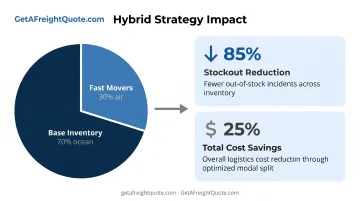
The solution: They adopted a hybrid strategy:
- Ocean (base inventory): 70% of projected volume ships 8 weeks ahead
- Air (fast movers): 30% ships 10 days ahead, reacting to real demand signals
Results: Stockouts dropped 85%, and total shipping costs fell 25% compared to an all-air approach. Through a TMS platform, they also unlocked enterprise-level rates and cut another 15–20% on both modes.
Example 2: Mid-Sized Industrial Parts Manufacturer
A manufacturer importing CNC machine components used air freight exclusively—$8,000 per shipment every 2 weeks, totaling $208,000 annually.
The analysis: The logistics team reviewed demand patterns and found 70% of components were consumed in predictable, steady volumes. Only 30% faced urgent, variable demand.
The solution:
- Predictable components moved to ocean at $2,500 per shipment every 6 weeks (about 70% of volume)
- Urgent, variable parts stayed on air at $2,400 per shipment every 2 weeks
Results: Annual shipping costs dropped from $208,000 to $88,000 (a $120,000 / 58% reduction) while production schedules held steady. After leveraging aggregated volume through a freight platform for better rates, they saved an additional $13,000 annually.
The Common Challenge
Both businesses initially struggled to get competitive rates. Hybrid mode choice fixed the inventory problem, but pricing still lagged: traditional forwarders prioritized larger clients, so small and mid-sized shippers often saw second-tier rates. Access to a TMS that aggregates shipper volume, such as GetAFreightQuote.com, gave them enterprise-level pricing without needing Fortune 500 shipment volume.
Practical takeaway: Match each shipment to air or ocean by urgency, value, and volume—then use aggregated platform rates so smaller shippers are not locked into weaker pricing.
Compare air and ocean rates for your lanes: GetAFreightQuote.com lets you shop both modes and line up your own carrier accounts side by side before you book.
Conclusion
The air versus ocean freight question has no absolute winner. The right choice depends on your shipment's urgency, size, value, and your business priorities.
Air freight delivers speed, reliability, and inventory velocity that help you avoid stockouts and missed sales windows. Ocean freight wins on cost and capacity for bulk moves. Match each shipment to the mode that optimizes total landed cost and still meets customer expectations.
In short:
- Choose air when time, reliability, or product value matter most
- Choose ocean when you can plan ahead and need lower cost per unit
- Use both strategically instead of locking into a single mode
Small businesses no longer need to accept second-class pricing. Freight platforms provide enterprise-level negotiated rates and transparent side-by-side comparisons, so shipment volume is no longer a barrier.
Successful international shippers run ocean for planned base inventory and air for urgent or high-value goods. Compare options on every shipment rather than defaulting to one mode.
Frequently Asked Questions
What is air freight and ocean freight?
Air freight moves cargo by aircraft for the fastest international delivery (typically 5–10 days) at a higher cost. Ocean freight moves cargo by container ship for the lowest per-unit cost, with transit usually 20–45+ days.
What is the difference between air freight and ocean freight?
Air is typically 5–10 times faster but costs far more per kilogram, with tighter weight and volume limits. Ocean offers much higher capacity and lower unit cost, with weekly sailings versus air’s more frequent flights. Air fits urgent, high-value goods; ocean fits bulk or non-urgent cargo.
How much does air freight cost?
Air freight typically runs $3–$8 per kilogram by lane, billed on chargeable weight (the greater of actual or volumetric weight: L×W×H÷6,000 cm). Fuel, security, and handling fees often apply. A 500 kg shipment commonly totals about $2,500–$5,000 depending on lane and service level.
How does ocean freight work?
Ocean freight ships cargo in standardized containers (20ft or 40ft). Businesses book Full Container Load (FCL) at a flat rate per container for exclusive use, or Less than Container Load (LCL) charged per cubic meter when sharing containers. Transit ranges from 20-45+ days depending on route, plus additional time for port handling and customs clearance.
What is the difference between BL and AWB?
A Bill of Lading (BL) is the ocean freight shipping document serving as proof of ownership and receipt of goods; it can be negotiable (transferable ownership). An Air Waybill (AWB) is the air freight shipping document serving as a receipt and tracking number; it is non-negotiable and shipper-specific.
How can small businesses get competitive air and ocean freight rates?
Small shippers often paid 30–50% more than large corporations because of lower volume. TMS platforms like GetAFreightQuote.com aggregate demand so smaller businesses can access negotiated air and ocean rates and compare carriers side by side before booking.