Small and mid-sized businesses feel this pain most. Most don't have a dedicated freight accountant on staff. Bookkeepers default to habit rather than GAAP guidance, and freight-in gets lumped in with freight-out, or accessorial fees vanish into a generic "shipping" bucket.
This guide breaks down freight-in versus freight-out journal entries, FOB terms, the cost drivers that complicate freight tracking, and the GAAP rules that keep your books audit-ready.
Key Takeaways
- Freight-in capitalizes into inventory; freight-out expenses immediately.
- FOB shipping point vs. destination decides who owns freight costs and risk timing.
- GAAP's matching principle ties freight costs to the same period as the sale.
- Invoice transparency and rate reconciliation matter as much as journal accuracy.
What Is Freight Accounting?
Freight accounting is the process of recording, classifying, and analyzing every cost tied to moving goods, whether from a manufacturer to a warehouse or from a warehouse to a customer's dock. It's not just bookkeeping. Done right, it directly shapes your COGS, gross margin, and inventory valuation.
Freight spend is enormous at the macro level: U.S. business logistics costs have recently topped $2.6 trillion, equal to roughly 8.7% of GDP, according to CSCMP's State of Logistics Report. That figure covers the entire national logistics economy, not a single company's freight-to-revenue ratio, but it underscores how much money moves through this one category.
Two variables determine how a freight charge gets treated on your books:
- Who pays the freight — the buyer or the seller
- Whether the cost is baked into the price of goods or billed separately
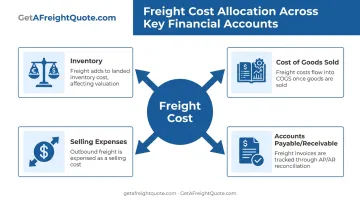
Freight accounting touches several accounts at once:
- Inventory (balance sheet)
- Cost of goods sold
- Selling expenses
- Accounts payable and receivable
Complexity multiplies once a business starts using multiple carriers and modes. A company running LTL, parcel, ocean, and rail freight simultaneously needs a systematic recording process, or reconciliation becomes a monthly headache.
Freight-In vs. Freight-Out: Definitions and Journal Entries
Classification hinges on one question: which direction are the goods moving, and who bears responsibility for the cost? This is the GAAP matching principle in action, pairing costs with the period and asset they actually relate to.
Freight-In Accounting Treatment
Freight-in is the cost of shipping inbound raw materials or inventory. Rather than expensing it immediately, GAAP requires you to capitalize it, adding it to the inventoriable cost of the goods themselves per AccountingTools' guide on capitalizing freight-in costs.
The standard journal entry looks like this:
| Account | Debit | Credit |
|---|---|---|
| Inventory | ✓ | |
| Accounts Payable / Cash | ✓ |
That freight charge doesn't hit the income statement right away. It sits in inventory until the goods sell, at which point it flows into COGS through this follow-up entry:
| Account | Debit | Credit |
|---|---|---|
| COGS | ✓ | |
| Inventory | ✓ |
Example: A retailer pays a carrier $800 to move a shipment of inventory from a supplier's warehouse to its own distribution center. That $800 gets added to the inventory account, increasing the per-unit cost of every item in that shipment.
Freight-Out Accounting Treatment
Freight-out is the cost of shipping finished goods to customers. Unlike freight-in, it's treated as a period cost and expensed immediately rather than capitalized into inventory.
The corresponding journal entry looks like this:
| Account | Debit | Credit |
|---|---|---|
| Freight-Out / Delivery Expense | ✓ | |
| Cash / Accounts Payable | ✓ |
This reduces operating income in the period the shipment goes out, regardless of when the related sale happened. If the invoice arrives late, that's an accrual timing issue, not a reason to capitalize the cost.
Example: An online seller advertises "free shipping" and covers a $45 carrier charge to deliver an order. That $45 is booked as a selling expense. It never touches inventory, even though the customer paid nothing extra for it.
Key Differences at a Glance
| Factor | Freight-In | Freight-Out |
|---|---|---|
| Direction of goods | Inbound (supplier to buyer) | Outbound (seller to customer) |
| Who typically pays | Buyer | Seller |
| Financial statement impact | Balance sheet (inventory) | Income statement (expense) |
| Effect on margin | Impacts gross profit via COGS | Impacts operating income |
FOB Shipping Point vs. FOB Destination: Why the Terms Matter
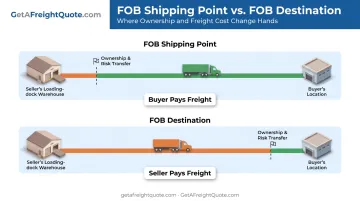
FOB terms decide who owns the goods, who bears the risk, and which party's books record the freight cost. Under UCC Article 2-319, the seller's obligations shift depending on the designated FOB point.
FOB shipping point:
- The buyer assumes ownership and risk once goods leave the seller's dock
- The buyer pays and records the freight cost as freight-in
- The seller only covers costs incurred before shipment
FOB destination:
- The seller retains ownership and risk until goods reach the buyer's location
- The seller books the freight cost as an expense (freight-out)
- The buyer records no freight cost on this leg
Here's why this matters beyond terminology: it determines when revenue and expense recognition happens. A shipment sitting in transit under FOB destination terms is still the seller's inventory. Under FOB shipping point, it's already the buyer's asset the moment it leaves the dock, even if it takes a week to arrive.
Get this wrong and you'll misstate inventory on the balance sheet at period-end, especially for shipments in transit when the books close.
Key Factors That Influence Freight Costs (and Their Accounting Impact)
Freight rates aren't static, and that volatility creates real accounting headaches. Finance teams need to true up estimates against actuals regularly.
Fuel price volatility. Diesel prices swing weekly, and many carriers apply fuel surcharges tied to national averages. When diesel jumped over a dollar per gallon year-over-year, carriers adjusted their surcharge formulas accordingly.
Since carriers set surcharge formulas independently rather than following a single standard, accrued freight expense estimates can drift from actual billed amounts if you're not reconciling monthly.
Mode and equipment. The way freight moves changes what lands on the invoice:
- LTL — Classification under the NMFC system depends on density, handling difficulty, and liability, which directly sets the rate
- FTL — Equipment type (dry van, flatbed, refrigerated) changes pricing structure entirely
- Air cargo — Chargeable weight is the higher of actual or volumetric weight, so bulky low-weight shipments can cost more than expected
- Parcel — Rates scale with dimensional weight and zone, adding variability invoice to invoice
This mode-specific variability means flat per-shipment cost assumptions rarely hold, so accrual entries should reflect actual equipment and service mix.
Seasonality and accessorials. Demand spikes during peak season push spot rates higher, and accessorial charges (detention, liftgate fees, residential delivery, redelivery) stack on top of the base rate. These fees vary by carrier and shipment type, which is exactly why they're so easy to miss during manual invoice review. Tools like GetAFreightQuote.com's freight audit service catch these discrepancies automatically, reducing manual review.
GAAP Compliance and Best Practices for Freight Accounting
GAAP's matching principle is the backbone of freight accounting: costs must land in the same period as the inventory movement or sale they relate to. Get the timing wrong, and COGS becomes unreliable for the entire reporting period.
The capitalization rule is straightforward once you apply it consistently:
- Freight-in is an inventoriable cost, capitalized and released to COGS when goods sell
- Freight-out is a period cost, expensed as incurred
Common Mistakes That Distort the Books
- Misclassifying freight-in as freight-out (or vice versa), which skews both gross margin and inventory value
- Overlooking accessorial charges buried in carrier invoices
- Failing to reconcile invoiced amounts against contracted rates, letting overcharges slip through unnoticed
Best Practices Worth Adopting
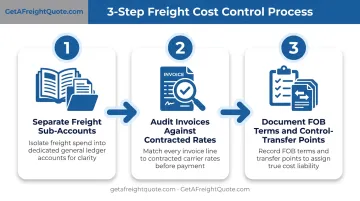
- Separate freight sub-accounts. Set up distinct sub-accounts within COGS and SG&A so freight-in and freight-out never blend together. This alone makes audits faster.
- Audit invoices against contracted rates regularly. Billing errors and overcharges are common enough that a monthly reconciliation habit pays for itself.
- Document your FOB terms and control-transfer conclusions. Note the specific FOB location on every purchase order, not just "FOB," so there's no ambiguity later.
Invoice transparency is where a lot of this breaks down in practice. When freight invoices arrive scattered across multiple carriers with accessorial fees buried in the fine print, reconciliation turns into detective work.
GetAFreightQuote.com's TMS platform addresses this directly through consolidated e-billing (one clean invoice across every mode and carrier) and automated auditing that flags discrepancies before payment is due. Rate transparency at booking gives finance teams a documented reference point for checking invoiced charges.
If your team is spending hours each month chasing down freight discrepancies, connecting with a freight expert can show how much of that manual work is possible to automate away.
Frequently Asked Questions
What is the accounting entry for freight-in?
Debit Inventory and credit Accounts Payable or Cash. That cost stays capitalized in inventory until the goods sell, at which point it moves into COGS.
How are freight costs accounted for in GAAP?
GAAP applies the matching principle, requiring freight-in to be capitalized as part of inventory and freight-out to be expensed in the period it's incurred.
Is freight-out considered an expense or part of COGS?
Freight-out is recorded as an operating or selling expense, though some companies present it within COGS. Either way, it's never capitalized into inventory.
Who is responsible for freight costs under FOB shipping point vs. FOB destination?
Under FOB shipping point, the buyer owns the goods and freight cost once they leave the seller's dock. Under FOB destination, the seller retains that responsibility until delivery.
Where do freight costs appear on financial statements?
Freight-in shows up on the balance sheet within inventory value. Freight-out appears on the income statement as a selling or operating expense.
Can freight costs ever be capitalized as part of an asset's value?
Yes. Freight-in on inventory purchases and freight tied to acquiring fixed assets can both be capitalized. Freight-out, in contrast, is never capitalized.