Here's the problem: inbound freight can represent roughly 10% of raw-material spend, according to McKinsey's analysis of the chemicals industry. Yet most small and mid-sized businesses have zero visibility into what they're actually paying for it, because suppliers often bundle it into the product price.
This guide breaks down what inbound freight actually costs, what inflates it, and the specific levers you can pull to bring it back under control.
Key Takeaways
- Inbound freight is often hidden inside supplier pricing, so you can't track true cost unless you ask
- Active management typically generates 5-8% savings
- FOB and collect vs. prepaid terms decide who controls inbound cost and risk
- Taking routing control away from suppliers usually beats "best way" shipping instructions
- Small businesses can now access pooled-volume carrier rates once reserved for enterprise shippers
What Are Inbound Freight Costs?
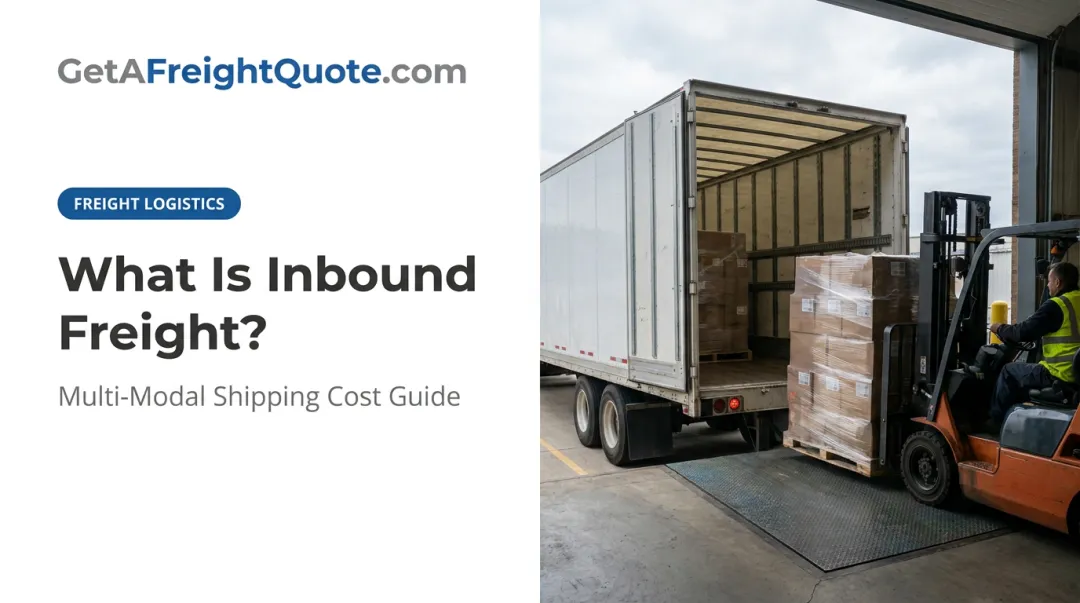
Inbound freight is the cost of getting materials, components, or finished goods from your suppliers to your dock. It's the mirror image of outbound freight: outbound moves product from you to your customer; inbound moves it from your vendor to you.
The tricky part: suppliers rarely itemize it. Freight gets folded into the unit price or shows up as a vague "shipping" line, which means you're trusting the vendor's math without a way to check it.
Why that matters:
- Suppliers often receive volume discounts from carriers that they don't pass on to you
- A marked-up freight charge inflates your landed cost without ever appearing as "freight" on the invoice
- Supply Chain Management Review puts inbound freight around 10% of material cost (illustrative, not universal)
If you've never asked a supplier to separate freight from goods cost, you likely don't know what you're actually paying for transportation. That's the first gap to close.
What Drives Up Your Inbound Freight Costs
Five factors quietly push inbound freight costs higher than they need to be — and most stay hidden until you audit the details.
"Best Way" Shipping Puts Suppliers in Charge
When a purchase order says "ship best way," you're handing routing decisions to the supplier. Their "best way" optimizes for their convenience, not your cost. Suppliers often pick a familiar carrier, not the cheapest option for your lane.
Hidden Accessorial Fees
Accessorials pile up fast, and they vary by carrier and tariff. Real examples from published carrier rules tariffs:
- Fuel surcharges ranging from 8.2% to 13.0% depending on the diesel index, per R+L Carriers' 2025 tariff
- Detention charges of $52.50 per 15 minutes (minimum $63.00), per Central Transport's tariff
- Liftgate fees running $9.35 per hundredweight, with a minimum of $183.75
- Guaranteed delivery surcharges adding 20-40% on top of linehaul cost

Double Freight Billing Risk
If nobody reconciles vendor invoices against actual carrier billing, you can end up paying twice for the same shipment — once embedded in the vendor's price, once as a separate freight charge. Freight-billing error rates of 2–3% create meaningful annual losses when multiplied across hundreds of shipments.
Poor Freight Classification
Every LTL shipment gets an NMFC class from 50 to 500 based on density, handling, and liability. Misclassify a shipment, and you either overpay or risk a costly reclassification charge later. A Freight-All-Kinds (FAK) agreement — a private deal that rates several actual classes at one agreed class — can simplify this when it matches your real density and freight mix.
Expedited Freight From Supplier Delays
When a supplier falls behind schedule, they sometimes ship "collect" via rush methods to save face — and you absorb the premium. The premium varies by lane, carrier, and weight, so skip blanket "30% more" claims. Compare the rush quote to your contracted rates before you accept collect expedited freight.
Freight Terms Every Buyer Should Understand
Freight terminology is more than paperwork. It determines who's liable for damage and who actually pays.
| Term | What it means |
|---|---|
| FOB origin/shipping point | Ownership transfers when the carrier picks up at the seller's dock. You own the risk in transit. |
| FOB destination | Ownership transfers on delivery to you. Seller carries the risk. |
| Freight collect | You pay the carrier directly. |
| Freight prepaid | The vendor pays the carrier and doesn't charge it back. |
| Prepaid and add | Vendor pays the carrier, then adds that cost to your invoice as a line item. |
| Prepaid and allowed | Vendor pays and doesn't separately charge you; freight is baked into the goods price. |
The buyer-favorable combination is freight collect, FOB destination: you control routing and carrier choice, while the seller still holds risk until delivery.

Don't treat freight terms as boilerplate. Negotiate them alongside price, payment terms, and delivery windows — not as a footnote after the deal is done.
Proven Strategies to Reduce Inbound Freight Costs
You don't need enterprise volume to start cutting inbound costs. You need visibility and a plan.
- Request itemized invoices from your top suppliers by spend. Separating goods cost from freight cost exposes hidden markups immediately.
- Negotiate carrier rates directly. Ask carriers about backhaul lanes and underutilized capacity. They often discount to fill empty miles.
- Consolidate shipments from multiple vendors into fewer, larger loads. One documented case saw a company achieve 12.4% freight savings and shipments moving 1.2 days faster after consolidating LTL shipments, according to ODW Logistics.
- Establish routing instructions and vendor compliance programs instead of relying on "best way" shipping. A GEODIS case study documented compliance chargebacks dropping from $232,000 to $83,000 in a year (a 64% improvement) once routing errors were eliminated.
- Audit freight bills regularly against receiving records to catch duplicate billing and carrier non-compliance.
- Get visibility through a Transportation Management System (TMS). Nucleus Research found TMS adoption cut transportation spend by 11%, with follow-up findings showing potential reductions of 15% in transportation costs and 47% in demurrage.

GetAFreightQuote.com helps small and mid-sized shippers put these steps into practice. The platform opens access to pre-negotiated rates across more than 100 national, regional, and local LTL carriers, with full invoice transparency before you book.
Support for the strategies above includes:
- Consolidated e-billing and spend analytics by carrier and mode
- Automated auditing that flags billing errors before they cost you money
- LTL negotiation that typically delivers 15-35% savings over an 8-10 week engagement
When to Take Control of Inbound Freight vs. Leaving It to Suppliers
Taking control isn't automatically the right move for every business. It depends on your volume and internal coordination.
Consider leaving it to suppliers when:
- Your order volume is low and irregular
- The supplier's consolidated shipments already beat what you could negotiate alone
- Coordination costs would outweigh the freight savings
Consider taking control when:
- You can leverage existing outbound volume to negotiate inbound lanes
- You have repeatable lanes and predictable shipment patterns
- Procurement, receiving, and logistics teams can coordinate on routing and compliance
That last point matters more than people expect. Taking control of inbound freight isn't just a procurement decision — it requires receiving teams to enforce vendor compliance and logistics to manage carrier relationships. Without that internal alignment, even the best negotiated rate falls apart at the dock.
Even with that alignment, many shippers still never push on rates. A 2023 Pitney Bowes survey found that over two-thirds of mid-size and large shipping decision-makers never negotiated custom carrier rates, often assuming they lacked the volume to matter. That assumption costs money. Volume-pooling models now let smaller shippers negotiate from a position of collective strength.

Frequently Asked Questions
What are inbound costs?
Inbound costs are the expenses of bringing materials or goods from suppliers into your business. This includes transportation, handling, accessorial fees, and any related receiving costs.
What is a typical freight charge?
Freight charges vary widely by mode, weight, distance, and market conditions. Truckload spot rates have hovered around $2.25–$2.30 per mile recently, while LTL pricing indexes sit over 65% above 2018 baselines. Always verify current rates for your specific lane.
What does "inbound shipping" mean?
Inbound shipping refers to the delivery and receipt of materials into your facility, typically arriving from vendors or suppliers as part of your procurement process.
How can I lower my inbound freight costs?
Negotiate freight terms directly into purchase agreements, consolidate shipments where possible, and use a TMS for rate visibility and billing audits. Small changes in routing control often produce outsized savings.
Who is responsible for paying inbound freight costs?
Responsibility depends entirely on the negotiated FOB and freight terms between buyer and seller. FOB destination versus origin, and prepaid versus collect, determine who pays and who holds the risk.
Can small businesses get the same freight rates as large companies?
Yes. Platforms that pool shipping volume across many small and mid-sized businesses can secure negotiated rates typically 20-50% below retail—pricing once reserved for Fortune 500-level shippers.