Understanding which regional carriers serve your lanes and how they stack up against national alternatives isn't optional—it's essential for building a cost-effective, reliable LTL shipping strategy. Whether you're shipping manufacturing components from Ohio to Pennsylvania or distributing retail goods across the Southeast, choosing the right carrier can mean the difference between next-day delivery and a three-day detour through a national hub network.
Key Takeaways
- Regional LTL carriers cover 3–15 contiguous states with denser terminals and stronger local service than nationals
- Carriers like Southeastern Freight Lines, A. Duie Pyle, and Pitt Ohio often beat nationals on their home lanes
- Strong shippers mix regional and national carriers, matching each lane to the best-fit provider
- Choose regionals by mapping lanes, running pilots, and comparing total landed cost, not base rates alone
- GetAFreightQuote.com lets you compare 100+ regional and national LTL options side by side in one place
What Are Regional LTL Carriers?
Regional LTL carriers are trucking companies that specialize in less-than-truckload freight within a defined geographic area, typically 3-15 contiguous states, rather than offering coast-to-coast coverage.
Unlike national carriers that route freight through hub networks across the country, regional carriers build dense terminal networks, run direct delivery routes, and hire drivers who know local roads, traffic, and weather.
How regional carriers operate:
- Dense terminal networks within their service area reduce freight handling touches
- Direct routes between terminals minimize transfer points where damage occurs
- Drivers repeatedly cover the same lanes, building familiarity with delivery locations
- Local management teams maintain direct relationships with shippers and consignees
- Focused geography allows faster response to service issues and exceptions
Regional vs other carrier types:
| Carrier Type | Geographic Coverage | Terminal Density | Service Model |
|---|---|---|---|
| Regional | 3-15 contiguous states | High density within region | Direct routes, minimal handling |
| National | Coast-to-coast (48 states) | Lower density per region | Hub-and-spoke, multiple touches |
| Sub-regional | Metro area or 1-3 states | Very high local density | Last-mile focus, limited range |
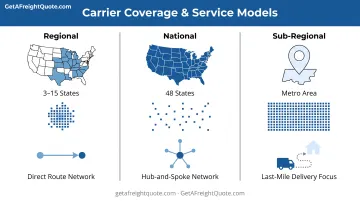
Regional carriers serve shippers with concentrated freight patterns: businesses moving 60%+ of LTL volume within a single region, manufacturers shipping between facilities in adjacent states, or companies that prioritize service quality over maximum geographic reach.
If your freight flows from North Carolina to Florida or from Ohio to Pennsylvania, a regional carrier with direct service can deliver faster and more reliably than a national carrier routing through multiple hubs.
Most regional carriers extend coverage beyond their direct footprint through interline agreements with other regional carriers, though these partnerships add handling touches and transit time compared to direct lanes.
Regional vs National LTL Carriers: When to Use Each
Regional carriers deliver stronger service inside their geography—and none outside it. National carriers give you coast-to-coast reach, but your freight moves through more terminals, more transfers, and more hands.
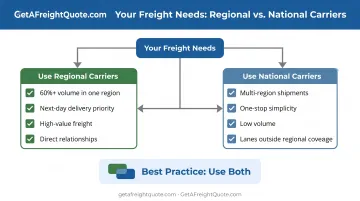
When regional carriers are the better choice:
- Consistent volume within their service area — if 60%+ of your shipments stay inside one region, the rates, priority handling, and dedicated support usually outweigh building a national-only roster
- Time-sensitive deliveries — next-day and second-day service on core regional lanes beats national carriers' hub-and-spoke transit times
- High-value or damage-prone freight — fewer handling touches mean lower damage risk
- Service quality priority — direct carrier rep relationships and local accountability matter when issues arise
When national carriers are necessary:
- Shipments crossing multiple regions — a load from California to Florida requires national coverage or multiple regional interline partners
- One-stop-shop simplicity — managing one national carrier is easier than coordinating three regional carriers
- Low-volume shippers — without negotiating leverage, you may not secure competitive regional rates
- Lanes without direct regional coverage — some origin-destination pairs fall outside every regional carrier's footprint
Most successful shippers use both: regional carriers on core lanes, national carriers for everything else. You keep regional service quality where volume concentrates, and still cover cross-country or odd-lane freight when you need it.
Top Regional LTL Carriers for 2026
These carriers were selected based on geographic specialization, terminal density, technology capabilities, and documented service performance. Most run focused regional networks; a few have grown into multi-regional coverage while keeping dense service in their core markets.
Southeastern Freight Lines
Founded in 1950 and headquartered in Lexington, South Carolina, Southeastern Freight operates 89 service centers across 13 southern states and Puerto Rico. The carrier reports over 99.35% on-time performance for next-day lanes within its core geography, a result of minimal freight handling and regional density that eliminates unnecessary terminal touches.
| Category | Details |
|---|---|
| Geographic Coverage | 13 southern states plus Puerto Rico (direct); extended US through interline partners |
| Service Strengths | Next-day service on major Southeast lane pairs; dedicated customer service reps; real-time tracking integration |
| Best For | Shippers with consistent Southeast volume; time-sensitive deliveries; freight requiring minimal handling to reduce damage risk |
Terminal density supports direct routing between most major metro pairs in the Southeast, which is why next-day performance holds up on core manufacturing and distribution corridors.
A. Duie Pyle
Founded in 1924 and headquartered in West Chester, Pennsylvania, A. Duie Pyle covers the Mid-Atlantic and Northeast across 11 states direct. Strategic locations also extend reach into North Carolina and Ohio.
| Category | Details |
|---|---|
| Geographic Coverage | Mid-Atlantic and Northeast (11 states direct); interline partnerships for national reach |
| Service Strengths | Next-day delivery across I-95 corridor; white-glove residential delivery; integrated warehouse and distribution services |
| Best For | E-commerce and retail shippers; residential and inside delivery requirements; businesses needing combined LTL and warehousing solutions |
A. Duie Pyle goes beyond standard LTL with more than 4 million square feet of distribution space and 600+ dedicated service drivers. That mix fits shippers who need warehousing and delivery tied to the same regional network.
Pitt Ohio
Pitt Ohio has operated since 1979 from Pittsburgh, Pennsylvania. It runs 25 direct terminals plus 31 sister-company terminals across a 10-state Mid-Atlantic and Midwest footprint, with extended ground service throughout the eastern US.
| Category | Details |
|---|---|
| Geographic Coverage | 10-state direct coverage (Mid-Atlantic/Midwest); extended ground service throughout eastern US |
| Service Strengths | Ground expedite for time-critical shipments; paperless operations; proactive shipment notifications and exception management |
| Best For | Manufacturing and industrial shippers; time-critical freight requiring expedited service; technology-focused businesses needing API integration |
Pitt Ohio invests heavily in technology and offers GROUND, Fast Track expedited, and supply-chain services including warehousing, transloading, drayage, freeze protection, and dedicated service. Their focus on paperless operations and real-time visibility appeals to shippers who prioritize digital integration.
Dayton Freight Lines
Family-owned since 1981 and headquartered in Dayton, Ohio, Dayton Freight operates 73 service centers across 14 states in the Midwest, Northeast, and Mid-Atlantic, plus New England.
| Category | Details |
|---|---|
| Geographic Coverage | 14 states across Midwest, Northeast, and Mid-Atlantic; interline for national coverage |
| Service Strengths | Low claims ratio and strong on-time performance; driver-friendly policies that reduce turnover; next-day service on major Midwest/Northeast lanes |
| Best For | High-value freight requiring low damage rates; shippers prioritizing reliability over cost; consistent volume between Midwest and Northeast markets |
Dayton Freight has built its reputation on service quality, winning recognition for consistent on-time delivery and low damage rates. Their driver-focused policies reduce turnover and keep experienced drivers on their routes, which translates directly to better service for shippers.
Averitt Express
Established in 1971 and headquartered in Cookeville, Tennessee, Averitt operates 143 locations across the Southeast and South-Central US with multi-regional reach. The carrier offers LTL plus truckload, expedited, international, and warehousing services through an integrated platform.
| Category | Details |
|---|---|
| Geographic Coverage | Southeast and South-Central US (direct); North American coverage through partner networks |
| Service Strengths | Multi-service provider (LTL, truckload, expedited); strong Gulf Coast and Tennessee/Florida corridor coverage; integrated technology platform |
| Best For | Shippers needing multiple modes (LTL, truckload, expedited); Gulf Coast and South-Central lanes; businesses valuing direct carrier relationships and local service |
Clarios named Averitt its 2024 LTL Carrier of the Year, and the carrier was recognized as a top provider and leading asset-based carrier in the 2024 Mastio Quality Awards. Averitt's multi-service approach allows shippers to consolidate LTL, truckload, and expedited freight under one carrier relationship.
Ward Transport and Logistics
Started in 1931 and headquartered in Altoona, Pennsylvania, Ward Transport runs direct service across 11 East Coast states through 22 locations, from the Mid-Atlantic into the Southeast. National reach comes through interline partnerships.
| Category | Details |
|---|---|
| Geographic Coverage | East Coast from Mid-Atlantic to Southeast (11 states direct); national interline coverage |
| Service Strengths | Specialized equipment capabilities; flexible scheduling options; focus on customized regional solutions |
| Best For | Shippers with unique equipment or handling requirements; businesses needing flexible scheduling; regional East Coast freight patterns |
Ward Transport focuses on flexibility and customized solutions, making them a strong fit for shippers whose freight doesn't match standard LTL profiles or who need specialized handling within the East Coast corridor.
Saia LTL Freight
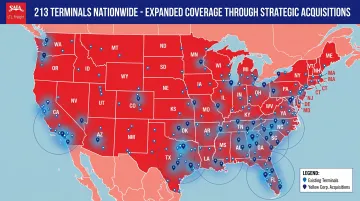
Founded in 1924 and now headquartered in Johns Creek, Georgia, Saia operates 213 owned and leased terminals providing direct service to all 48 contiguous states. The carrier acquired 28 former Yellow Corporation terminals in 2024, significantly expanding capacity and creating pricing opportunities.
| Category | Details |
|---|---|
| Geographic Coverage | 48 contiguous states (direct coverage); strongest density in Southeast, South-Central, and West |
| Service Strengths | Rapid network expansion; competitive pricing due to new capacity; guaranteed and expedited service options; real-time tracking technology |
| Best For | Shippers seeking competitive rates from a growing carrier; Southeast and Western US lanes; businesses willing to evaluate carriers based on recent performance improvements |
Saia reports that 85% of shipments deliver within 48 hours. The Yellow terminal acquisitions transformed Saia from a strong regional carrier into a multi-regional carrier with national reach, creating opportunities for shippers who can work with a carrier actively expanding its network.
How to Choose the Right Regional LTL Carrier for Your Needs
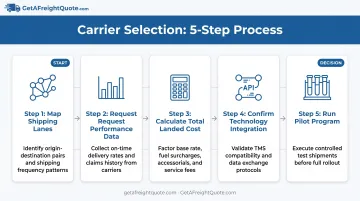
Start with your shipment data, not carrier sales decks. Work through these steps before you commit volume on regional lanes.
Map your shipping lanes Pull 6–12 months of LTL data and plot origin-destination pairs. If 60%+ of volume stays inside one region (Southeast, Mid-Atlantic, Midwest), regional carriers are a strong fit. Rank your top 10–15 lanes by volume and revenue—those are where selection matters most.
Request lane-specific performance data Skip company-wide averages. Ask for on-time delivery, claims ratios, and transit times on your origin-destination pairs. A carrier at 98% nationwide may run 92% on the lane you care about.
Evaluate total landed cost, not base rates A $450 quote with a 15% fuel surcharge, $75 in accessorials, and a 2% damage rate can cost more than a $520 quote with lower fees and fewer claims. Factor in:
- Fuel surcharges (percentage vs. flat fee)
- Accessorials (liftgate, residential, inside delivery, reweigh, reclassification)
- Claims history for your freight class
- Invoice accuracy and audit/recovery potential
Confirm technology integration If you use a TMS, verify EDI/API connectivity, real-time tracking, automated POD retrieval, and proactive exception alerts. Strong digital platforms cut admin work and the hidden cost of managing freight by hand.
Pilot before you commit Move test volume across 2–3 carriers on your core lanes. Track on-time performance, damage rates, invoice accuracy, and response to service issues. Choose from results, not sales promises.
Conclusion
There's no single "best" regional LTL carrier. The right choice depends on your shipping lanes, freight characteristics, and service needs. Southeastern Freight may fit heavy Southeast volume, while A. Duie Pyle covers Mid-Atlantic lanes and a national carrier handles coast-to-coast exceptions.
Most successful shippers run a mix of 2–4 carriers and match each shipment to the provider best suited for that lane.
When you evaluate options, focus on:
- Lane-specific performance data, not base rates alone
- Total landed cost, including accessorials and claims impact
- Pilot shipments measured against clear KPIs
- A carrier mix you revisit as freight patterns change
GetAFreightQuote.com gives you access to 100+ LTL carriers—including regional specialists like Southeastern Freight and Saia plus national providers—in one rate-shopping platform. Compare prices, book, and track without managing separate portals for every carrier. Start comparing rates at GetAFreightQuote.com.
Frequently Asked Questions
What is the difference between a regional LTL carrier and a national LTL carrier?
Regional carriers specialize in specific geographic areas (typically 3-15 states) with dense terminal networks and direct delivery routes. National carriers offer coast-to-coast coverage across 48 states but may have lower density in any given region and route freight through more terminals, adding handling touches.
When should I use a regional LTL carrier instead of a national carrier?
Use regional carriers when you ship consistent volume within their service area and need next-day or second-day delivery. They also fit high-value or damage-prone freight and shippers who want direct carrier relationships over maximum geographic reach.
How do regional LTL carriers price their services?
Regional carriers use the same NMFC freight classification system as national carriers, pricing based on freight class, weight, origin/destination ZIP codes, and accessorial services. They often offer more competitive base rates within their core geography due to higher terminal density and fewer handling touches.
Can regional LTL carriers ship outside their service area?
Most regional carriers partner with other regional or national carriers through interline agreements to extend coverage beyond their direct footprint. However, interline shipments add freight handling touches, increase transit time, and may introduce service inconsistency compared to direct lanes within the carrier's core geography.
What are the typical service areas for major regional LTL carriers?
Common regional coverage patterns include the Southeast (Southeastern Freight, Averitt), Mid-Atlantic and Northeast (A. Duie Pyle, Pitt Ohio, Ward Transport), and Midwest (Dayton Freight). Most regional carriers cover 3-15 contiguous states within their core geography, with interline partnerships extending national reach.
Should I work with a freight broker or TMS to access regional LTL carriers?
Freight brokers and TMS platforms let you compare rates across regional and national carriers instantly, without separate contracts for each provider. Platforms like GetAFreightQuote.com offer access to 100+ carriers through one interface.