But getting a fair LTL rate is harder than it sounds. Freight classification rules are dense, accessorial fees pile up fast, and the carrier market keeps consolidating into fewer, larger players. Small and mid-sized shippers often can't tell if their quote is competitive or padded.
This guide breaks down what LTL actually is, how the hub-and-spoke shipping process works, how it stacks up against full truckload (FTL) and parcel shipping, and how businesses of any size can access the same negotiated rates that large-volume shippers get.
Key Takeaways
- LTL covers freight from 150 to 10,000 pounds, letting shippers split trailer space and costs.
- Freight class, density, distance, and accessorial charges drive LTL pricing, not just shipment weight.
- FTL suits near-capacity or bulky, low-density loads; LTL suits smaller, palletized freight.
- The top 25 U.S. LTL carriers generated $48.175 billion of the $52.828 billion total 2024 market.
- TMS platforms now give small shippers enterprise-grade rates and real-time visibility tools.
What Is LTL Freight Shipping?
LTL exists for a simple reason: not every shipment needs a full trailer. If your freight is too large or heavy for parcel carriers like UPS or FedEx Ground, but doesn't come close to filling a 53-foot trailer, LTL fills the gap.
The industry standard puts LTL freight at roughly 150 to 10,000 pounds, with some carriers extending that range to 20,000 pounds depending on their network and equipment.
FedEx Freight, for example, caps individual LTL shipments at 15,000 pounds, with no single piece or pallet exceeding 4,000 pounds. That's a carrier-specific limit, not a universal industry ceiling, so always confirm weight thresholds with your carrier before booking.
How Shared Trailer Space Works
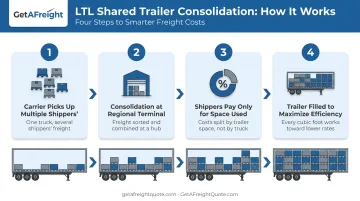
Here's the core mechanism:
- A carrier picks up freight from multiple shippers in a local area
- That freight gets consolidated onto one trailer at a regional terminal
- Each shipper pays only for the square footage and weight their pallets occupy
- The carrier fills out the trailer with other shippers' freight to maximize efficiency
Typical LTL shippers move anywhere from a single pallet up to five or six pallets per shipment. They don't have consistent volume to justify booking an entire truck, so paying for shared space makes far more financial sense.
Terminals and hubs form the backbone of this process. Local pickup trucks bring freight to a nearby terminal, where it's sorted and consolidated with other shipments heading in the same direction. We'll walk through that full process next.
The U.S. LTL market generated $52.828 billion in revenue in 2024, according to SJ Consulting's Top 25 LTL Carriers report, a slight dip from $53.214 billion the year before. That revenue flows almost entirely through the shared-trailer model described above, a structure that runs nothing like full truckload or parcel shipping.
How LTL Freight Shipping Works
LTL runs on a hub-and-spoke network model. Understanding each step helps explain both the cost structure and the transit time variability shippers experience.
The Hub-and-Spoke Journey
- Local pickup — A driver collects your palletized freight from your dock or facility
- Terminal consolidation — Your shipment arrives at a local terminal, where it's weighed, measured, and grouped with freight heading the same direction
- Linehaul transfer — Consolidated freight moves via long-haul trailer to a destination-area terminal
- Destination sort — At the receiving terminal, your freight is separated from the rest of the load
- Final delivery — A local driver completes delivery to the consignee
Each stop adds handling, which is why LTL transit times run longer and less predictable than FTL. Freight might touch two, three, or more terminals before reaching its destination, and each touch ties back to how your shipment is priced, starting with freight classification.
NMFC Classification Determines Your Rate
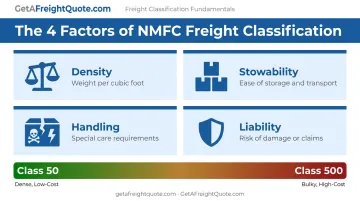
Every LTL shipment gets assigned a freight class, and that class drives your price more than almost anything else. The National Motor Freight Traffic Association maintains 18 classes, ranging from class 50 (dense, easy-to-handle freight) to class 500 (bulky, low-density, high-liability freight).
Classification depends on four factors:
- Density — weight per cubic foot; denser freight typically earns a lower class and cheaper rate
- Stowability — how easily your freight fits alongside other shipments in the trailer
- Handling — special requirements from fragility, hazards, or unusual dimensions
- Liability — exposure to damage, theft, or spoilage
In July 2025, the NMFC expanded its density scale from 11 to 13 subprovisions, shifting roughly 2,000 items onto the updated table. This reflects a shift toward density- and dimension-based pricing, where carriers increasingly measure actual cube rather than relying purely on legacy commodity descriptions. Classification sets your base rate, but accessorial charges can add just as much to your final invoice.
Accessorial Charges Add Up Fast
Beyond the base rate, watch for these common add-ons:
- Liftgate service — needed when there's no loading dock
- Residential delivery — surcharge for non-commercial addresses
- Inside delivery — moving freight beyond the curb or dock
- Limited-access fees — for schools, military bases, or construction sites
These charges are carrier-specific and published in individual tariffs, but they can add hundreds of dollars to a single shipment if not anticipated during booking.
The good news: TMS platforms like GetAFreightQuote.com now give shippers real-time visibility into exactly where freight sits in this multi-stop journey, something that used to be a black box for most small businesses.
LTL vs. FTL vs. Parcel Shipping: Which Is Cheaper?
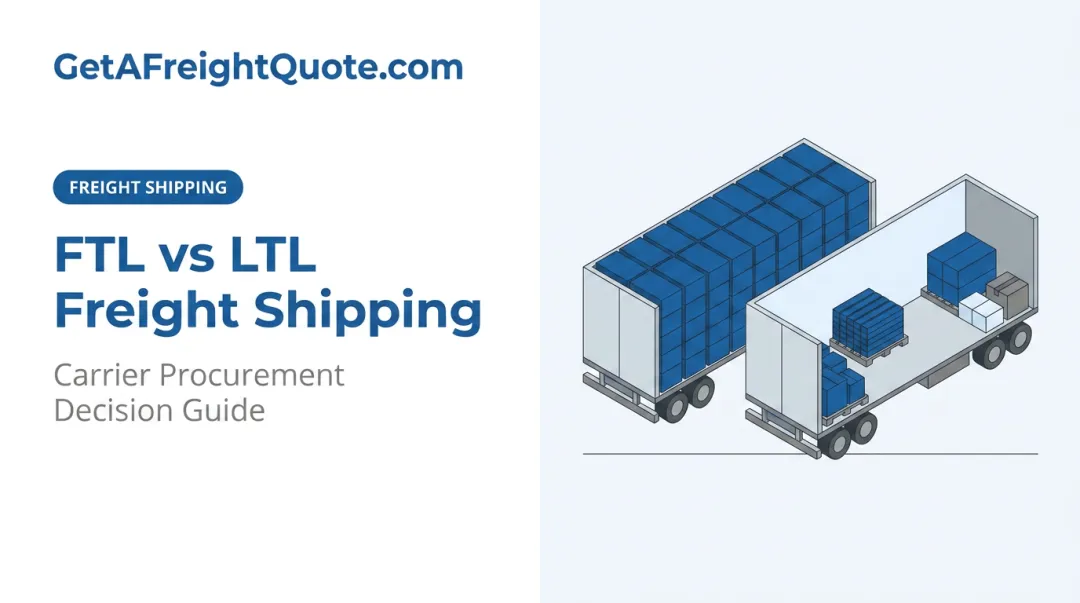
The general rule is straightforward: LTL is cheaper for small shipments, while FTL becomes cost-competitive once freight approaches trailer capacity.
Here's how the three modes stack up:
| Mode | Typical Weight Range | Cost Structure | Speed | Best Use Case |
|---|---|---|---|---|
| Parcel | Under 150 lbs (UPS caps packages at 150 lbs) | Priced per package/dimension | Fastest for small items | Individual boxes, e-commerce orders |
| LTL | ~150–10,000 lbs (up to 15,000–20,000 with some carriers) | Priced by class, density, weight, and space used | 1–5 business days typical, longer on some lanes | 1–6 pallets, no full-truck volume |
| FTL | Near full trailer capacity | Flat rate for the whole truck, regardless of how full | Fastest and most direct | Full pallet loads, time-sensitive freight |
The Density Exception
Weight alone doesn't tell the whole story. If your freight is lightweight but bulky—think patio furniture or foam packaging—it can take up an entire trailer's cube space even if it's well under LTL weight limits. In that scenario, booking a full truck often costs less than paying LTL's density-based penalty for wasted space.
Reliability and Speed Tradeoffs
FTL keeps things simple: a single truck runs a direct route from pickup to delivery, with one point of contact the whole way. Nothing gets touched between pickup and delivery. LTL, by contrast, involves multiple terminal stops and handoffs, which lowers your per-shipment cost but increases variability. DAT notes that FTL is inherently faster because the truck never stops to pick up or drop off other freight along the way.
LTL vs. Parcel for Multi-Piece Shipments
If you're shipping several boxes to one destination, parcel carriers charge per package. Once your piece count or total weight passes a certain threshold, LTL's palletized, single-BOL pricing usually beats stacking individual parcel rates, especially for shipments exceeding a few hundred pounds.
Pros and Cons of LTL Shipping
LTL isn't the right fit for every shipment. Weighing the tradeoffs upfront saves headaches later.
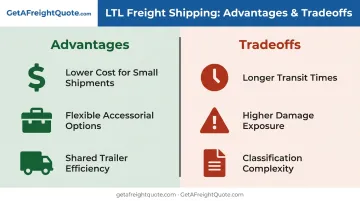
Advantages
- Lower cost for small shipments: you pay only for the space you use, not an entire trailer
- Flexible accessorial options: liftgate, residential, and inside delivery services adapt to your delivery site
- Shared trailer efficiency: consolidating multiple shippers' freight makes better use of available truck capacity than running a half-empty trailer
Tradeoffs
- Longer, less predictable transit: multiple terminal stops mean more opportunities for delay
- Higher damage exposure: freight gets handled more times than a sealed FTL trailer, increasing claims risk
- Classification complexity: incorrect NMFC codes or missing documentation trigger reweighs and reclassification fees
Choosing the right carrier type for your lane helps offset these drawbacks:
- National carriers offer broad network coverage for multi-region shipping
- Regional carriers often deliver faster transit with fewer touches on shorter lanes
- Asset-light providers offer flexibility on unusual or hard-to-serve routes
Matching carrier type to lane characteristics is one of the simplest ways to improve reliability without raising cost.
The LTL Landscape in 2026: Trends and How to Get the Best Rates
The LTL carrier market has consolidated since Yellow Corporation's shutdown in July 2023, which removed a carrier that had handled about 10% of the LTL market, according to FreightWaves' coverage of the closure. Remaining carriers absorbed most of that freight, but the episode accelerated a broader trend: fewer, larger carriers now dominate industry revenue.
That consolidation shows up in 2024 market data, where the top 25 carriers captured $48.175 billion of the $52.828 billion total U.S. LTL market. For small and mid-sized shippers, that concentration has historically meant less negotiating leverage and higher rates than large-volume shippers pay for identical lanes. Fewer carriers controlling more volume also changes how those rates get set day to day.
Dynamic Pricing Is the New Normal
Carriers increasingly price LTL shipments dynamically, adjusting rates based on lane demand, capacity, and competitive conditions rather than static published tariffs alone. A lane that costs $400 to ship this week might jump to $550 next week if capacity tightens or fuel surcharges spike. This shift rewards shippers who can compare rates in real time rather than relying on a single carrier relationship.
Technology Is Closing the Gap
This is where TMS platforms change the equation. GetAFreightQuote.com operates as an authorized reseller of an established TMS platform, giving small and mid-sized businesses the same tools that Fortune 500 shippers have used for years:
- Pre-negotiated carrier rates across 100+ domestic LTL and FTL carriers, with typical savings of 20–50% below standard retail rates
- Side-by-side rate comparison so shippers can weigh price against transit time and service level before booking
- Full invoice transparency with automated auditing that flags unwarranted accessorial charges before payment
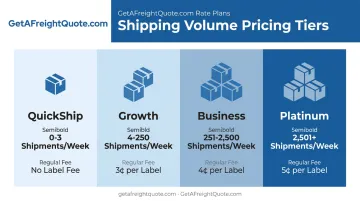
- Tiered pricing starting at QuickShip (0–3 shipments/week, no label fee) up through Platinum (2,501+ shipments/week at 5 cents per label)
For businesses that want a deeper level of support, the company's Managed LTL Services program includes carrier procurement, benchmarking, and a TMS implementation valued at $150,000 to $250,000, provided at no direct cost through an Off-Bill Incentive model paid by carriers rather than the shipper.
The result: businesses no longer need Fortune 500 shipment volume to access enterprise-grade rates and full shipment visibility.
Frequently Asked Questions
What is less-than-truckload (LTL) shipping?
LTL is the transport of freight, roughly 150 to 10,000 pounds, consolidated with other shippers' goods on a single trailer. You pay only for the space and weight your freight occupies, not the full truck.
Is less-than-truckload (LTL) or full truckload (FTL) shipping cheaper?
LTL is generally cheaper for smaller shipments since you split trailer costs with other shippers. FTL becomes more cost-effective as freight nears trailer capacity or involves bulky, low-density goods that eat up cube space.
What is the average LTL freight class?
Freight class ranges from 50 to 500 based on density, handling requirements, stowability, and liability exposure. Most general commercial freight lands somewhere in the middle of that range, though exact class depends on your specific commodity.
How long does LTL shipping typically take?
Transit times typically run 1 to 5 business days domestically, depending on distance and terminal transfers. Some carriers quote up to 10 days for less common lanes, so confirm estimates before booking.
What weight qualifies a shipment for LTL service?
The general industry range is 150 to 10,000 pounds, with some carriers accepting freight up to 15,000 or 20,000 pounds. Keep in mind that low-density, high-cube freight can push a shipment into FTL pricing even below these weight thresholds.
Do I need a freight broker or platform to book LTL shipments?
You can book directly with carriers, but a broker or platform like GetAFreightQuote.com adds leverage: negotiated rates, no hidden accessorial fees, and side-by-side carrier comparisons you likely couldn't get alone.