This guide covers everything you need to know: how to get ABF quotes through multiple channels, the factors that drive ABF pricing, recent rate changes and what they mean for your budget, and how to access better pre-negotiated rates through platforms designed for small and mid-sized businesses.
Key Takeaways
- ABF Freight (owned by ArcBest) ranks 7th among North American LTL carriers with 240 service centers
- Request ABF quotes via ABF’s customer tools, freight brokers, or multi-carrier platforms like GetAFreightQuote.com
- Your quote hinges on freight class, weight, dimensions, lane, accessorials, and current tariff rates
- Rates rose about 5.9% effective June 22, 2026, after a similar 5.9% increase in August 2025
- Multi-carrier platforms help small businesses access negotiated rates typically reserved for high-volume shippers
What is ABF Freight?
ABF Freight is the LTL subsidiary of ArcBest Corporation. It ranks as the 7th largest LTL carrier in North America per Transport Topics' 2026 revenue rankings, up one position from 8th place in 2025.
Network Coverage
ABF operates 240 service centers across all 50 US states, Canada, and Puerto Rico. That footprint reaches major metros and secondary markets smaller carriers often skip, supporting domestic and North American cross-border shipments.
Union Operating Model
ABF is a unionized carrier represented by the International Brotherhood of Teamsters under the ABF National Master Freight Agreement, running through June 30, 2028. The contract sets nationally bargained wages, benefits, and work terms, with annual wage increases and limited regional adjustments.
Union labor affects carrier cost models, but the impact on your rates still depends on contract terms, lane, and shipping volume.
How to Get ABF Freight Quotes
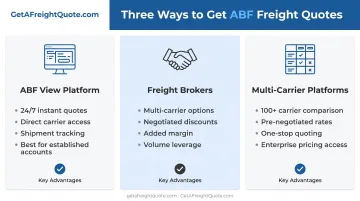
Getting Quotes Through ABF's View Platform
ABF's official View platform provides direct access to instant LTL quotes 24/7. Enter pickup and delivery details, handling-unit type and quantity, dimensions, weight, and any special services. Full field requirements are listed below.
Benefits of View:
- Get instant pricing without phone calls or callbacks
- Book, manage, and track shipments in one platform
- Quote after hours when carrier sales desks are closed
- Work directly with the carrier on service issues
View works best for shippers with established ABF accounts or those willing to accept published tariff rates with standard discounts. Small-volume shippers may find that View quotes reflect higher base rates compared to what high-volume shippers or brokers can secure.
Getting Quotes Through Freight Brokers
Freight brokers can provide ABF quotes alongside other carriers, often with negotiated discounts not available when going direct. Brokers aggregate shipping volume across their entire customer base, using that leverage to negotiate better base rates than individual low-volume shippers could obtain.
The Trade-off: Brokers add a margin to carrier rates, but that margin may still deliver a better net price than your direct rate, especially if you ship fewer than 10–20 LTL loads per week. The key is understanding whether the broker's negotiated base rate plus their margin beats your direct pricing.
Getting Quotes Through Multi-Carrier Platforms
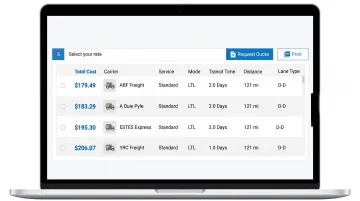
Transportation Management System (TMS) platforms and freight quoting services let you compare ABF against multiple carriers side-by-side with one quote request. GetAFreightQuote.com, for example, returns instant ABF Freight quotes alongside 100+ national and regional LTL carriers such as Old Dominion, XPO, Estes, and Saia.
Key advantages:
- Save time with one form instead of visiting multiple carrier sites
- Compare price and transit time across carriers in a single view
- Access pre-negotiated rates typically reserved for Fortune 500-level volumes
- Add your own ABF account next to platform rates so you always see the best price
Platforms like GetAFreightQuote.com also eliminate the need to manage multiple carrier relationships, logins, and billing systems while maintaining full visibility into your shipping costs.
Required Information for Accurate Quotes
To obtain accurate ABF quotes and avoid costly reweigh or reclassification charges, you'll need:
- Pickup and delivery ZIP codes and location types (dock, residential, limited access)
- Shipment date (affects fuel surcharges and capacity availability)
- Total weight per handling unit and shipment total
- Freight class or sufficient detail (dimensions and commodity description) for class determination
- Dimensions (length × width × height) of each handling unit
- Special services: Liftgate, inside delivery, residential, limited access, appointment delivery, etc.
Critical: Accuracy matters. If ABF reweighs your shipment or reclassifies your freight at pickup, you'll face a $55 adjustment fee plus the difference in freight charges when the correction changes your invoice by at least $10.
What Affects ABF Freight Pricing?
Freight Class and NMFC Codes
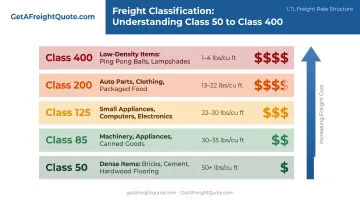
The National Motor Freight Classification (NMFC) system assigns classes from 50 to 500 based on density, handling, stowability, and liability.
ABF uses freight class as a primary rating factor. Higher classes—lower density, more fragile, or harder to handle—carry higher per-pound rates.
Common classification examples:
- Class 50: Dense, compact freight (bricks, cement)
- Class 85: Crated machinery, refrigerators
- Class 125: Small household appliances
- Class 200: Auto parts, clothing on hangers
- Class 400: Deer antlers (seriously)
Incorrect classification is the most common cause of unexpected charges. If you're uncertain about your freight class, provide accurate dimensions and commodity details so carriers can determine the correct class before pickup.
Weight and Density
Weight affects pricing in two ways. Total shipment weight sets your rate bracket, and density (pounds per cubic foot) helps determine freight class.
Heavier shipments usually lower the per-pound rate. That benefit shrinks if the freight is light for its size and rates into a higher class.
Density calculation:
Density = Weight (lbs) ÷ Cubic feet
Cubic feet = (Length × Width × Height in inches) ÷ 1,728
If your freight weighs 500 lbs and occupies 25 cubic feet, your density is 20 lbs/cu ft, which typically falls into Class 100 or 125 depending on the commodity.
Dimensions and Linear Foot Rules
ABF's tariff includes multiple dimension-based rules that affect pricing:
Over-dimensional charges: ABF adds fees when at least one article exceeds these length thresholds:
- 8–10 feet: $375 per shipment
- 11–13 feet: $700 per shipment
- 14–19 feet: $950 per shipment
- 20–27 feet: $1,450 per shipment
Capacity loads: Shipments using at least 24 linear feet and at least 5 linear feet of width rate as capacity loads under separate rules. When freight takes that much trailer space, space—not just weight—drives the charge.
Cubic minimum: ABF calculates cubic capacity for very low-density shipments by dividing total cubic inches by 1,728. If this cubic minimum exceeds your class-based rate, the cubic minimum becomes your linehaul charge.
Lane and Distance
Distance matters, but lane balance often matters more. Backhaul lanes (more freight leaving than arriving) often price lower than similar-distance headhaul lanes where capacity is tight.
Chicago to Atlanta, a relatively balanced lane, may cost less per mile than Los Angeles to Boise, a headhaul lane where trucks often return empty. Seasonal demand, economic conditions, and regional manufacturing patterns keep these dynamics moving.
Accessorial Charges
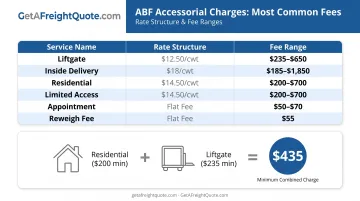
ABF's current tariff (ARC 111-J, effective June 22, 2026, revised August 12, 2026) lists exact accessorial charges:
| Service | Charge |
|---|---|
| Liftgate | $12.50/cwt; $235 minimum, $650 maximum per occurrence |
| Inside pickup/delivery | $18/cwt; $185 minimum, $1,850 maximum per occurrence |
| Residential delivery | $14.50/cwt; $200 minimum, $700 maximum per shipment |
| Construction site/limited access | $14.50/cwt; $200 minimum, $700 maximum per shipment |
| Arrival notification | $73 per notification |
| Appointment delivery | $70 (two-hour window); $63, $56, or $50 for wider windows |
| Reweigh/reclassification | $55 when corrected weight or class changes charges by $10+ |
These charges add up quickly. A residential delivery with liftgate service on a 500-lb shipment (5 cwt) would incur $235 (liftgate minimum) + $200 (residential minimum) = $435 in accessorials before considering linehaul charges.
Fuel Surcharges and Market Conditions
ABF applies fuel surcharges as a percentage of linehaul charges based on the U.S. National Average Fuel Index. The percentage updates weekly (effective Wednesday through Tuesday) and appears as a separate line item on your freight bill. Fuel surcharges typically do not apply to accessorial charges.
General rate increases (GRIs) change published tariff rates, but your bill depends on contract terms.
Percentage-off-tariff contracts feel GRIs in proportion to the increase. Flat per-cwt contracts usually stay put until renewal.
Market conditions add another layer beyond published rates: demand, capacity, seasonal peaks, and economic cycles. Tight periods (holidays, harvest, back-to-school) push spot rates up. Softer demand often brings sharper competitive pricing.
ABF Freight Rates and Recent Changes
ABF announced an increase of about 5.9% to general LTL rates and charges effective June 22, 2026. This follows a similar 5.9% increase effective August 4, 2025. Back-to-back GRIs show ABF is holding firm on price even when freight demand is uneven.
What this means for shippers
The 5.9% figure represents the average increase to ABF's published tariff rates. Your actual cost impact depends on several factors:
- Contract structure: Fixed-percentage discounts pass the 5.9% through proportionally; negotiated flat rates often stay put until renewal
- Lane-specific effects: Some lanes take larger increases; others get smaller adjustments based on market conditions
- Accessorial changes: The tariff update also revised some accessorial charges and rules
- Fuel fluctuations: Separate from the GRI, weekly fuel surcharges still move with diesel prices
Small shippers on standard discount agreements usually feel increases close to the published GRI. High-volume shippers with custom contracts often see little change until the next annual negotiation.
After a GRI, compare ABF against other LTL carriers on your lanes to confirm your discount still holds up.
How to Get Better LTL Rates Than ABF's Standard Pricing
Understanding Your Options Beyond Direct Carrier Pricing
Small and mid-sized businesses typically get weaker rates going direct to carriers because of low shipping volume. Carriers tier pricing by annual freight spend and shipment frequency.
They reserve the most aggressive rates for customers shipping 50+ loads per week and charge higher base rates to occasional shippers. You pay more per shipment simply because you ship less—even when class, weight, dimensions, and lane match a high-volume shipper's freight.
Using Pre-Negotiated Carrier Rates Through TMS Platforms
Authorized TMS resellers aggregate demand across their customer base and unlock carrier rates usually reserved for high-volume shippers. GetAFreightQuote.com, for example, gives small businesses enterprise-grade TMS technology plus pre-negotiated rates across ABF Freight and more than 100 other national, regional, and local LTL carriers.
What that unlocks:
- Multi-carrier comparison: Compare ABF against Old Dominion, XPO, Estes Express, Saia, and others with one quote request
- Instant rate shopping: View live carrier rates and transit times side by side in seconds
- Negotiated pricing: Access rates negotiated at volumes you couldn't achieve individually
- Full transparency: See every rate before booking with no hidden fees or callback-based quoting
- Flexible account integration: Add your own ABF or other carrier accounts alongside platform rates to ensure least-cost routing
The platform typically replaces a $150,000–$250,000 standalone TMS investment, making enterprise logistics technology accessible at small-business pricing. Platform fees range from no charge (QuickShip tier, 0–3 shipments/week) to 5¢–9¢ per label based on weekly volume—disclosed upfront, not buried in carrier rates.
Comparing Multiple Carriers Instead of Single-Sourcing
Loyalty to a single carrier may simplify vendor management, but it often costs more than rate shopping each shipment. Different carriers win different lanes based on network density, terminal locations, and market position.
ABF may offer the best price and transit time on your Chicago-to-Dallas lane, while a regional carrier beats ABF on Portland-to-Seattle. Multi-carrier platforms make that comparison practical without juggling separate logins, relationships, and billing systems.
GetAFreightQuote.com's TMS centralizes quoting, booking, tracking, and documentation across your carrier portfolio and automatically flags the least-cost option for each shipment.
Optimizing Shipment Characteristics for Better Rates
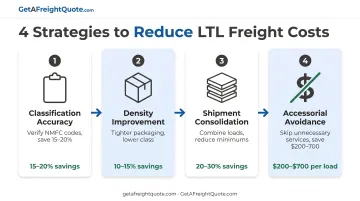
Even with the best carrier rates, you can reduce costs further by how you prepare and present freight:
- Classification accuracy: Verify freight class with NMFC guidelines and real dimensions. Fixing Class 125 to Class 100 can cut linehaul 15%–20% and avoid the $55 reclass fee.
- Density improvement: Tighter packaging raises density and can drop your class. Packaging choices change density—and your invoice. Palletize loose cartons and cut void space to move Class 125 freight toward Class 100.
- Shipment consolidation: Combine small shipments when you can. LTL minimums and higher per-pound rates at low weights mean three 200-lb shipments often cost more than one 600-lb shipment to the same destination.
- Accessorial avoidance: Skip services you do not need. Dock access can eliminate liftgate ($235–$650); business-hours delivery can avoid residential charges ($200–$700). Small cuts add up across shipments.
Frequently Asked Questions
How can I get a quote for ABF Freight?
You can get ABF quotes three ways: ABF's View platform for 24/7 online quoting; freight brokers with negotiated ABF discounts; or multi-carrier platforms like GetAFreightQuote.com that compare ABF against 100+ LTL carriers side by side.
How much is ABF Freight?
ABF rates depend on freight class, weight, dimensions, lane, and accessorials. A 500-lb Class 100 shipment from Chicago to Dallas might run $300–$600 depending on services and your discount level—get lane-specific quotes for accurate pricing.
What is the ABF Freight tariff for 2026?
ABF's published tariff (ARC 111-J) increased about 5.9% effective June 22, 2026 (latest revision August 12, 2026). Most shippers pay negotiated discounts, not full tariff. The full tariff is on ABF's website.
What is a good freight quote?
A good quote pairs competitive total delivered cost with clear fees, realistic transit times, and a carrier that runs on time with low damage rates. Compare full cost—not just linehaul—and confirm transit times match your delivery commitments.
Is ArcBest an LTL carrier?
ArcBest is the parent company of ABF Freight, the LTL carrier. It also offers truckload brokerage, expedited, and final-mile services through other units. For LTL quotes and pricing, focus on ABF Freight specifically.
What does ABF stand for?
ABF originally stood for Arkansas Best Freight, after its 1923 founding in Fort Smith, Arkansas. Today ABF is simply the brand name and no longer expands as a formal corporate title.