This pricing gap isn't just frustrating; it's a competitive disadvantage. Over two-thirds of mid-size to large organizations surveyed by Pitney Bowes in 2023 admitted they don't negotiate custom carrier rates, often citing insufficient shipment volume. If established companies struggle to secure better terms, small businesses face an even steeper challenge.
This guide explains how shipping procurement works, why it matters, and how small businesses can use technology and strategy to access carrier rates and tools once available only to Fortune 500 companies.
Key Takeaways
- Strategic procurement cuts costs, locks in peak-season capacity, and builds reliable carrier relationships
- Small businesses offset low volume with TMS platforms that offer pre-negotiated rates and aggregated buying power
- Transparent rate comparison eliminates hidden fees such as fuel surcharges, liftgate charges, and detention
- Technology automates quoting, booking, tracking, and invoice auditing—saving time and cutting errors
- A mix of 3–5 carriers provides backup capacity and keeps pricing competitive
What is Shipping Procurement?
Shipping procurement is the process of sourcing, negotiating, and managing transportation services so goods move at the right cost and service level. It is more than calling a carrier when a shipment is ready. You analyze demand, compare modes and carriers, lock in terms, and track performance over time.
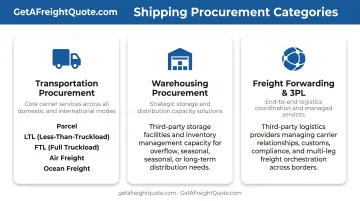
Core categories typically include:
- Transportation procurement – Carrier contracts for parcel (UPS, FedEx, USPS), LTL, full truckload (FTL), air, and ocean freight
- Warehousing procurement – Storage and distribution capacity when you need it
- Freight forwarding and 3PL – Third-party coordination of carriers, warehousing, and customs
For most small and mid-sized businesses, transportation procurement is the main lever. It drives per-shipment cost, reliability, and your ability to scale in peak seasons.
Why Shipping Procurement Matters for Small Businesses
Poor shipping procurement leads to inflated costs, unpredictable service, and competitive disadvantage.
When you're booking shipments reactively—calling carriers as orders arrive—you're accepting whatever rates and service levels are offered that day. That ad-hoc approach makes budgeting difficult and leaves you exposed when peak season capacity tightens.
Carriers also price on volume, so small shippers start behind. A company moving 10,000 packages a month gets better per-package rates than one shipping 100. The same gap shows up in technology: according to FreightWaves, TMS adoption in 2022 was only 10% for small shippers, versus 25% for medium-size shippers and about 50% for large shippers.
Strategic procurement levels this playing field by:
- Securing better rates through pre-negotiated contracts or technology platforms that pool volume across multiple shippers
- Ensuring capacity during holidays, e-commerce rushes, and seasonal peaks when spot-market rates spike
- Building carrier relationships that deliver consistent service, priority handling, and accountability when issues arise
- Providing cost transparency so you can budget accurately and identify where fees are eating into margins
The Shipping Procurement Process Explained
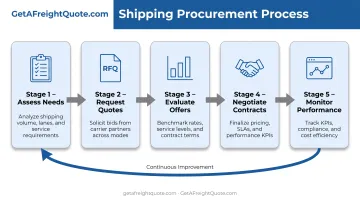
Assess Shipping Needs and Requirements
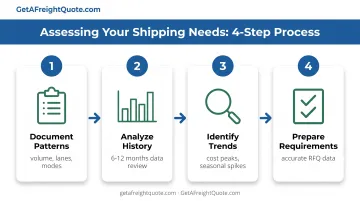
Start by documenting your shipment patterns. Capture:
- Average monthly volume
- Most common lanes (origin-destination pairs)
- Preferred modes (parcel, LTL, FTL, air, ocean)
- Special handling needs (refrigeration, hazmat, white-glove delivery)
Review 6–12 months of historical data to spot trends:
- Which lanes account for the highest costs?
- Do you experience seasonal volume spikes?
- What percentage of shipments require accessorials like liftgate service or residential delivery?
- How often do you need expedited transit versus standard ground?
Use that picture of your freight to request accurate quotes and negotiate commitments you can actually keep.
Request Quotes and Proposals (RFQ/RFP)
Approach carriers or freight brokers with detailed requirements. The more specific your information, the more competitive and accurate the proposals you'll receive.
Include these details in your RFQ:
- Shipment volume by mode and lane
- Package dimensions, weights, and freight classes
- Service-level expectations (standard, expedited, guaranteed)
- Contract duration (annual, multi-year)
- Special requirements (insurance, tracking, appointment delivery)
- Volume commitments you're willing to make in exchange for better rates
For small businesses, freight brokers or a TMS platform like GetAFreightQuote.com simplify this step by returning multiple carrier quotes at once, so you don't have to contact each carrier individually.
Evaluate and Compare Offers
Don't choose based solely on the lowest base rate. Carriers structure pricing differently, and what looks cheapest upfront may cost more after fees.
Evaluate these criteria:
- Price – Base rate plus all surcharges and accessorials
- Reliability – On-time delivery percentage and claims history
- Transit times – How quickly shipments move on your key lanes
- Service coverage – Geographic reach and mode availability
- Technology integration – API connections, tracking visibility, electronic documentation
- Total landed cost – The complete expense from origin to final destination
Total landed cost includes product cost, freight, duties, insurance, customs, handling, fuel surcharges, packaging, loading/unloading, and documentation. Armstrong defines this methodology as the true measure of shipping expense and the fairest way to compare carriers.
Negotiate Terms and Finalize Contracts
Small businesses can negotiate better terms even without Fortune 500 volume by applying these strategies:
- Multi-year agreements – Commit to longer terms in exchange for rate stability and annual caps on increases
- Volume commitments – Promise a minimum monthly or annual volume to secure tiered discounts
- Rate caps – Negotiate maximum annual rate increases (e.g., CPI + 2%)
- Bundling services – Combine parcel and LTL with one carrier to increase your total volume leverage
- Performance clauses – Include penalties for missed service commitments or quality thresholds
Common contract types:
- Fixed rates – Locked pricing for the contract term; predictable but may be higher initially
- Spot market rates – Real-time pricing based on current capacity; flexible but volatile
- Index-linked pricing – Rates adjust based on diesel fuel indexes or other market indicators
Monitor Performance and Manage Relationships
Procurement doesn't end when you sign a contract. Track carrier performance continuously to ensure you're receiving the service and rates you negotiated.
Monitor these KPIs:
- On-time delivery percentage by carrier and lane
- Damage and loss claim rates
- Invoice accuracy and billing errors
- Carrier responsiveness to service failures
- Rate changes versus contract terms
Conduct quarterly business reviews with your primary carriers to discuss performance, address issues, and identify cost-reduction opportunities. Poor performance or market changes may justify renegotiating terms or switching carriers mid-contract.
Common Challenges in Shipping Procurement
Challenge 1: Lack of Volume Leverage
Small businesses lack the shipment volume to command the steep discounts large shippers receive. While exact premiums vary by carrier and lane, the gap is significant enough that many small shippers feel priced out of competitive markets.
Overcome this by:
- Using TMS platforms that pool volume across hundreds of users to negotiate enterprise-level rates
- Joining buying groups or freight cooperatives that aggregate shipments
- Committing to longer contract terms or modest volume minimums in exchange for better pricing
- Partnering with 3PLs who combine your freight with other customers' shipments
Challenge 2: Hidden Costs and Fee Surprises
Base rates tell only part of the story. Carriers add surcharges and accessorial fees that can double or triple the quoted price.
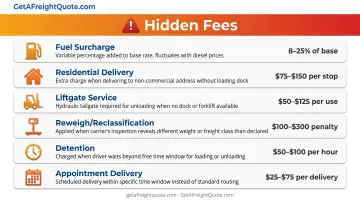
Common hidden fees include:
- Fuel surcharges – Weekly adjustments tied to diesel indexes
- Residential delivery – Extra charges for non-commercial addresses
- Liftgate service – Fees for hydraulic liftgate use at pickup or delivery
- Reweigh and reclassification – Penalties when actual weight or freight class differs from the bill of lading
- Detention – Charges when your facility delays loading or unloading beyond free time
- Appointment delivery – Fees for scheduling specific delivery windows
Old Dominion's tariff, for example, shows how fast accessorials add up:
- Detention: $3.00 per minute after free time (minimum $50 per shipment)
- Liftgate service: $4.40 per hundredweight (minimum $105, maximum $330)
- Residential delivery: $7.20 per hundredweight (minimum $115, maximum $580)
Solution: Use platforms that display total landed cost upfront, including all accessorials, before you book. This transparency eliminates billing surprises and lets you compare true costs across carriers.
Challenge 3: Limited Carrier Options and Capacity Constraints
Small shippers often maintain relationships with just one or two carriers, leaving them vulnerable when capacity tightens. During peak seasons (holidays, back-to-school rushes, harvest periods), carriers prioritize high-volume customers. Small shippers then struggle to secure space or face steep premiums.
Mitigate capacity risk by:
- Building relationships with 3–5 carriers across multiple modes
- Forecasting volume weeks or months ahead and reserving capacity early
- Using freight brokers or TMS platforms with access to 100+ carrier networks
- Diversifying between national, regional, and local carriers to access different capacity pools
Challenge 4: Time-Consuming Manual Processes
Manual shipping work eats hours every week: requesting quotes by email or phone, waiting on replies, comparing inconsistent proposals, booking freight, printing labels, tracking packages, and reconciling invoices.
For small businesses without dedicated logistics staff, that busywork pulls time away from selling and serving customers.
Automation solves this by:
- Providing instant multi-carrier rate comparisons in one screen
- Enabling self-service booking and label printing 24/7
- Tracking all shipments across carriers in a unified dashboard
- Auditing invoices automatically to catch billing errors and overcharges
Challenge 5: Difficulty Comparing Rates Across Carriers
Carriers structure pricing differently. One might offer a low base rate but charge high residential fees. Another might bundle fuel surcharges while a competitor itemizes them separately. Without standardized formats, comparing proposals accurately is nearly impossible.
Transportation Insight reports that freight invoice audits typically find errors in 3%–6% of invoices, most commonly from accessorial charges and misapplied discounts. Catching and resolving these errors can protect 1%–5% of total freight spend.
Solution: Use technology that normalizes rate structures and displays total cost per shipment, making apples-to-apples comparisons straightforward.
Best Practices for Effective Shipping Procurement
Strong shipping procurement rests on four habits: know your data, spread carrier risk, price the full cost, and use the right technology.
Practice 1: Analyze Your Shipping Data
Track historical shipment patterns over 6–12 months. Calculate average costs per lane, identify where you're overspending, and determine which carriers perform best on your most important routes.
Key metrics to track:
- Cost per shipment by lane, mode, and carrier
- On-time delivery rates by carrier
- Claims frequency and resolution time
- Accessorial fee trends over time
Use this data during negotiations to demonstrate volume, identify pricing anomalies, and justify requests for better rates or terms.
Practice 2: Diversify Your Carrier Mix
Avoid over-reliance on a single carrier. Maintain active relationships with 3–5 carriers across modes to ensure backup capacity and create competitive pricing pressure.
Supply Chain Dive reported that in December 2024, the average number of carriers per company account was 5.74 for parcel shippers. Your ideal count will differ, but diversity protects against service disruptions and strengthens bargaining power at contract renewals.
Practice 3: Prioritize Total Cost, Not Just Base Rate
The lowest base rate may come with expensive accessorials that push the final cost above a competitor's higher base rate. Calculate total landed cost, including all fees, surcharges, and accessorials, before making decisions.
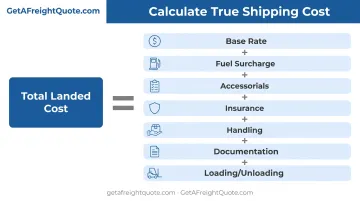
Total landed cost formula (freight-relevant components):
Base rate + fuel surcharge + accessorials (liftgate, residential, detention, etc.) + insurance + handling + documentation + loading/unloading
This approach reveals the true expense of each carrier option and prevents budget surprises.
Practice 4: Use Technology and TMS Platforms
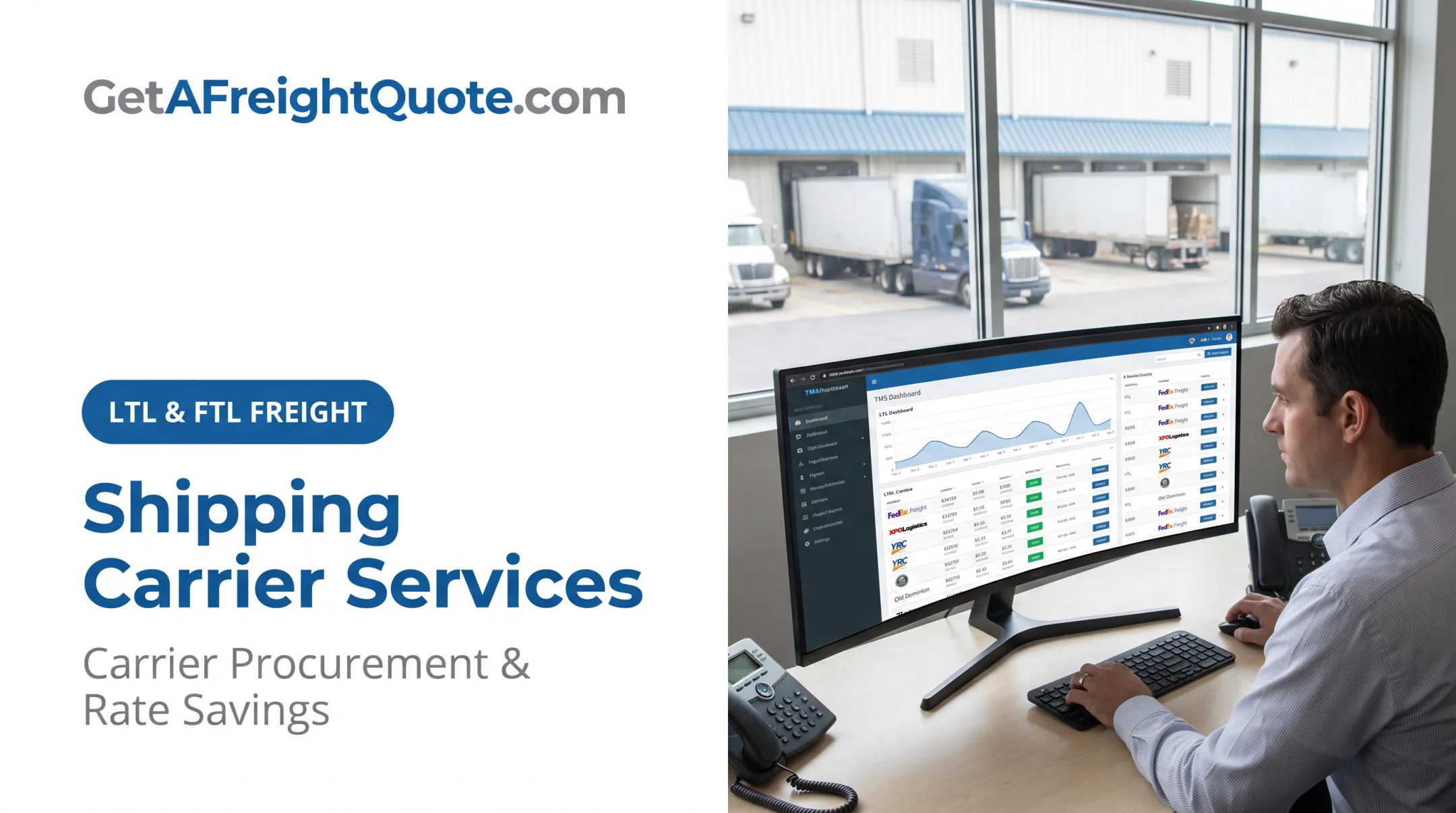
Modern Transportation Management Systems provide instant rate comparisons, pre-negotiated carrier contracts, shipment tracking, and invoice auditing. Those capabilities were once limited to enterprise shippers. Nucleus Research found that TMS platforms cut transportation spending by an average of 11% in 2023.
GetAFreightQuote.com offers authorized access to TMS technology and Fortune 500-negotiated carrier rates, with typical savings of 20–50% below retail pricing. The platform is self-funded by the savings it creates: customers pay a small per-label fee (5–9 cents depending on volume) instead of the $150,000–$250,000 software investment those tools usually require.
How Technology Transforms Shipping Procurement
Transportation Management Systems automate every stage of procurement, eliminating manual work and providing visibility that was impossible before cloud platforms.
The National Motor Freight Traffic Association (NMFTA) defines a TMS as software that helps plan, execute, and optimize the physical movement of goods. That coverage includes procurement, carrier selection, route planning, load consolidation, electronic tendering, GPS tracking, and freight settlement.
Core TMS capabilities:
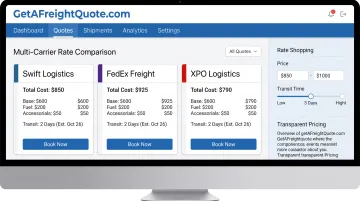
- Real-time rate shopping – Compare parcel, LTL, and FTL rates across 100+ carriers by price, transit time, and service level
- Transparent pricing – See fuel surcharges, accessorials, and handling charges upfront before booking
- Multi-carrier booking – Reserve shipments, print labels, and tender freight electronically
- Automated tracking – Monitor every shipment across all carriers in one dashboard
- Invoice auditing – Flag billing errors, duplicate charges, and misapplied discounts automatically
- Performance analytics – Track on-time delivery, cost per lane, carrier reliability, and savings trends
GetAFreightQuote.com's TMS platform is self-funded by the savings it generates, requiring no upfront investment. Customers can connect their own UPS, FedEx, or LTL accounts and compare those negotiated rates against GetAFreightQuote.com's rates on every shipment.
The "bring your own rates" feature preserves existing carrier relationships while ensuring you always select the lowest-cost option.
Market growth confirms the shift to technology-enabled procurement:
Berg Insight forecasts that the North American TMS market will grow from about $1.9 billion in 2024 to nearly $3.2 billion by 2029, an 11.2% compound annual growth rate. Cloud-based platforms give businesses of any size access to advanced logistics tools without enterprise budgets.
Frequently Asked Questions
What are the main stages of shipping procurement?
Shipping procurement typically follows five steps: assess needs and volume, request carrier or broker quotes, evaluate total landed cost and service quality, negotiate contract terms, then monitor performance and manage the relationship.
What are the three main types of shipping procurement?
The three types are transportation (parcel, LTL, FTL, air, ocean), warehousing (storage and distribution centers), and freight forwarding or 3PL services that coordinate carriers, facilities, customs, and documentation for you.
How can small businesses compete with large shippers on rates?
Use TMS platforms that aggregate volume across many shippers to unlock enterprise-level carrier rates. Join buying groups or freight cooperatives, consolidate shipments to raise per-carrier volume, and commit to longer terms for better pricing and rate caps.
What are the biggest challenges in shipping procurement?
Limited volume weakens negotiating power and drives higher rates. Hidden fees like fuel surcharges, liftgate, detention, and reweigh charges cause budget overruns when not disclosed upfront. Manual quoting, booking, and tracking also pull time away from core work.
How does technology improve shipping procurement?
TMS platforms automate multi-carrier rate comparison, display transparent all-in pricing before booking, enable real-time shipment tracking across carriers, and deliver performance analytics that identify cost-reduction opportunities. Invoice auditing catches billing errors automatically, protecting 1%–5% of freight spend from overcharges.
What should I look for in a shipping procurement partner?
Look for transparent pricing with no hidden fees, pre-negotiated carrier rates that deliver real savings, easy-to-use technology, responsive support, and a platform that scales with your business without forced upgrades or repricing.