The distinction runs deeper than paperwork. It determines who controls carrier selection, who negotiates the rate, and who absorbs the financial risk if something goes wrong mid-shipment.
This guide defines both terms, compares them side by side, and helps you decide which arrangement fits your shipping strategy — whether you're a small business shipping direct-to-consumer or a distributor managing retailer routing guides.
Key Takeaways
- Freight collect means the consignee pays and typically controls carrier choice.
- Freight prepaid means the shipper pays and controls routing.
- The Bill of Lading legally designates who pays; an incorrect mark risks rebilling fees and delivery disputes.
- Consignees aren't automatically off the hook under collect terms; federal law can still assign them liability.
- Many businesses run a hybrid model: prepaid for retail or D2C orders, collect for high-volume enterprise accounts.
Freight Collect vs Freight Prepaid: Key Differences at a Glance
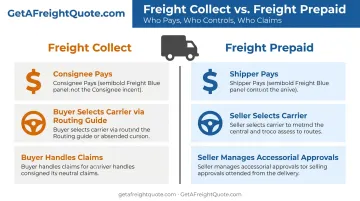
In simplest terms: freight collect means the receiver pays; freight prepaid means the shipper pays. But payment responsibility also decides who picks the carrier and manages routing, not just who gets the invoice.
Per Old Dominion Freight Line's official BOL guide, "Collect" means the freight invoice goes to the consignee, while "Prepaid" means it goes to the shipper. That's the whole distinction at the carrier level. Everything else (routing control, claims handling, accessorial approvals) flows from that one designation.
The BOL itself is the legal record of this arrangement. Mark it wrong, and the carrier may bill the wrong party, triggering a correction request, a rebilling fee, and a delayed payment cycle for everyone involved.
Quick Comparison
| Factor | Freight Collect | Freight Prepaid |
|---|---|---|
| Who pays | Consignee/receiver, upon delivery | Shipper/consignor, before or at shipment |
| Who controls carrier & routing | Buyer selects carrier, often via a routing guide | Seller selects carrier, manages pickup and scheduling |
| Risk & documentation | Buyer is bill-to party; handles claims and disputes | Seller is bill-to party; manages accessorial approvals |
Notice that payment and control travel together. A buyer that pays collect freight usually has the leverage, plus the routing guide, to dictate which carrier moves the shipment.
What Is Freight Collect?
Freight collect means the consignee (the receiver) is responsible for paying freight charges and any ancillary fees upon delivery. You'll sometimes hear it called "collect upon delivery," though that phrasing can mislead people into confusing it with cash-on-delivery (COD).
It isn't the same thing. Official carrier routing guides list freight collect as a standard billing designation while separately rejecting COD as an accepted payment method entirely. Collect describes who gets billed, not how the payment is physically exchanged.
Operationally, freight collect shifts cost control to the buyer. That's useful when the buyer has better rates. But it also requires the shipper to trust that the consignee will actually settle the bill.
Pros and Cons of Freight Collect
- Pro: Gives the receiver more control over final shipping cost, especially valuable if they hold strong carrier contracts or volume discounts.
- Pro: Separates payment for goods from payment for freight, improving cash flow flexibility for whichever party manages the transaction.
- Con: Introduces payment risk for the shipper. There's no guarantee the consignee pays on delivery, which can mean storage costs or a collection dispute.
That risk isn't just theoretical. Under 49 U.S. Code § 13706, a consignee can be held liable for freight charges billed at delivery, even charges discovered later, unless it gave the carrier written notice, before delivery, stating it acted only as an agent without beneficial ownership.
Marking a shipment "collect" doesn't automatically release the shipper from exposure if the consignee disputes or defaults on payment.
When to Choose Freight Collect
Freight collect works best when the buyer has stronger carrier rates or an established routing guide, common with large retailers and distributors that run formal vendor compliance programs.
Example: A vendor shipping to a big-box retailer that mandates freight collect terms and requires use of its assigned carrier is a textbook case. The retailer's volume gives it better rates than most individual suppliers could negotiate on their own.
What Is Freight Prepaid?
Freight prepaid flips the arrangement: the shipper (or consignor) is responsible for paying all freight charges and additional fees. A close cousin, "Prepaid & Add," means the seller pays the carrier directly, then adds that freight cost to the buyer's commercial invoice as a reimbursement, not a separate carrier bill.
Operationally, this puts the seller in the driver's seat. They pick the carrier, manage scheduling, and control the pickup process. For the customer, that simplifies the buying experience considerably: one invoice, no surprise carrier charges.
Pros and Cons of Freight Prepaid
- Pro: Builds trust with new or smaller customers by bundling freight into a single, predictable invoice.
- Pro: Often paired with FOB Destination terms, meaning the seller retains liability until delivery, which matters for fragile or high-value goods.
- Con: The seller absorbs cash-flow risk if unexpected accessorial charges (think liftgate fees or residential surcharges) surface mid-transit that weren't part of the original quote.
That last point matters more than it looks. A seller quoting freight prepaid needs visibility into likely accessorial costs before committing, not after the shipment is already moving.
When to Choose Freight Prepaid
Freight prepaid fits best when the shipper has negotiated better freight rates than the customer and wants control over service level and delivery timing.
Example: A small business shipping direct-to-consumer often wants a frictionless buying experience, with freight built into the product price rather than billed separately.
Tools like GetAFreightQuote.com's Parcel Rate Shopping Tool help smaller operations compare UPS, FedEx, and USPS rates side by side. That way, bundling freight into the price doesn't mean quietly eating a bad rate.
Freight Collect vs Prepaid: Which One Should You Choose?
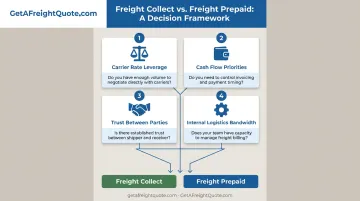
The decision comes down to four factors:
- Carrier rate leverage: who has negotiated the better deal?
- Cash flow priorities: can you absorb freight cost upfront, or do you need it billed elsewhere?
- Trust between shipper and receiver: will the other party actually pay?
- Internal logistics bandwidth: do you have the staff to manage carrier selection and claims?
Beyond these four factors, documentation accuracy deserves its own callout. The BOL must clearly state "Prepaid" or "Collect," because an incorrect designation causes both confusion and added cost.
XPO's 2025 tariff, for example, charges $47.35 for a corrected Bill of Lading, requiring a written request, consignee authorization, and action within 30 days. Old Dominion charges a similar $40 fee, and neither amount is a rounding error across dozens of monthly shipments.
Situational recommendation:
- Choose freight collect if the buyer has stronger rates and wants routing control.
- Choose freight prepaid if you want to control carrier selection and deliver a smoother customer experience.
Many businesses don't pick one and stick with it forever. A hybrid approach is common: prepaid for retail or small accounts, collect for high-volume enterprise customers, depending on individual contracts and buyer routing requirements.
Rate transparency makes this decision easier. GetAFreightQuote.com gives small and mid-sized shippers access to negotiated, enterprise-level carrier rates, plus the ability to add existing carrier accounts for direct comparison.
That means a business can offer freight prepaid terms without losing cost competitiveness, or benchmark a buyer's proposed collect terms before signing off. For enterprise shippers weighing this at scale, Managed LTL Services adds benchmarking, TMS visibility, and ongoing governance to guide that call lane by lane.
Other Freight Payment Terms You Should Know
Freight collect and prepaid aren't the only designations you'll encounter on a BOL. A few related terms are worth knowing:
- Third-Party Freight: A logistics broker or 3PL pays instead of the shipper or receiver, though their name and account must still appear on the BOL.
- FOB vs. Freight Terms: FOB determines where risk transfers between buyer and seller; freight terms determine who pays for transport. They're often paired, such as FOB Origin with Freight Collect.
- Incoterms for International Shipments: Cross-border shipments layer Incoterms on top of domestic freight payment terms, adding additional rules around risk, insurance, and customs clearance responsibilities.
Confusing FOB with freight payment terms is a common documentation mistake. Treat them as two separate boxes to check, not one.
Conclusion
There's no universal "better" option between freight collect and freight prepaid. The right choice depends on carrier rate leverage, cash flow needs, and how much trust exists between shipper and receiver.
What matters more than picking a side is getting the documentation right. Correctly assigning and recording freight terms on the BOL protects margins and prevents billing disputes, regardless of business size. And whichever way you lean, platforms like GetAFreightQuote.com that offer genuine rate transparency make either choice easier to execute with confidence.
Frequently Asked Questions
What is considered collect freight?
Collect freight refers to shipments where the consignee or receiver pays freight charges upon delivery, sometimes called "collect upon delivery." The receiver pays these charges directly, not the shipper.
Are FOB and collect the same?
No. FOB designates the point where risk and ownership transfer, while freight collect designates who pays for transportation. They can appear together on one shipment but address different contract terms.
Who pays collect freight charges?
The consignee or receiver pays, either directly to the carrier upon delivery or according to billing terms specified in the shipping contract.
What is the difference between freight collect and freight prepaid?
Freight collect means the receiver pays; freight prepaid means the shipper pays. This also affects who controls carrier selection and routing for the shipment.
What does "Prepaid & Add" mean?
It's a variation of freight prepaid where the shipper pays the base freight cost plus any accessorial charges. The shipper then adds that total to the buyer's invoice as a reimbursement.
Can a shipment use both prepaid and collect terms?
A single shipment leg uses one designation, but businesses commonly apply prepaid terms to some customer segments and collect terms to others, depending on volume and contract type.