TMS software pricing varies dramatically based on deployment type (cloud vs. on-premise), company size, shipment volume, and integration requirements. A small e-commerce business might spend $50–$200 per user monthly, while an enterprise shipper could invest $100,000+ for a customized implementation. Understanding these variables—and the total cost beyond the sticker price—determines whether you're getting value or overpaying.
This guide breaks down 2026 TMS pricing models, explains what drives costs up or down, and shows how to budget for the right system based on your shipment volume and growth trajectory.
TL;DR: TMS Software Cost Essentials
- Cloud per-user: $69–$149/user/month on established platforms; flat-rate entry plans often $60–$400/month
- Per-shipment: About $2–$5/load historically; many modern tools charge $0.05–$0.09 per label by volume
- On-premise: $50,000–$400,000+ upfront, plus 15–20% annual maintenance (2022 benchmark)
- What sets the price: Deployment type, users, features, integrations, and carrier network access
- Budget beyond the license: Implementation, training, and integrations can match or exceed subscription cost; per-user fits small teams, per-shipment fits high-volume ops
How Much Does TMS Software Cost? (Pricing Overview)
TMS software has no fixed price. Costs depend on the pricing model you choose, how you deploy the system (cloud or on-premise), and which features your business requires.
Common budgeting mistakes include:
- Focusing only on subscription price and ignoring implementation, training, and integration costs that can add $5,000–$100,000+
- Selecting the wrong pricing model: per-user plans get expensive as headcount grows, while per-shipment fees rise with volume
- Overlooking ongoing expenses like carrier-connection fees, support upgrades, and per-transaction charges that add up over time
Typical Cost Ranges by Pricing Model
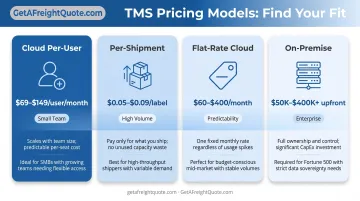
Cloud-Based SaaS TMS (Per-User Pricing): Current vendor examples include AscendTMS at $69–$149/user/month across Basic, Premium, and Pro tiers. This model fits small teams with stable headcount, but cost scales with every seat. Ten users at $119/month runs $1,428 monthly, or $17,136 a year.
Cloud-Based SaaS TMS (Per-Shipment/Transaction Pricing): Historical data from 2022 cites $2–$5 per load for cloud broker TMS platforms. Modern platforms may use label-based pricing: for example, $0.05–$0.09 per label depending on weekly shipment volume, with carriers charged separately. This model aligns cost with transaction volume rather than team size.
Flat-Rate Cloud TMS: Entry-level flat-rate platforms start around $95/month (Shiptify at €89), $60/month (MyCarrierTMS Starter with 3 users/3 locations), or $400/month (Logistically with unlimited users/customers/locations). These plans offer budget predictability but often cap users, locations, or data retention.
On-Premise TMS (One-Time License): 2022 benchmarks report $50,000–$400,000+ upfront licensing fees, plus annual maintenance at 15–20% of license cost. Customers assume responsibility for servers, security, customization, and IT infrastructure. Current 2025–2026 on-premise pricing is not widely published.
Enterprise TMS Platforms: Large-scale implementations for enterprise shippers range from $100,000 to over $1,000,000. Pricing is customized by shipment volume, user count, modules, and scope. Gartner notes that platforms like Oracle TMS use subscription pricing driven by these variables, but exact figures stay confidential.
What's Typically Included and Excluded
✅ Included: Core TMS features (rate shopping, shipment tracking, carrier selection, basic reporting), standard integrations, platform access, and basic support
❌ Excluded: Implementation and configuration, data migration, user training, custom integrations with ERP/WMS/e-commerce systems, carrier-connection fees, advanced analytics modules, and dedicated account management
Key Factors That Affect the Cost of TMS Software
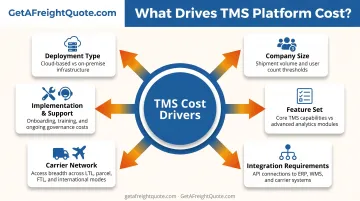
TMS pricing depends on your business requirements, shipment volume, user count, and technical complexity. Six variables determine whether you'll spend $500 or $50,000.
Deployment Type: Cloud vs. On-Premise
Cloud-based (SaaS) TMS charges monthly or annually, typically per user or per transaction, with lower upfront costs and no infrastructure investment. The vendor handles updates, security, and maintenance. Flat-rate and per-shipment models further reduce entry barriers for small businesses.
On-premise TMS requires a large upfront license fee, historically $50,000–$400,000+ based on 2022 data. You also cover ongoing IT infrastructure, servers, security, and internal customization. Annual maintenance typically adds 15–20% of the license cost. This model suits enterprises with strict data-control requirements and dedicated IT resources.
Company Size and User Count
Per-user pricing scales directly with team size. A 3-person logistics team at $119/user/month costs $357 monthly; a 50-person department costs $5,950 monthly. Small teams benefit from predictable per-user pricing, while large teams may find flat-rate or per-shipment models more economical.
Volume-based pricing rewards high-volume shippers. Platforms offering per-shipment or tiered label fees (e.g., $0.09/label for 4–100 weekly shipments, $0.05/label for 2,501+ weekly shipments) let costs scale with transactions rather than headcount. If your team is small but shipment volume is high, this model delivers better ROI.
Feature Set and Functionality
Core TMS features—rate shopping, shipment tracking, carrier selection, and standard reporting—are included in most base plans.
Advanced features command premium pricing:
- Route optimization and dynamic load planning
- Real-time shipment visibility and exception management
- Predictive analytics and business intelligence dashboards
- Multi-modal support (parcel, LTL, FTL, intermodal, air, ocean)
- AI-driven decisions and KPI tracking
For example, AscendTMS's Pro tier at $149/user/month adds AI capabilities, outbound EDI, e-signature, and CRM integration beyond the $69 Basic tier. Enterprise platforms like Blue Yonder bundle AI decision tools, extensive carrier networks, and end-to-end transportation management, but pricing is customized and not publicly disclosed.
Integration Requirements
Connecting your TMS to existing systems can equal or exceed subscription costs. Integrations with ERP (SAP, NetSuite), WMS (warehouse management), CRM, and e-commerce platforms (Shopify, WooCommerce) often require:
- API development and custom middleware
- EDI connections for carrier communication
- Data mapping and testing
- Ongoing maintenance and updates
Some vendors include pre-built integrations at no extra charge. AscendTMS advertises 140+ integrations, Alvys offers 120+ with no setup fee, and Logistically includes API access in its $400/month starting price. Others bill separately for build and maintenance, and multi-system projects can push total cost well beyond the subscription alone.
Carrier Network and Connectivity
Access to pre-negotiated carrier rates and integrated carrier networks (LTL, FTL, parcel, freight forwarders) directly affects what you pay to move freight. Some TMS platforms provide robust carrier connectivity as part of the subscription; others require you to bring your own carrier accounts or charge fees for carrier connections.
Certain providers aggregate customer volume to negotiate rates typically available only to Fortune 500 shippers, then pass those savings to smaller customers. This model can deliver 20–50% carrier-rate reductions, offsetting platform fees. Pricing structures still vary: some platforms take a percentage of shipping spend, others charge per-connection fees, and some include carrier access in the base price.
Implementation, Training, and Support
One-time implementation costs cover system configuration, data migration, carrier setup, and workflow customization. Complexity and customization needs determine the final bill. Simple cloud deployments may take a few weeks; multi-ERP, multi-workflow enterprise rollouts can require 12–20 weeks and extensive consulting.
Ongoing costs include:
- User training (initial onboarding and periodic updates for new features)
- Customer support tiers (basic email/phone vs. dedicated account management)
- Technical support and maintenance (included in SaaS plans or billed as 15–20% of on-premise license cost annually)
- Strategic consultation and optimization services
Vendors differ widely: some include setup, training, and support at no extra charge, while others bill separately for each service.
Cost Breakdown of TMS Software
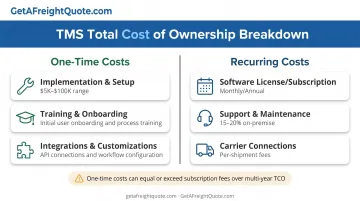
Total cost of ownership extends far beyond the monthly subscription or license fee. Plan for these six categories:
| Cost Category | One-Time or Recurring | Description |
|---|---|---|
| Software License or Subscription Fee | Recurring (SaaS) or One-Time + Annual Maintenance (On-Premise) | Core TMS access; pricing varies by model (per-user, per-shipment, flat-rate) |
| Implementation & Setup | One-Time | System configuration, data migration, carrier integrations, workflow customization |
| Training & Onboarding | One-Time (initial) + Periodic (new users/features) | User training, documentation, onboarding support; costs vary by vendor and team size |
| Integrations & Customizations | One-Time (build) + Periodic (maintenance) | Connecting TMS to ERP, WMS, e-commerce platforms; custom workflows, reports, and data mapping |
| Ongoing Support & Maintenance | Recurring (monthly or annual) | Software updates, technical support, customer success teams; 15–20% of on-premise license cost or included in SaaS |
| Carrier Connections & Transaction Fees | Recurring (per-shipment or monthly) | Access to carrier networks, EDI connections, per-shipment or per-load fees; some vendors include, others charge separately |
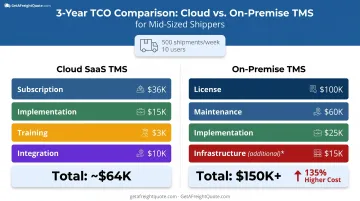
Example: 3-Year TCO for a Mid-Sized Shipper
Profile: 500 shipments/week, 10 users, cloud TMS at $100/user/month.
- Subscription: $100/user/month × 10 users × 36 months = $36,000
- Implementation: $15,000 (one-time)
- Training: $3,000 (initial + periodic updates)
- ERP/WMS integration: $10,000 (build + maintenance)
- Support: Included in the SaaS subscription
3-year TCO: ~$64,000 (excluding carrier transaction fees, if any)
On-premise looks different over the same window:
- License: $100,000 (one-time)
- Maintenance: $60,000 ($20,000/year × 3, typically ~20% of license)
- Implementation: $25,000
- Infrastructure: Servers, IT overhead, and upgrades on top
3-year TCO: $150,000+ before internal IT time.
Commercial model matters as much as list price. Some managed freight providers bundle TMS access and implementation into the service—GetAFreightQuote.com, for example, includes implementation often valued at $150,000–$250,000 at no separate fee under managed LTL—so those line items may drop out of your spreadsheet entirely.
Low-Cost vs. High-Cost TMS Software — What's the Difference?
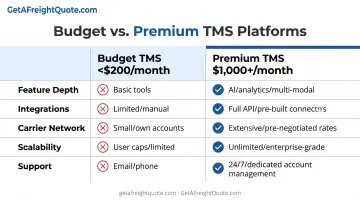
Budget-friendly and premium TMS platforms differ in feature depth, integration capabilities, carrier access, scalability, and support—and those gaps drive both price and day-to-day fit.
Feature Depth
Lower-Cost TMS: Basic rate shopping, shipment tracking, carrier selection, and standard reporting. Enough for small businesses with straightforward shipping needs.
Higher-Cost TMS: Built for complex supply chains and high-volume operations, typically including:
- Advanced route optimization and real-time visibility
- Predictive analytics and AI-driven decision-making
- Multi-modal support (parcel, LTL, FTL, intermodal, ocean, air)
- Dynamic load planning and exception management
Integration Capabilities
Lower-Cost TMS: Limited pre-built integrations; may require manual data entry, CSV uploads, or basic API connections. MyCarrierTMS lists 10 third-party integrations.
Higher-Cost TMS: Full API access, pre-built connectors for major ERP (SAP, NetSuite), WMS, CRM, and e-commerce platforms, and real-time data sync across systems. Platforms like Logistically include API access even at $400/month entry pricing.
Carrier Network Access
Lower-Cost TMS: Smaller carrier network; you may need to bring your own carrier accounts and negotiate rates independently.
Higher-Cost TMS: Extensive carrier network with pre-negotiated rates across LTL, FTL, parcel, and freight forwarders. Volume aggregation can unlock rates typically reserved for Fortune 500 shippers, with documented savings of 20–50%.
Scalability & Customization
Lower-Cost TMS: Limited customization options and user/location caps (e.g., MyCarrier Starter: 3 users, 3 locations, 60-day data retention). May struggle to scale as shipment volume and complexity grow.
Higher-Cost TMS: Custom workflows, architecture that handles enterprise-level volume, unlimited users/locations (e.g., MyCarrier Professional, Logistically), and flexible data retention and reporting.
Support & Service Level
Lower-Cost TMS: Basic email and phone support, help desk, knowledge base, and self-service training resources.
Higher-Cost TMS: Dedicated account management, 24/7 support, hands-on training, strategic consultation, implementation help, and post-go-live customer success (e.g., Shipwell's hypercare + CSM model).
How to Estimate the Right Budget for TMS Software
The right TMS aligns with your business size, shipment volume, feature requirements, and growth path. Price alone is a weak budget guide.
Key budgeting considerations:
1. Current shipment volume and projected growth
- Per-user models suit small, stable teams with predictable headcount
- Per-shipment or tiered label-fee models track transaction volume and scale cleanly for high-growth shippers
- Flat-rate models with unlimited users work well for mid-sized teams with moderate, stable volume
2. Required feature set
- Basic shipping tools (rate shopping, tracking, reporting) satisfy straightforward needs
- Advanced optimization, real-time visibility, predictive analytics, and multi-modal support justify premium pricing for complex operations
3. Integration needs
- ERP, WMS, or e-commerce connectivity may need paid connectors or custom work
- Manual entry lowers software cost but raises labor cost and error risk
- Include one-time integration build cost and ongoing maintenance in the budget
4. Internal IT resources
- Cloud-based SaaS eliminates infrastructure management, updates, and security overhead
- On-premise needs dedicated IT, servers, security, and maintenance—usually only worth it for large enterprises with strict data-control rules
5. Total cost of ownership over 3–5 years
- Subscription fees are just the starting point
- Add implementation, training, integrations, support, and transaction fees
- Model both low-volume and high-volume scenarios to understand cost scaling
Alternative approach: TMS resellers such as GetAFreightQuote.com can change the budget math for smaller shippers. They pair enterprise TMS tools with pre-negotiated carrier rates, so you are not locked into Fortune 500-level volume to get competitive pricing.
Typical label pricing runs $0.05–$0.09 per label by weekly volume tier, often with no upfront implementation fee. For budgeting, that model usually means:
- Costs scale with shipments instead of large seat or license blocks
- Aggregated volume unlocks stronger carrier rates without a solo volume commitment
- Carrier savings of 20–50% can offset platform fees early in the term
- Enterprise features stay in reach for small and mid-sized teams
What Most People Miss When It Comes to the Cost of TMS Software
Subscription price is only one line item. These oversights are what usually blow up the real TMS budget.
- Total cost of ownership: Implementation, training, integrations, and support can equal or exceed the monthly fee. A $100/month platform that needs $20,000 in setup costs more than a $200/month fully managed option.
- Per-shipment fees: At $3 per load, 500 loads a week is $1,500/week—or about $78,000 a year—on top of the subscription.
- Training and change management: Adoption drives ROI. A strong TMS that the team underuses delivers little value, so budget for onboarding, refreshers, and ongoing support.
- Cheapest-tool trap: A $50/month TMS with manual entry, weak carrier rate tools, and no room to scale often costs more in freight spend and rework than a $150/month platform that automates workflows.
Conclusion
TMS software pricing varies based on several factors:
- Deployment type (cloud vs. on-premise)
- Pricing model (per-user, per-shipment, or flat-rate)
- Feature set, company size, and integration needs
Total cost of ownership, not just the subscription fee, drives better budgeting, vendor selection, and long-term ROI. The best fit balances functionality, carrier network access, scalability, and the value you actually use.
A $69/user/month platform can beat a $400,000 on-premise system on ROI when it matches your shipment volume, team size, and growth plans.
Frequently Asked Questions
What is the average cost of TMS software for small businesses?
Entry-level TMS plans typically run $60–$400/month on flat-rate pricing, or $69–$149 per user/month. Per-shipment models at $0.05–$0.09 per label often fit small teams better when volume is growing faster than headcount.
Do TMS systems charge per user or per shipment?
Both. Per-user SaaS pricing bills monthly or annually per licensed seat and scales with team size. Per-shipment models charge by volume (historically $2–$5 per load, or $0.05–$0.09 per label today) and suit high-volume shops with fewer users.
Are there hidden costs in TMS software?
Yes. Budget beyond the sticker price for:
- Implementation, data migration, and carrier connections
- Custom ERP, WMS, or e-commerce integrations
- Training, premium support, and add-on subscriptions such as load boards or rate databases
Is cloud-based or on-premise TMS more cost-effective?
Cloud SaaS usually wins on total cost for small and mid-sized businesses: lower upfront spend, no servers to run, and updates included. On-premise licensing often runs $50,000–$400,000+ plus 15–20% annual maintenance and dedicated IT, so it fits mainly large enterprises that need strict data control.
How long does TMS implementation typically take?
Most standard cloud TMS go-lives take 12–14 weeks. Multi-ERP or multi-workflow projects often stretch to 16–20 weeks, and heavily customized enterprise rollouts can take six months or longer.
Can small businesses afford enterprise-level TMS software?
Yes. Cloud SaaS and authorized resellers (including GetAFreightQuote.com) put enterprise TMS and negotiated carrier rates at small-business prices. Flat rates around $400/month, per-label fees of $0.05–$0.09, or bundled rate programs deliver advanced tools without Fortune 500 volumes or six-figure upfront costs.