Introduction
A small business owner packs up a case of lithium-ion battery packs for a customer shipment. No hazard label. No shipping paper.
Carriers flag the box at the hub and hold the shipment. Now there's a fine on the way, along with an angry customer waiting on a delayed order.
This scenario plays out more often than most shippers realize. According to the Pipeline and Hazardous Materials Safety Administration (PHMSA), approximately 1,500 transportation incidents occur every year when hazardous materials are shipped undeclared.
Federal rules under DOT, IATA, and IMDG govern hazmat shipping, and getting it wrong carries real financial and safety consequences.
This guide breaks down hazmat classification, the regulations that apply to your shipment, a step-by-step compliance process, carrier-specific rules, and how to simplify compliant hazmat freight shipping as your business grows.
Key Takeaways
- Hazmat shipments fall into 9 hazard classes, identified via the Safety Data Sheet before packaging
- Federal rules (49 CFR, IMDG, IATA/ICAO) govern packaging and labeling, varying by transport mode
- USPS, UPS, FedEx, and LTL carriers each enforce their own certification and prohibited items list
- A freight technology platform simplifies hazmat rate comparison and compliance for small and mid-sized businesses
What is Hazmat Shipping?
Under 49 CFR 171.8, the DOT defines a hazardous material as any substance or material capable of posing an unreasonable risk to health, safety, and property when transported in commerce. That definition is broader than most people assume.
Hazmat isn't limited to industrial chemicals or drums of solvent. It includes designated hazardous substances, hazardous wastes, marine pollutants, elevated-temperature materials, and anything else listed on the Hazardous Materials Table or meeting Part 173 classification criteria.
Why hazmat shipping is different: Standard freight moves under general carrier tariffs. Hazmat freight adds risk to people, property, and the environment at every point in transit, including loading, transport, and handling. That risk triggers regulatory scrutiny that doesn't exist for ordinary freight, from how it's packaged to how it's documented and who's allowed to carry it.
The 9 Hazmat Hazard Classes You Need to Know
Every hazmat shipment falls into one of nine internationally recognized hazard classes, several of which contain further divisions.
| Class | Category | Example |
|---|---|---|
| 1 | Explosives | Detonators, emulsion explosives |
| 2 | Gases | Oxygen, flammable gas, propane |
| 3 | Flammable liquids | Gasoline, acetone |
| 4 | Flammable solids | Sulfur, sodium |
| 5 | Oxidizers/organic peroxides | Ammonium nitrate |
| 6 | Toxic/infectious substances | Regulated medical waste |
| 7 | Radioactive materials | Low-specific-activity material |
| 8 | Corrosives | Glacial acetic acid |
| 9 | Miscellaneous | Dry ice, lithium batteries |
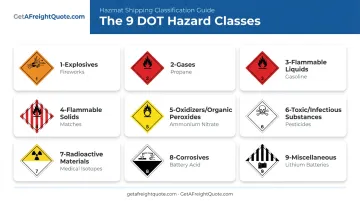
Some materials qualify under more than one class, such as a corrosive liquid that's also flammable. When that happens, shippers must consult every applicable hazard class and assign the correct primary and subsidiary hazard designations.
Everyday Items That Qualify as Hazmat
Plenty of common shipments carry hazmat obligations that businesses miss entirely:
- Lithium-ion batteries: classified as Class 9, UN3480 when shipped alone and UN3481 when packed with equipment, due to fire and thermal runaway risk
- Aerosols: UN1950, Class 2, because of internal pressure and flammability
- Perfumes and fragrances: UN1266 only when perfume is the product's primary function; otherwise classified by flammable liquid content
- Dry ice: UN1845, Class 9, since it releases carbon dioxide gas and requires vented packaging
- Paints and solvents: typically UN1263, Class 3, based on flashpoint testing
- Nail polish: often flammable liquid, n.o.s., rather than a perfumery classification
Key Regulations Governing Hazmat Shipping
Compliance depends on which regulatory body governs the transport mode you're using. Shippers stay responsible for correct classification regardless of who physically moves the freight.
DOT 49 CFR (Domestic Ground Shipping)
Title 49 of the Code of Federal Regulations is the primary rulebook for hazmat moving by U.S. ground transport, spanning several parts:
- Part 171: general definitions and incident reporting
- Part 172: the Hazardous Materials Table, shipping papers, marking, labeling, and training
- Part 173: classification criteria, packing groups, and packaging
- Parts 174-177: mode-specific rules for rail, air, vessel, and highway
- Parts 178-180: packaging specifications and tank-car requirements
Together, these parts cover classification, packing groups, quantity limits, labeling, and mandatory staff training.
IMDG, IATA/ICAO (International & Air Shipping)
Once a shipment leaves domestic ground transport, different frameworks apply:
- IMDG Code governs hazmat shipped by sea, covering packing, stowage, and segregation requirements set by the IMO
- ICAO Technical Instructions and IATA's Dangerous Goods Regulations govern air shipments, with stricter per-package quantity limits reflecting the added risk of altitude and pressure changes
- Domestic 49 CFR requirements still apply: international standards layer on top of the HMR framework rather than replace it
A shipment moving by air still needs to satisfy applicable 49 CFR provisions alongside IATA rules.
How to Ship Hazmat Correctly: Step-by-Step
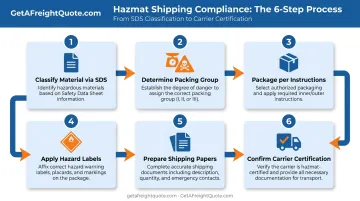
Getting a hazmat shipment out the door compliantly follows a specific sequence. Skipping a step is usually where shippers run into trouble.
Classify the material using its Safety Data Sheet. Check Section 14 (Transport Information) for the UN ID number, proper shipping name, hazard class, and packing group.
Determine the packing group. Packing groups rank danger level and determine required packaging:
Packing Group Danger Level I Great danger II Medium danger III Minor danger Select DOT-specification or UN-standard packaging rated for that group and quantity.
Package the material per manufacturer instructions. Use required inner and outer containers, absorbent or cushioning material for liquids, and seal properly to prevent leaks.
Apply correct hazard labels and orientation markings. Handlers need to know at a glance how the shipment must be carried, stored, and stacked.
Prepare complete shipping papers. Include the following on every shipment:
- UN ID number and proper shipping name
- Hazard class and packing group
- Quantity and type of packages
- Emergency contact information
- Shipper's certification
Confirm carrier-specific certification requirements and any special DOT permits before tendering the shipment. Acceptance criteria vary widely across carriers and transport modes. Many hazmat shippers verify requirements with an experienced freight partner such as GetAFreightQuote.com before tendering.
Hazmat Shipping Requirements by Carrier
Regulatory compliance gets you halfway there. Each carrier layers its own certification process, paperwork, and prohibited items list on top of federal rules, so confirming acceptance before booking matters just as much as classification.
USPS Hazmat Shipping
USPS accepts only a narrow slice of hazmat categories, and shippers need to check Publication 52 and the Domestic/International Shipping Restrictions pages before mailing anything hazmat-adjacent.
Commonly prohibited items include:
- Gasoline and all fireworks
- Explosives (Divisions 1.1, 1.2, 1.3, 1.5, 1.6)
- Toxic gases (Division 2.3)
- Liquid mercury and ammunition
Some materials, like butane and propane, can ship as Limited Quantity via surface transportation. Lithium batteries face detailed chemistry- and quantity-specific limits, particularly for international mail. Because these limits change based on chemistry and quantity, always verify eligibility against Publication 52 before every shipment.
UPS & FedEx Ground Hazmat Shipping
Both UPS and FedEx require shipper certification and a specific account setup before they'll accept hazmat freight.
UPS specifics:
- Requires a Scheduled Pickup account; hazmat isn't accepted at UPS Customer Centers or The UPS Store
- Needs a Shipper's Declaration and UPS Shipper's Certification
- Prohibits toxic-inhalation-hazard materials, Division 5.2 items in air service, and damaged lithium batteries
FedEx Ground specifics:
- Requires the OP-950 Shipper's Certification, signed by an authorized representative
- Does not accept hazardous waste
- Unavailable in Alaska, Hawaii, and Canada, including Limited Quantity packages
Neither carrier accepts fireworks or human remains under standard hazmat service.
LTL & Freight Carrier Hazmat Shipping
For bulk or palletized hazmat (think drums of industrial chemicals, battery pallets, or bulk containers of cleaning solvent), LTL and FTL freight carriers are often more practical than small parcel carriers built around individual boxes.
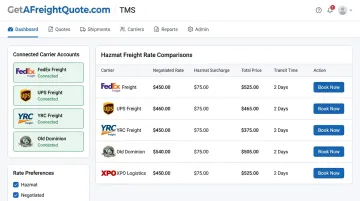
Hazmat freight rates vary significantly by carrier depending on classification, packaging, and available hazmat-certified capacity. That variability makes rate comparison tools genuinely valuable rather than optional.
This is where a platform like GetAFreightQuote.com fits in. HAZMAT Transportation is listed as one of its core LTL and FTL service offerings, and its customer support team specifically covers HAZMAT compliance.
That combination matters when you need a human to answer a carrier-acceptance question, not just a quoting tool. Businesses can also connect their own existing carrier accounts alongside the platform's negotiated rates, comparing pricing across multiple carriers before booking.
Common Mistakes to Avoid & Choosing a Hazmat Shipping Partner
Common Compliance Mistakes
Most hazmat violations trace back to a handful of avoidable errors.
- Misclassifying hazmat or relying on an outdated SDS: SDS revisions change Section 14 details, risking shipment rejection, fines, or a safety incident.
- Reusing packaging with old hazard labels still attached: Leftover labels from previous shipments cause misclassification or misrouting at the carrier's hub.
- Failing to confirm carrier-specific restrictions before booking: Acceptance criteria vary by carrier, and skipping this check risks refusal after tender.
The financial stakes are real. PHMSA's enforcement page states a statutory civil penalty range of $450 to $75,000 per violation, with possible criminal referral in serious cases.
One 2022 case against an electronics recycler carried a proposed assessment of $21,600 for just two alleged violations, showing how quickly penalties scale even for smaller infractions.
Choosing the Right Partner for Hazmat Freight Shipping
Hazmat rules differ by carrier, mode, and shipment volume, and that complexity hits small and mid-sized businesses hardest. Without a dedicated logistics team, these shippers often overpay or settle for whichever carrier will simply accept the freight, compliant or not.
GetAFreightQuote.com was built to close that gap. The platform gives businesses of any size access to:
- Negotiated carrier rates typically reserved for high-volume shippers
- Enterprise-grade TMS technology with full rate transparency before booking
- Hands-on support from a team versed in HAZMAT compliance
Shippers can also add their existing carrier accounts into the platform alongside GetAFreightQuote.com's negotiated rates, comparing hazmat freight pricing and capabilities across multiple carriers in one place before committing to a booking.
Frequently Asked Questions
What is considered HAZMAT shipping?
Hazmat shipping covers any material posing an unreasonable risk to health, safety, or property in transit, sorted into 9 DOT hazard classes. Common examples include lithium batteries, aerosols, and industrial chemicals.
Does the USPS take HAZMAT shipping?
USPS accepts only certain hazmat classes in limited quantities under Publication 52. Always verify current eligibility and restrictions before mailing.
What items must be included on a HAZMAT shipping paper?
Shipping papers require the UN ID number, proper shipping name, hazard class, packing group, quantity and type of packages, emergency contact information, and the shipper's certification.
What are the 9 hazmat hazard classes?
Explosives, gases, flammable liquids, flammable solids, oxidizers/organic peroxides, toxic/infectious substances, radioactive materials, corrosives, and miscellaneous hazardous materials.
Can hazmat be shipped via LTL or full truckload freight?
Yes. Bulk or palletized hazmat commonly ships via LTL or FTL with proper classification, packaging, and carrier certification. Rates vary by carrier and hazmat classification.
Do I need special training to ship hazmat materials?
Yes. Hazmat employees need DOT-mandated training covering general awareness, safety, and function-specific duties, with recurrent training required at least once every 3 years.