Manual, spreadsheet-based rate management simply can't keep pace with daily market swings. Carrier surcharges shift weekly. Capacity tightens overnight. Businesses still pricing freight by hand are making decisions on stale data, and it's costing them margin and customers.
This article breaks down the trends reshaping freight rate management software this year: what's driving them, how they're changing daily operations, and what to watch for as the technology keeps evolving.
Key Takeaways
- Rate management is shifting from spreadsheets to AI-driven, API-connected platforms
- Multi-modal visibility and self-service quoting are now standard industry expectations
- Small and mid-sized shippers now access Fortune 500-level rates and TMS tools
- Rising quote-speed demands and margin pressure are accelerating platform adoption
- Early adopters report faster quoting, tighter cost accuracy, and stronger retention
Key Trends Shaping Freight Rate Management Software in 2026
Rate management software used to sit in the back office, running calculations behind the scenes. That's no longer the case. It's now a strategic system that protects revenue, wins deals, and keeps pricing accurate in real time.
AI-Powered Predictive Rate Analytics
Machine learning models now digest historical rates, seasonality patterns, and live market signals to forecast pricing windows months out. Instead of reacting to a rate spike after it hits, shippers can see it coming and lock in contracts early.
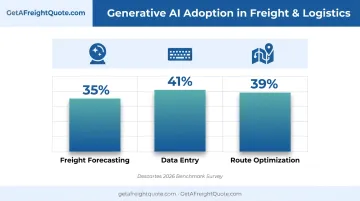
Adoption is already substantial. In Descartes' ninth annual transportation management benchmark survey of 616 shippers and logistics providers, 35% reported using generative AI specifically for freight forecasting, alongside 41% using it for data entry and 39% for route optimization.
That's a meaningful share of the market already treating prediction as standard practice, not experimentation. Why it matters:
- Shifts rate decisions from reactive to proactive
- Lets shippers time contract commitments before market spikes
- Reduces the guesswork that used to come with seasonal rate swings
Real-Time API-Driven Rate Integration
Live carrier API feeds are replacing static rate sheets and manual uploads. Rates update the moment a carrier changes them, not whenever someone remembers to refresh a spreadsheet.
Nippon Express integrated live air-freight rates into its quoting system and reduced quoting time by 65%, with a 15-20% productivity gain. That's a direct, measurable operational payoff.
This matters because version-control errors disappear. A quote generated Tuesday morning reflects Tuesday morning's actual capacity and surcharge environment, not last week's.
Unified Multi-Modal Rate Management Platforms
Shippers used to log into separate carrier portals for parcel, LTL, truckload, air, and ocean rates. Now single platforms let them compare all of it side by side for hybrid routing decisions.
Gartner defines a modern TMS around exactly this capability: multimodal sourcing, planning, and execution spanning truckload, LTL, intermodal, rail, ocean, air, and parcel, with built-in rate comparison and settlement.
The payoff for complex, multi-leg shipments is real lowest-landed-cost decision-making instead of mode-by-mode guesswork. No more toggling between five browser tabs to figure out whether rail-to-truck beats straight LTL on a given lane.
Self-Service Customer Portals and Instant Quoting
Customer-facing portals now allow 24/7 rate lookups, booking, and modification without waiting on a rep. This has moved from nice-to-have to expected.
Freightos' State of Online Freight 2025 report found that half of leading freight forwarders and 4 of the 5 largest ocean carriers now offer instant quoting. That's a fast shift in a historically slow-moving industry.
The impact shows up fast:
- Builds trust through upfront pricing transparency
- Removes friction for shippers who want a rate at 11pm, not 9am the next business day
- Serves as a genuine competitive differentiator between providers
Democratization of Enterprise-Grade Rates for Small and Mid-Sized Businesses
Here's where the market is changing most dramatically. A new model has emerged where authorized TMS resellers bundle negotiated carrier rates, advanced rate software, and hands-on support into one accessible package.
GetAFreightQuote.com runs on exactly this model. Instead of building a proprietary TMS from scratch, it operates as an authorized reseller of an established enterprise-grade platform, then layers negotiated carrier rates on top.
The mechanism behind it is volume pooling. By aggregating shipment volume across hundreds of small and mid-sized businesses, the platform negotiates the same rate tiers a Fortune 500 shipper would command alone, then passes those rates down to individual users.
One standout feature is the ability to add your own existing UPS, FedEx, or LTL carrier accounts directly into the platform. The system then rate-shops those accounts alongside the platform's own negotiated rates on every shipment, always booking whichever option is cheaper. That removes the old trade-off between keeping existing carrier relationships and accessing better group rates.
The result: it removes the volume barrier that historically forced small businesses to accept inferior shipping rates. A company shipping three packages a week is no longer priced like a company shipping three packages a week.
What's Driving These Freight Rate Management Trends
Several forces are converging to push adoption faster than most logistics teams expected.
- Technology maturity: AI, automation, and API infrastructure have reached a point where real-time rate processing is commercially viable for mid-market companies, not just enterprise budgets
- Rising digital investment: Among large shippers with more than $500 million in revenue, 59% expect to have at least 10 digital use cases in place by 2027, according to McKinsey
- Cost and efficiency pressure: Sales and pricing teams are under constant pressure to quote faster without adding headcount, pushing manual quoting workflows toward automation
- Regulatory pressure: FMCSA's proposed broker transparency rule would require property brokers to keep transaction records electronically and produce them within 48 hours of a request
- Competitive dynamics: Carriers and forwarders that don't digitize rate access risk losing deals outright to competitors who can quote in minutes instead of days
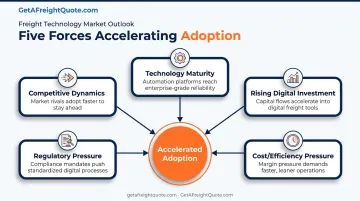
None of these forces operate in isolation. Regulatory pressure and competitive dynamics both point toward the same outcome: systems that produce a clean, auditable, fast rate every time, with no manual lookup step in between.
How These Trends Are Impacting the Freight Industry
These shifts aren't theoretical. They're producing measurable changes across operations, business strategy, and the workforce itself.
Operational Impact
Quote generation has compressed from hours or days into minutes. C.H. Robinson's Orders Agent illustrates the scale of what's now possible: it processes roughly 5,500 truckload orders per day, in about 90 seconds each, saving a reported 600 labor hours daily.
That kind of speed changes daily workflows entirely. Rate analysts spend less time on lookup tasks and more time managing exceptions. Automated validation is also catching rate and invoicing errors before they turn into disputes weeks later, which used to be the norm.
Business Impact
Better rate visibility is shifting strategic priorities. Leadership teams are now weighing technology investment alongside the classic contract-versus-spot rate mix decision, because the software itself has become a lever for margin protection.
Transparent, accurate quoting is also becoming a retention factor, not just a cost play:
- Customers increasingly expect instant, accurate pricing before they'll commit
- Win-rate improvements are showing up as a direct benefit of faster quote turnaround
- Pricing transparency is turning into a trust signal that keeps shippers from shopping around
Workforce Impact
Rate analyst roles are changing shape. Instead of manual lookups, analysts now focus on carrier negotiation, data interpretation, and dashboard-driven decision-making.
That shift demands a different skill set, one that logistics organizations are actively hiring and training for right now.
Future Signals for Freight Rate Management in the Years Ahead
The trends above are just the current wave. Here's what to watch over the next one to three years.
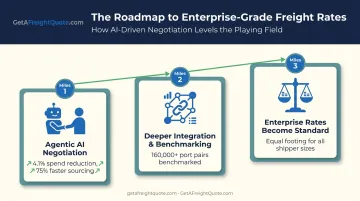
Agentic AI handling autonomous negotiation. Early signals are already visible. Project44's Freight Procurement Agent reportedly cut freight spend by 4.1%, sourcing-cycle time by 75%, and manual coordination by 70% in early deployments. The system continuously benchmarks contracted rates against live market conditions and runs digital mini-bids within shipper-defined guardrails.
Deeper integration and standardized benchmarking. Expect tighter connections between rate management, yard and warehouse systems, and standardized rate indexes. Xeneta's ocean benchmark already covers more than 160,000 port-to-port pairs and over $20 billion in freight spend, a sign of where market transparency is headed.
Enterprise-grade rates becoming the market standard. The reseller-driven democratization model is likely to keep expanding until negotiated rates and advanced TMS tools stop being a large-shipper advantage entirely. Businesses of every size are heading toward equal footing on both technology and price.
Conclusion
AI-driven forecasting, real-time API integration, multi-modal visibility, self-service portals, and rate democratization are converging to define freight rate management software in 2026. Each trend reinforces the others: faster data feeds better predictions, and better predictions make self-service quoting trustworthy.
Businesses that adapt early are gaining a lasting edge in cost control, quoting speed, and customer trust. Waiting on a spreadsheet-based process while competitors quote in minutes is no longer a viable strategy.
Closing that gap starts with the right technology partner. Partnering with a provider that combines enterprise-grade technology with pre-negotiated rates, like GetAFreightQuote.com, allows businesses of any shipment volume to compete on equal footing in this new landscape. Shipment volume no longer dictates the rates or the quoting speed a business can offer its customers.
Frequently Asked Questions
What is freight rate management?
Freight rate management is the process of tracking, calculating, and optimizing transportation costs across carriers and modes using centralized software. It replaces manual rate lookups with automated comparison and validation.
How much does TMS software cost?
Costs vary by provider and business size, ranging from per-shipment fees to six-figure enterprise licenses. Reseller models with per-label pricing make enterprise-grade TMS far more affordable for smaller shippers.
What's the difference between a TMS and freight rate management software?
A TMS manages the broader shipment lifecycle, including booking, tracking, and settlement. Rate management software focuses specifically on pricing, quoting, and rate accuracy, though modern platforms often combine both functions.
Can small businesses benefit from freight rate management software?
Yes. Reseller platforms now pool shipping volume across many small businesses to unlock the same negotiated rates large enterprises receive individually. This gives smaller shippers access to pricing usually reserved for high-volume enterprises.
How is AI changing freight rate management in 2026?
AI is driving predictive pricing forecasts and automated rate validation, while enabling real-time market benchmarking across carriers. Instead of reacting to rate changes, shippers can anticipate pricing windows and lock in favorable rates ahead of market spikes.
What should I look for when choosing freight rate management software?
Prioritize real-time rate updates, multi-modal support, transparent pricing with no hidden fees, and strong integration capabilities with your existing carrier accounts and systems.