The good news: the digital freight brokerage market has grown up. What started as one disruptive app has splintered into dedicated TMS platforms, hybrid tech-broker models, and reseller programs that put enterprise-grade tools in the hands of small and mid-sized businesses.
This guide breaks down the top Uber Freight alternatives for 2026 - digital brokers, hybrid models, and standalone TMS software - so you can match a platform to your shipment volume, budget, and support needs.
Key Takeaways
- Uber Freight remains active in 2026, but flat revenue and support complaints are pushing shippers elsewhere
- Alternatives fall into three categories: digital brokers, hybrid tech-broker platforms, and standalone TMS software
- Leading 2026 options include C.H. Robinson, Echo Global Logistics, Trimble TMS, and GetAFreightQuote.com
- Choose based on carrier reach, rate transparency, and support quality, not brand name alone
Overview of the Digital Freight Brokerage Market in 2026
Digital freight brokerage platforms use software to match shippers with carriers, cutting out the phone tag and paperwork traditional brokers relied on for decades. TMS platforms go a step further, letting shippers control routing, tendering, and carrier selection directly instead of handing those decisions to a broker.
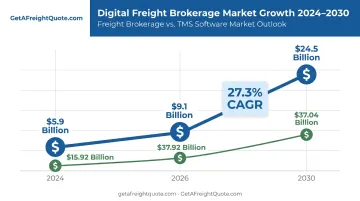
The market has grown fast. Grand View Research values the global digital freight brokerage market at $5.9 billion in 2024, projecting it will reach $9.1 billion in 2026 and $24.5 billion by 2030 - a 27.3% compound annual growth rate.
The broader transportation management software market is climbing a similar curve, forecast to jump from $15.92 billion in 2024 to $37.04 billion by 2030.
Uber Freight helped spark this shift when it launched in 2017. Since then, competition has multiplied:
- Traditional 3PLs added tech layers to compete on visibility and automation
- AI-driven providers emerged promising smarter rate matching and lane pricing
- TMS resellers built bridges between enterprise software and small business budgets
That growth means shippers frustrated with any single platform now have real options at every price point and volume level. Finding the right fit means matching your freight profile, shipment volume, and budget to the platform built for it.
Top Uber Freight Alternatives in 2026
We evaluated each option on four factors: carrier network size, technology depth (real-time tracking, API/EDI integration), pricing transparency, and customer support quality.
Convoy (Now Part of DAT Freight & Analytics)
Convoy built its name on machine-learning freight matching, using Automated Reloads to bundle backhauls and cut empty miles. The company once reported that this program reduced empty miles by as much as 50% in major markets and cut related emissions by 45%.
Here's the catch: Convoy shut down its independent brokerage in October 2023. Flexport acquired the technology stack a month later, then sold the platform to DAT Freight & Analytics in July 2025. Shippers researching "Convoy" today are actually evaluating DAT's version of that tech, not an active standalone brokerage.
| Attribute | Details |
|---|---|
| Model Type | Digital freight matching technology, now operated under DAT |
| Best For | Shippers who liked Convoy's sustainability-focused matching model |
| Pricing | Market rate plus platform fees |
C.H. Robinson
One of the largest 3PLs in the world, C.H. Robinson reported $16.2 billion in FY2025 revenue, paired with its proprietary Navisphere TMS. Navisphere connects with 44 third-party TMS and ERP systems and automates quoting, order processing, and appointment setting.
This combination of established human broker relationships and technology suits shippers who need high-touch service for complex freight, not just a self-service app.
| Attribute | Details |
|---|---|
| Model Type | Traditional broker plus tech layer |
| Best For | Complex, high-touch shipments |
| Pricing | Premium, reflecting personalized service |
Echo Global Logistics
Echo blends proprietary technology (EchoConnect) with dedicated account teams and 24/7/365 human support. The Jordan Company has owned Echo since completing its acquisition in November 2021.
Echo's specialized freight capabilities - oversized loads, expedited hot-shot service, heavy-haul and over-dimensional freight - make it a solid fit for shippers whose loads don't fit neatly into a standard van.
| Attribute | Details |
|---|---|
| Model Type | Hybrid tech plus human support |
| Best For | Specialized or irregular freight |
| Pricing | Mid-to-high, varies by service level |
Transfix
Transfix looks different than it did two years ago. The company sold its digital freight brokerage business to NFI in June 2024 and pivoted entirely to software, now selling its AI-powered pricing and workflow tools to freight brokers and 3PLs rather than shippers directly.
Its Custom Cost Models generate lane-level pricing predictions using freight history and market signals - useful technology, but shippers benefit from it indirectly through the brokers who license it, not by booking loads on Transfix themselves.
| Attribute | Details |
|---|---|
| Model Type | AI pricing and TMS software for brokers/3PLs |
| Best For | Brokers seeking rate accuracy tools (indirect benefit for shippers) |
| Pricing | Software licensing |
Trimble TMS
Trimble unveiled its next-generation TMS for Shippers in June 2026 - a cloud-native, modular, AI-powered platform built for shippers who want to manage freight operations directly instead of relying on a broker intermediary.
Modules cover route optimization, freight allocation, real-time visibility, predictive ETAs, and settlement, with integrations to ERP systems and tools like PC*Miler through a developer portal. It's a strong fit for shippers who want operational control, though it requires more internal bandwidth than outsourcing to a broker.
| Attribute | Details |
|---|---|
| Model Type | Standalone TMS software |
| Best For | Shippers wanting in-house freight control |
| Pricing | Software licensing/subscription-based |
GetAFreightQuote.com
GetAFreightQuote.com takes a different approach entirely: it's an authorized reseller of an advanced TMS platform, built to give small and mid-sized businesses the negotiated carrier rates and technology usually reserved for Fortune 500 shippers.
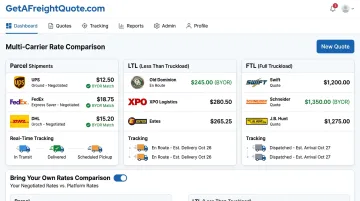
The platform combines pre-negotiated rates, full invoice transparency with no hidden fees, and hands-on support. Its Bring Your Own Rates feature lets shippers connect their existing UPS, FedEx, or LTL contracts and compare them side-by-side against GetAFreightQuote.com's negotiated pricing before booking anything.
Under the hood, the platform includes:
- Multi-carrier rate shopping across parcel, LTL, and FTL in one screen
- Access to 100+ national, regional, and local carrier partners
- Real-time tracking with 24/7/365 visibility across all carriers
- API and EDI integration, plus optional ERP add-ons like NetSuite and SAP
- Consolidated e-billing with automated audits that catch overcharges before payment
| Attribute | Details |
|---|---|
| Model Type | TMS reseller with negotiated rates |
| Best For | Small-to-mid-sized businesses seeking enterprise-level rates |
| Pricing | Self-funded by savings generated; per-label fees from $0 to 5¢, no hidden fees |
How We Chose the Best Alternatives
We assessed each platform on carrier network size, technology depth (tracking, integrations), rate transparency, and verified customer feedback rather than marketing claims or brand recognition alone.
A common mistake shippers make: picking a platform because it promises "lower rates" without checking who actually owns the carrier relationship or what happens when a shipment goes sideways. A flashy dashboard doesn't help much if support takes three days to answer a detention dispute.
Each criterion connects directly to a business outcome:
- Transparent pricing reduces surprise accessorial charges and billing disputes
- Deep carrier networks reduce the odds of stranded shipments during capacity crunches
- Responsive support cuts down on the administrative hours spent chasing answers
Platforms that score well across these criteria tend to reduce total shipping costs, not just the quoted rate.
Why Rate Transparency and Volume-Independent Pricing Matter for Small Shippers
Freight platforms, Uber Freight included, have layered in added fees like Quick Pay charges and complex detention pay processes over the past few years. These costs land hardest on smaller shippers who don't have a dedicated logistics team parsing every line item.
Fee complexity isn't the only issue. Traditional freight pricing has also favored volume over fairness.
Shippers spending $500,000 or less annually on parcel and freight have historically received worse rates than large enterprises, not because their freight is harder to move, but because carriers price based on leverage. A business shipping 50 pallets a week gets a different quote than one shipping 5,000, even for identical lanes.
The Volume-Independent Pricing Model
This is where reseller models like GetAFreightQuote.com change the equation. By pairing a TMS platform with pre-negotiated carrier rates, the platform gives smaller shippers access to enterprise pricing and full rate visibility before booking, regardless of their individual shipment volume.
Common billing problems this model catches:
- Accessorial fee creep - liftgate, residential delivery, and detention charges that add hundreds of dollars per shipment
- Incorrect weights or freight classifications that inflate costs after the fact
- Unapproved accessorials added without the shipper's sign-off
- Missed discounts or fuel surcharge miscalculations that go undetected without an audit
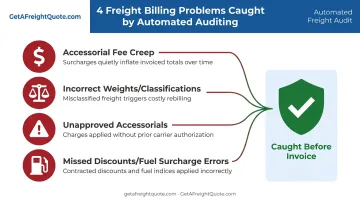
Automated freight auditing and pre-shipment validation catch these issues before they hit an invoice, not after a dispute drags on for weeks.
The result: self-service technology combined with hands-on support lets business owners focus on running their operation. Freight logistics, from booking through invoice review, gets handled with actual transparency instead of after-the-fact explanations.
Conclusion
Choosing the right Uber Freight alternative comes down to matching platform capabilities to your shipment volume, budget, and whether you want full operational control or hands-on support. There's no universal "best" option here, just the one that fits your freight profile.
Once you've narrowed down a shortlist, pilot the platform on a small set of lanes before migrating everything. Track:
- On-time delivery rates across the pilot lanes
- Support response time when issues arise
- Total cost per shipment, including fees you didn't expect
That data will tell you more than any comparison table.
If rate transparency and enterprise-level pricing without enterprise-level volume are what you need, get a free freight quote comparison through GetAFreightQuote.com. See what negotiated rates and transparent technology could do for your shipping costs.
Frequently Asked Questions
What are the best alternatives to Uber Freight?
Top alternatives include C.H. Robinson, Echo Global Logistics, Trimble TMS, and GetAFreightQuote.com, each suited to different needs, from high-touch service to volume-independent negotiated rates.
Is Uber Freight still operating?
Yes. Uber Freight remains active as of 2026, though it has faced reported revenue stagnation and reliability concerns, prompting many shippers to evaluate other platforms.
Who are the top freight forwarders?
Well-known forwarders include Kuehne + Nagel, DHL Supply Chain & Global Forwarding, and DSV. Unlike TMS platforms, which are software tools shippers control directly, forwarders assemble shipments and take responsibility for cargo.
How do TMS platforms differ from freight brokers like Uber Freight?
According to FMCSA's definitions, a broker arranges transportation and takes a transaction fee, while a TMS is software that lets shippers manage carrier relationships and rates directly.
Can small businesses get the same freight rates as large corporations?
Yes. TMS reseller models like GetAFreightQuote.com pool negotiated carrier rates typically reserved for high-volume shippers, making enterprise-level pricing accessible regardless of shipment volume.
What should I look for when switching freight platforms?
Evaluate carrier network size, fee transparency, integration capabilities, and support responsiveness. Pilot the switch on a small set of lanes before migrating fully.