That's the reality of international shipping in 2026. "Cheapest rate" isn't a fixed number — it's a moving target that shifts with weight, destination, carrier, and how fast you need it there.
Here's the bigger problem: small and mid-sized businesses often pay full retail for that unpredictability, while large corporations lock in negotiated discounts on the exact same lanes. That gap has less to do with shipping volume and more to do with who has access to better pricing tools.
This guide breaks down real 2026 international rates across USPS, FedEx, UPS, and DHL, and shows how any business — not just the Fortune 500 — can access better pricing.
TL;DR
- No single carrier is "cheapest" — cost depends on weight, destination, and speed
- USPS First-Class Package International wins under 4 lbs, but sacrifices speed and tracking
- FedEx, UPS, and DHL become cost-competitive for heavier or time-sensitive shipments
- Comparing live rates at time of shipping beats defaulting to one carrier
- GetAFreightQuote.com gives smaller shippers access to negotiated, high-volume pricing
What Actually Drives International Shipping Costs
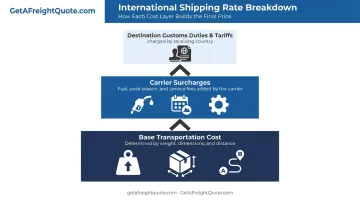
The number on your shipping label isn't the whole story. An international rate is built from three layers stacked on top of each other:
- Base transportation cost — determined by weight, dimensions, and distance
- Carrier surcharges — fuel, peak season, and service-specific fees
- Destination customs duties and tariffs — charged by the receiving country, not the carrier
That third layer catches a lot of shippers off guard. A rate that looks competitive at checkout can balloon once duties get added on the receiving end.
To make things messier, base rates don't hold still. Here's how the major carriers moved for 2026:
| Carrier | 2026 Rate Change | Rollout |
|---|---|---|
| FedEx | ~5.9% average increase | Phased in through the year |
| UPS | ~5.9% average increase | Phased in through the year |
| DHL | ~5.9% average increase | Phased in through the year |
| USPS | New international price tables, no blanket % | Effective January 2026 |
The FedEx figure comes from Supply Chain Dive's coverage of the FedEx rate change; UPS and DHL announced similar increases on their own timelines.
A rate you compared six months ago may already be outdated. Comparing current, real rates side-by-side is the only reliable way to find the cheapest option for a specific shipment right now.
Top Carriers for the Cheapest International Shipping Rates
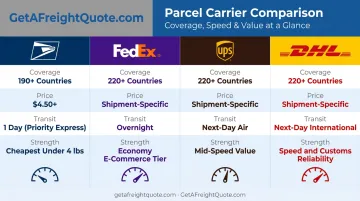
This comparison looks at starting rates, weight limits, transit time, and country coverage across the four dominant US-based international carriers. Each one wins on a different combination of speed, weight, and price.
USPS International Shipping
USPS reaches more than 180 countries and remains the default choice for lightweight, budget-conscious international shipments. It's not glamorous, but it's cheap (as long as your package stays under 4 pounds).
First-Class Package International Service is generally the least expensive tracked-or-untracked option for small parcels. The catch: once a package leaves the US, tracking visibility and delivery speed both drop off noticeably.
| Service Tier | Starting Rate | Weight Limit | Best For |
|---|---|---|---|
| First-Class Package Int'l | $19.40 | Up to 4 lbs | Lightweight, non-urgent shipments |
| Priority Mail Int'l | $32.65 | Up to 70 lbs | Faster delivery, better tracking |
| Priority Mail Express Int'l | $62.70 | Up to 70 lbs | Fastest USPS option, 3-5 business days |
Rates are current as of USPS's First-Class Package International Service page. For anything approaching 4 lbs, run the numbers before defaulting to First-Class: dimensional weight can push you into Priority territory anyway.
FedEx International Shipping
FedEx's network stretches across more than 210 countries and territories, split into a tiered service structure rather than one flat price. There's no universal starting rate; pricing depends on the specific shipment.
What makes FedEx stand out is its economy-tier positioning for e-commerce. It's often one of the cheapest tracked options for direct-to-consumer international shipments, without loading on a residential surcharge the way some services do domestically.
| Service Tier | Transit Time | Best For |
|---|---|---|
| International Economy | 2-5 business days | Cost-conscious tracked shipments |
| International Priority | 1-3 business days | Faster delivery without express pricing |
FedEx does apply a $6.95 per package surcharge on international package services tied to Canada and US import-rated shipments, effective January 2026. Worth factoring in before you assume Economy is always the cheaper path.
UPS International Shipping
UPS covers 220+ countries and territories through a four-tier international lineup. Like FedEx, pricing is shipment-specific rather than one flat number.
The Expedited and Saver tiers offer strong value for mid-speed delivery. But there's a wrinkle worth flagging: UPS has layered in per-pound trade surcharges on top of standard rates.
| Service Tier | Transit Time | Coverage | Best For |
|---|---|---|---|
| Worldwide Expedited | 2-5 business days | 220 countries | Budget-conscious, mid-speed delivery |
| Worldwide Saver | 1-3 business days | 220 countries | Reliable tracking, faster transit |
| Worldwide Express | 1-3 business days | 115 countries | Time-definite midday delivery |
| Worldwide Express Plus | 1-3 business days | 55 countries | Early-morning guaranteed delivery |
These surcharges matter more than they sound. UPS's Surge Emergency Fee notice lists per-pound fees ranging from $0.32 to $1.50 depending on the trade lane, with US-to-UAE and US-to-Israel lanes hitting the top of that range. On a 20-lb shipment, that's an extra $30 you won't see until the surcharge line.
DHL International Shipping
DHL's reputation is built on speed and customs handling, not low prices. Its Express Worldwide network covers 220+ countries, backed by a proprietary customs clearance system that tends to move shipments through borders faster than competitors.
Base pricing depends entirely on weight, zone, and speed — DHL doesn't publish a flat starting rate. What you're paying for is reliability and time-definite delivery.
| Service Tier | Transit Commitment | Coverage | Best For |
|---|---|---|---|
| Express Worldwide | End of next possible business day | 220+ countries | High-value or time-sensitive shipments |
| Express 12:00 | Before noon, next business day | 151 countries | Guaranteed morning delivery |
| Express 9:00 | Next business day, 9:00-10:30 AM | 85 countries | Mission-critical timing |
If cost is your only priority, DHL usually isn't the answer. If reliability on a specific lane matters more than shaving a few dollars off the label, it's worth the premium.
Manually checking rates across all four carriers for every shipment eats into time better spent running your business. GetAFreightQuote.com's TMS rate-shopping platform pulls live USPS, FedEx, UPS, and DHL rates side by side, so you know which carrier is cheapest before you print a label.
How to Actually Secure the Cheapest International Rate for Your Business
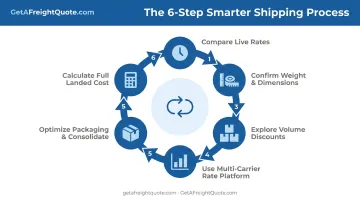
Knowing the carrier landscape is step one. Actually paying less requires a process. Here's what that looks like in practice:
Compare live rates at time of booking. Don't default to one preferred carrier out of habit. Identical packages can price 2-3x apart between services depending on the day, lane, and current surcharges.
Know exact weight and dimensions before quoting. Dimensional weight calculations can silently bump a shipment into a higher pricing tier — a box that "feels" light can still price like it weighs twice as much.
Look into volume-based discount programs. Carriers reserve their best pricing for high-volume shippers. That's a structural disadvantage if you're shipping a few hundred packages a month instead of a few hundred thousand.
Use a multi-carrier rate-comparison platform. Platforms like GetAFreightQuote.com pool shipment volume across hundreds of businesses to unlock negotiated FedEx, UPS, and USPS rates unavailable to individual small shippers, typically 20-50% below retail pricing. Users can also add their own carrier accounts alongside those rates for a true side-by-side comparison.
Optimize packaging and consolidate recurring shipments. Right-sized boxes reduce dimensional weight penalties. Consolidating multiple small shipments on a recurring international route can also lower the per-shipment cost meaningfully.
Calculate full landed cost, not just the base rate. A rate that looks competitive at checkout can turn expensive fast once duties, taxes, and surcharges get added.
For context, GetAFreightQuote.com's self-service platform scales its per-label fee down as shipment volume grows. Occasional shippers (0-3 shipments a week) pay no fee at all, while high-volume operations shipping 2,500+ packages weekly pay just 5 cents per label. The carrier savings alone typically dwarf that fee many times over.
Key Factors to Weigh Beyond the Sticker Price
A cheap rate that arrives late or damaged isn't actually cheap. Before booking on price alone, weigh these:
- Reliability and delivery guarantees — check each carrier's track record on the specific lane you're shipping, not just their general reputation
- Tracking and visibility — confirm international tracking coverage; some economy USPS tiers lose visibility entirely once a package leaves the domestic network
- Insurance and liability coverage — compare default liability limits, since USPS, FedEx, UPS, and DHL calculate them differently, as shown below
| Carrier | Default Liability Coverage |
|---|---|
| USPS Priority Mail Express International | Up to $100 (document coverage) |
| FedEx & UPS | $100 unless higher value is declared |
| DHL | Calculated by weight, not a flat cap |
Higher-value shipments almost always need supplemental insurance purchased separately. Don't assume the default coverage matches what you're actually shipping.
Conclusion
There's no fixed answer to "what's the cheapest international shipping rate." It shifts based on weight, destination, carrier, and how the shipment gets booked. USPS wins on light, non-urgent parcels. FedEx and UPS compete hard in the middle. DHL earns its premium when speed and customs reliability matter more than cost.
The businesses that consistently pay less aren't loyal to one carrier — they compare total landed cost and reliability every time and re-check as surcharges and rate increases shift throughout the year.
GetAFreightQuote.com helps businesses of any size do exactly that: compare negotiated carrier rates side by side, with full transparency and no hidden fees. The pricing that used to be reserved for the largest shippers is available to yours, too.
Frequently Asked Questions
What is the cheapest way to ship things internationally?
USPS First-Class Package International is typically cheapest for parcels under 4 lbs. For anything heavier or time-sensitive, compare live rates across FedEx, UPS, and DHL since pricing shifts by weight and destination.
Which carrier offers the cheapest international shipping rates for small businesses?
There's no fixed answer — it depends on weight and destination for each shipment. Rate-comparison platforms help small businesses surface the cheapest option per shipment instead of guessing.
Is DHL cheaper than USPS for international shipping?
Generally no. DHL is more expensive but faster and better tracked. USPS wins on cost for lightweight, non-urgent shipments where speed isn't critical.
How can a small business get discounted international shipping rates without high shipment volume?
TMS platforms and freight resellers like GetAFreightQuote.com pool negotiated rates across their entire customer base. This gives smaller shippers access to pricing normally reserved for high-volume accounts.
What factors cause international shipping costs to vary so much between carriers?
Package weight and dimensional weight, destination, service speed, fuel surcharges, and customs duties all combine to produce the final rate. Change any one variable, and the price shifts.
Do I need customs forms to ship internationally, and who handles them?
Yes, customs documentation is required for nearly all international shipments. Most carriers and shipping platforms, including USPS, FedEx, UPS, and DHL, now generate these forms electronically.