Introduction
Cross-border ecommerce has become a core growth channel for online sellers. The global cross-border market is on track to hit $4.81 trillion by 2032, and 59% of shoppers surveyed by DHL now buy from retailers outside their home country.
But shipping internationally isn't just domestic shipping with a longer address field. Customs paperwork, duty calculations, carrier selection, and the parcel-versus-freight decision trip up even experienced sellers.
This guide covers the full 2026 playbook: documentation requirements, landed cost math, choosing between parcel and freight, and packaging your shipments so they actually arrive intact. Whether you're shipping ten packages a week or ten thousand, you'll walk away knowing exactly how to ship abroad without the guesswork.
Key Takeaways
- Accurate HS codes, commercial invoices, and EORI/IOSS numbers prevent customs delays and surprise fees.
- DDP vs. DAP determines who pays duties at delivery, and getting it wrong drives cart abandonment and returns.
- Heavier, bulkier, or B2B shipments often perform better through freight forwarding than standard parcel carriers.
- Enterprise-grade freight rates and TMS tools are now accessible to small shippers through platforms like GetAFreightQuote.com.
Why International Ecommerce Shipping Matters in 2026
Selling abroad expands your addressable market, and it often lifts average order value along the way. International buyers also tend to diversify revenue away from any single domestic market slowdown. That upside is real, but so are the headaches.
Common challenges sellers face:
- Customs complexity that varies by product category and destination
- Longer, less predictable transit times compared to domestic orders
- Higher shipping costs driven by distance, weight, and mode
- Currency conversion swings that affect margins
- Returns logistics that require a second trip through customs
The biggest driver of abandoned international carts? Sticker shock at checkout. 48% of cross-border shoppers surveyed by DHL have abandoned a cart because of unexpected customs charges, and 43% cite customs charges as a general barrier to buying from foreign retailers.
That single stat should reshape how you present shipping costs. If a customer doesn't know their landed cost before hitting "buy," they'll often bail rather than risk a surprise bill at the door.
Documentation, Customs & Duties: What Every Ecommerce Shipper Needs to Know
Getting your paperwork right is the difference between a package that clears customs in a day and one that sits in a bonded warehouse for weeks.
HS Codes and Customs Declarations
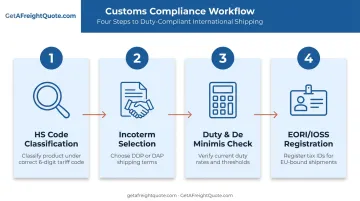
Every international shipment needs a customs declaration — a CN22 for lower-value items, a CN23 or full commercial invoice for higher-value or heavier shipments. The description matters more than most sellers realize; vague terms like "gift" or "merchandise" are a common trigger for manual review.
Product classification runs through Harmonized System (HS) codes, the international nomenclature used by more than 200 countries to determine tariffs. There are over 5,000 commodity groups, each with a six-digit base code that individual countries extend further. Get the code wrong, and you get a customs hold, a duty recalculation, or both.
Incoterms: DDP vs. DAP
Who pays duties and taxes? That's decided by your Incoterm, and it's one of the most overlooked decisions in ecommerce shipping.
| Term | Who arranges transport | Who pays import duties/taxes | Customer experience |
|---|---|---|---|
| DDP (Delivered Duty Paid) | Seller | Seller | Smoothest, no surprise bill at delivery |
| DAP (Delivered at Place) | Seller | Buyer | Risk of delivery-day sticker shock |
Note: "DDU" gets used colloquially, but it isn't part of the current Incoterms 2020 ruleset. DAP is the modern equivalent. DDP costs you more upfront, but it protects the customer relationship and reduces failed deliveries.
Duties, Tariffs, and the 2026 De Minimis Reality
Choosing DDP or DAP determines who owes money at delivery, but how much they owe depends on current duty rates, which vary by destination and shifted significantly in 2025. Duty-free de minimis treatment ended for China and Hong Kong on May 2, 2025, and was suspended for all countries by August 29, 2025.
CBP confirmed the $800 duty-free threshold remains indefinitely suspended as of its 2026 update, while it tests enhanced electronic data requirements for low-value mail.
Translation: don't model your U.S.-bound pricing around the old $800 exemption. Nearly every shipment now carries some duty exposure.
EORI, IOSS, and Tax IDs
Duty exposure isn't limited to the U.S. The EU has its own compliance requirements, starting with two acronyms every seller needs to know: EORI and IOSS. An EORI number is required for customs clearance, full stop.
If you're shipping consignments valued at €150 or less, IOSS simplifies VAT collection at the point of sale rather than at delivery. Many other regions now require a recipient tax ID for smooth clearance too, so check destination-specific rules before you scale.
Restricted and Prohibited Items
Even with paperwork and tax IDs sorted, certain product categories still get flagged. Common categories that trigger holds or outright rejection include:
- Aerosols and pressurized containers
- Lithium batteries (require specific packaging, labeling, and documentation)
- Liquids and perfumes
- Perishables and certain foods
- Counterfeit goods or items resembling weapons
Acceptance by your carrier doesn't guarantee admissibility at the destination. Verify rules per country and per carrier before you list a product for global sale.
Parcel, Courier, or Freight? Choosing the Right Shipping Method for 2026
Not every international order belongs in a parcel box. Here's how the three main options stack up.
Postal services are the budget option: affordable, but slower, with limited tracking visibility once the package leaves your country.
Express couriers like DHL, UPS, and FedEx offer speed and reliable tracking (DHL's Parcel International Direct runs 3-10 business days across 37 markets), but you pay a premium for it.
Freight forwarders become the better choice once your shipments hit certain thresholds:
- Bulk B2B or wholesale orders
- Restocking an overseas warehouse or retail partner
- Importing inventory from overseas manufacturers
- Oversized or heavy products that exceed standard parcel limits
Air Freight vs. Ocean Freight
If you do need freight, the next decision is mode. According to Freightos' comparison of air and ocean freight, air freight moves faster and offers more reliable tracking, while ocean freight costs significantly less for large-volume shipments but takes weeks instead of days. A shipment that arrives in 5 days by air can take 25-30 days by ocean, often at a fraction of the per-unit cost. Use air for time-sensitive restocks; use ocean for bulk inventory replenishment where cost matters more than speed.
Where TMS Technology Comes In
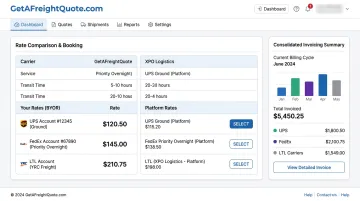
Comparing parcel, LTL, and freight rates across multiple carriers used to mean juggling spreadsheets and separate carrier logins. A Transportation Management System (TMS) puts every quote on one screen instead.
This is where GetAFreightQuote.com fits into the picture. The platform gives small and mid-sized ecommerce brands access to negotiated freight rates once reserved for Fortune 500 shippers, alongside enterprise TMS tools, without requiring Fortune 500 volume to unlock them.
Sellers can even add their existing UPS, FedEx, or LTL carrier accounts into the dashboard, a feature called Bring Your Own Rates. This lets you shop those contracts side-by-side against the platform's own discounted pricing, with consolidated invoicing across every carrier used.
Negotiate on Volume, Consolidate Where Possible
Whether you book through a TMS platform or negotiate directly with carriers, freight pricing tiers reward volume commitments. Consolidating shipments (combining smaller orders into fewer, larger freight loads) is one of the most reliable ways to unlock better pricing tiers without waiting to grow into enterprise-scale volume organically.
Calculating & Reducing the Total Landed Cost of International Shipping
Your landed cost is the full expense of getting a product to a customer abroad, not just the sticker price on the shipping label.
Landed cost components:
- Base freight or shipping rate
- Duties and import taxes
- Insurance
- Fuel surcharges
- Currency conversion impact
Flat-Rate vs. Real-Time Carrier Rates
Flat-rate shipping bands are simple to display at checkout but often overcharge on light packages and undercharge on heavy ones, eating margin either way. Real-time carrier-calculated rates are more accurate but require integration work. For international orders specifically, real-time rates tend to protect profitability better once volume grows.
Watch for Hidden Fees
Carriers bury real costs in surcharge schedules that rarely make it into casual rate comparisons:
- Remote area surcharges: often $50 per shipment or $0.50/lb, whichever is higher
- Oversize or overweight fees: commonly $30-$100 per package depending on dimensions
- Fluctuating fuel surcharges: adjusted multiple times per year by major carriers
Review a carrier's full fee schedule before committing to a lane, not just the headline rate.
Volume Discounts and Checkout Transparency Cut Costs
Shipment volume directly impacts negotiated rates: that's standard freight economics. What's changed is that platforms aggregating volume across many small shippers, including GetAFreightQuote.com, can pass along Fortune 500-level discounts without requiring individual shippers to hit Fortune 500-level volume themselves.
Transparency matters just as much as rate discounts. Unexpected customs charges are a leading cause of cart abandonment among cross-border shoppers, so displaying estimated duties and taxes before checkout directly protects your conversion rate.
Packaging, Insurance & Managing International Returns
Getting a package physically ready for international transit matters as much as the paperwork inside it.
Packaging best practices:
- Use reinforced boxes — international shipments pass through more handling points than domestic ones
- Fill all void space so contents can't shift during transit
- Format addresses correctly: full country name in capitals, and avoid mixing ISO codes with written names
Small formatting errors on the label cause delivery delays more often than sellers expect.
When to Add Insurance
Standard carrier coverage rarely covers full replacement value. Add supplementary international shipping insurance for high-value items, fragile goods, or shipments heading to regions with higher loss or damage rates.
Multi-carrier rate-shopping tools, including GetAFreightQuote.com's platform, make it easy to compare these added insurance costs before choosing a carrier.
Returns Need a Clear Policy Upfront
Return rates and regulations vary widely by country, and there's no reliable universal benchmark comparing domestic to cross-border return rates. What is clear: 33% of global shoppers avoid buying internationally because of return costs, and 79% will abandon a cart if their preferred return option isn't available.
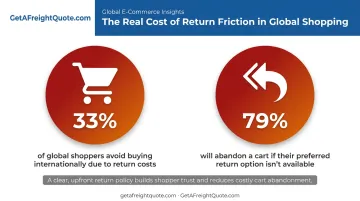
Spell out, before the sale, who covers return shipping and any customs re-entry costs. Ambiguity here erodes trust fast.
Frequently Asked Questions
What is the difference between DDP and DDU shipping for international orders?
DDP means the seller prepays duties and taxes, giving buyers a smoother, surprise-free delivery experience. DAP (often still called DDU) leaves the buyer responsible for these costs at the time of delivery.
How much does international shipping cost for ecommerce businesses in 2026?
Costs depend on destination, package weight and dimensions, shipping method (parcel vs. freight), and applicable duties and taxes. Comparing rates across multiple carriers is the most reliable way to control total cost.
Do I need a freight forwarder for international ecommerce shipping?
Freight forwarders make the most sense for bulk, heavy, or B2B international shipments. Standard parcel carriers typically suit individual direct-to-consumer orders just fine.
What documents are required to ship internationally?
Core documents include the commercial invoice, a customs declaration (CN22/CN23), correct HS codes, and a Certificate of Origin where applicable. Missing or vague documentation is the top cause of customs delays.
How can small ecommerce businesses get better international shipping rates?
Partnering with a platform like GetAFreightQuote.com that offers pre-negotiated carrier rates gives smaller shippers access to volume discounts they couldn't secure alone.
What items are restricted or prohibited from international shipping?
Common restricted categories include aerosols, lithium batteries, liquids, and perishables. Rules vary by destination country and carrier, so verify before listing a product for global sale.