Shippers face a real headache, though. Costs swing wildly depending on carrier, weight, and service level. Many small businesses overpay simply because they never negotiated rates or never bothered comparing all their options, parcel and freight alike.
This guide breaks down the cheapest carriers and services for 2026, explains what actually drives your total cost, and shows how businesses of any size can access better rates.
Key Takeaways
- USPS and FedEx win for parcels under 4.4 lbs; LTL freight wins for pallets and bulk orders
- CUSMA duty-free thresholds differ between courier (CAN$40-150) and postal (CAN$20) shipments
- Comparing multiple carriers before booking is the single biggest lever for cutting costs
- Small businesses can access negotiated freight rates via GetAFreightQuote.com, no Fortune 500 volume required
Overview of Shipping to Canada from the US in 2026
Shipping to Canada feels domestic, but it isn't. Every shipment crosses an international border, which means customs declarations, HS codes, and Canada Border Services Agency (CBSA) clearance. That changes how "cheapest" gets calculated. The final cost includes duties, taxes, and any brokerage fees on top of the base rate, not just the sticker price.
Geography works in shippers' favor here. Roughly 66% of Canadians live within 100 km of the US border, according to Statistics Canada's 2016 census data. That proximity keeps most transit times short and costs relatively manageable compared to overseas shipping.
Below, we compare the cheapest available carriers and services, from small parcels to bulk freight, using published 2026 rate data.
Cheapest Shipping Options to Canada from the US in 2026
We compared each option on four criteria: cost per pound, transit time, tracking reliability, and total landed cost, including customs and brokerage fees.
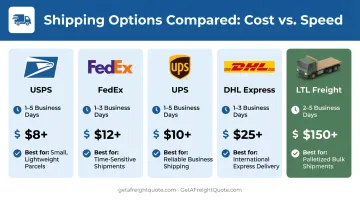
USPS (First-Class Package International / Priority Mail International)
USPS remains the go-to for very light parcels under 4.4 lbs. Once a shipment crosses the border, USPS hands it off to Canada Post for final delivery, which keeps prices low but adds a layer of unpredictability to tracking.
It stands out because it's simply the cheapest sticker price available for light packages. The tradeoff is slower transit and thinner tracking visibility, making it a fit for non-urgent, lower-value shipments rather than anything time-sensitive.
| Starting Price | $26.00 (First-Class Package International, 1 lb) |
| Transit Time | No fixed published window; Priority Mail International runs 6-10 business days |
| Best For | Light, low-value, non-urgent parcels |
FedEx (International Connect Plus / Ground)
FedEx built International Connect Plus specifically for e-commerce sellers shipping into Canada. It balances a lower cost profile with moderate speed, which is exactly what small business shippers need.
FedEx often undercuts USPS Priority for similar transit times, with noticeably better tracking. International Ground typically delivers in 2-7 business days, while International Connect Plus targets a 3-day window to Canada.
| Starting Price | Quote-based; varies by zone, weight, and dimensions |
| Transit Time | 2-7 business days (Ground); 3 days (International Connect Plus) |
| Best For | Small-to-medium e-commerce parcels needing a cost/speed balance |
UPS (Standard / Worldwide Expedited)
UPS Standard is a reliable ground option that reaches most Canadian addresses door-to-door. Worldwide Expedited exists for shippers who need faster delivery and are willing to pay for it.
Consistency is the real selling point. UPS covers virtually every province, though rates climb quickly once you step up to expedited service.
| Starting Price | $30.59-$47.82 (2-lb Standard, zone-dependent, fuel excluded) |
| Transit Time | Day-definite (Standard); 2-5 business days (Worldwide Expedited) |
| Best For | Businesses needing reliable ground delivery without express pricing |
DHL Express
DHL Express is the speed-focused option, and it comes with a built-in duty and tax calculator (MyGTS) that gives shippers upfront cost visibility instead of surprises at the border.
DHL wins on speed, offering the fastest average transit to major Canadian cities. That speed carries a real premium, so it's best reserved for shipments where timing matters more than shaving off a few dollars.
| Starting Price | $117.50 reference rate (1-lb Express Worldwide, Zone A) |
| Transit Time | Typically 1-2 business days to major cities |
| Best For | Time-sensitive shipments where a modest cost premium is acceptable |
LTL/FTL Freight via GetAFreightQuote.com
Once shipments get palletized, bulky, or numerous, parcel carriers stop making financial sense. Their per-pound pricing model breaks down fast at volume. LTL and FTL freight becomes the cheaper path per pound for bulk B2B shipments.
This is where GetAFreightQuote.com fits in. The platform gives small and mid-sized businesses access to negotiated carrier rates and TMS technology typically reserved for Fortune 500 shippers, with full rate transparency and zero hidden fees.
Businesses can compare freight quotes side-by-side before booking. A "Bring Your Own Rates" feature also lets shippers connect their existing UPS, FedEx, or LTL carrier accounts to benchmark against the platform's pre-negotiated pricing.
Through this structured negotiation process, GetAFreightQuote.com has delivered LTL savings typically ranging from 15% to 35%, translating to more than $500 million in collective client savings.
| Pricing Model | Negotiated per-hundredweight freight rates, cheaper than parcel per-pound cost at volume |
| Best For | Palletized goods, bulk inventory transfers, businesses without enough volume to negotiate their own contracts |
| Key Advantage | Side-by-side rate comparison plus the ability to add existing carrier accounts for best-price matching |
Factors That Affect Shipping Costs to Canada
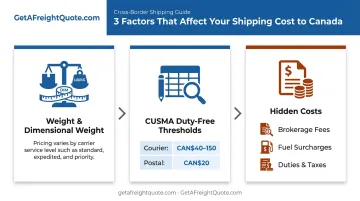
Three main levers determine what you actually pay, and none of them are the "advertised" rate alone.
Weight, dimensional weight, and service level shape your base rate:
- Actual weight sets the starting price tier for any carrier
- Dimensional weight, calculated from length, width, and height rather than actual weight, often costs more for bulky-but-light items like pillows or lampshades
- Service level, ground versus expedited, can double the cost for the identical package
CUSMA de minimis thresholds create the second major cost variable, and courier versus postal treatment differs sharply:
| Shipment Type | Duty & Tax-Free Threshold | Duty-Free (Taxes Still Apply) |
|---|---|---|
| Courier | Up to CAN$40 | Up to CAN$150 |
| Postal | Up to CAN$20 | Not applicable |
These figures come from CBSA's official CUSMA guidance, and thresholds can shift with trade policy changes, so confirm current rules before you ship.
Finally, watch for hidden costs layered on after the quoted rate:
- Brokerage fees for customs entry preparation
- Fuel surcharges, often index-based and adjusted weekly
- Duties and taxes above the applicable threshold
Rate-shopping platforms like GetAFreightQuote.com's TMS surface these add-ons side-by-side before you book, so the quoted rate matches what you actually pay. Choosing a Delivered Duty Paid (DDP) option shifts these costs to the shipper upfront, preventing surprise charges for the recipient at the door.
How We Chose the Cheapest Shipping Options
Our comparison relied on published 2026 rates for standardized package sizes and weights across each carrier. We cross-checked these rates against transit time reliability and total landed cost, meaning duties, taxes, and brokerage fees, not just the base shipping rate.
The most common mistake businesses make? Picking a carrier based on the advertised base rate alone. A shipment that looks cheapest at checkout can quickly become the most expensive option once these costs stack up:
- Dimensional weight charges
- Fuel surcharges
- Customs and brokerage fees
Rate-shopping across carriers before booking catches these gaps before they hit your invoice.
Conclusion
The cheapest way to ship to Canada in 2026 depends on what you're sending and how fast you need it there. Small parcels favor USPS or FedEx. Bulk or palletized shipments are almost always cheaper when moved through LTL freight instead of parcel carriers.
Rate-shop across multiple carriers every time, and factor in total landed cost, not just the quoted shipping price, before you finalize a decision.
If your business ships pallets, bulk inventory, or recurring B2B freight into Canada, get a free freight quote from GetAFreightQuote.com and access negotiated carrier rates without needing enterprise-level shipping volume.
Frequently Asked Questions
What is the cheapest way to ship items from the US to Canada?
For light parcels, USPS or FedEx International Connect Plus typically offer the lowest rates. For bulk or palletized shipments, LTL freight is almost always cheaper per pound.
How much does it cost to ship a package to Canada from the US in 2026?
Costs vary by weight, carrier, and service level. Reference the rate comparisons above for current pricing across USPS, FedEx, UPS, and DHL.
Do I have to pay customs duties when shipping to Canada?
Most US-made goods qualify duty-free under CUSMA, but Canadian sales tax and brokerage fees may still apply once you pass the courier (CAN$40-150) or postal (CAN$20) thresholds.
What's the cheapest way to ship pallets or bulk freight to Canada?
LTL freight with negotiated carrier rates is often much cheaper per pound than parcel carriers for bulk shipments. Platforms like GetAFreightQuote.com let you compare freight quotes side-by-side before booking.
How long does shipping to Canada take?
Transit times range from 1-2 business days for DHL Express to 6-10 business days for USPS Priority Mail International. Ground and economy postal options land on the slower end.
Is USPS or FedEx cheaper for shipping to Canada?
USPS is typically cheaper for very light packages under 4.4 lbs. FedEx often wins on cost-to-speed ratio once packages get slightly heavier, plus it offers better tracking visibility.