The tricky part? There's no single "shipping cost" to plan around. A one-pound phone case and a 40-pound patio heater don't belong in the same budget line. Weight, dimensions, destination zone, carrier, delivery speed, and whether the item ships as a small parcel or freight all move the number independently.
This guide breaks down realistic 2025 cost ranges, the factors driving those numbers up or down, how to calculate your own shipping costs step by step, and when switching from parcel to freight actually saves money.
Key Takeaways
- Parcel costs range from under $10 to $200+; freight pricing is quoted separately by class and lane.
- Weight, DIM weight, shipping zone, and delivery speed drive most cost differences between similar orders.
- Packages over 150 lbs or oversized dimensions often get reclassified to LTL freight.
- Smarter packaging, multi-carrier rate shopping, and negotiated pricing cut shipping costs without slowing delivery.
How Much Does Ecommerce Shipping Cost? (Pricing Overview)
There's no fixed price tag for shipping an ecommerce order. Cost depends on the package's weight and size, where it's headed, which carrier handles it, and how fast it needs to arrive. Anyone quoting a single flat number is guessing.
That guess becomes expensive fast. A flat average might work fine for a 2-lb T-shirt shipment, but it falls apart the moment an order is oversized, unusually heavy, headed to a rural zip code, or crossing an international border.
Sellers who budget shipping as one static line item routinely watch it erode margin on exactly those orders.
Typical Cost Ranges (2025 Published Rates)
| Package profile | Weight | Typical published rate range |
|---|---|---|
| Light/small parcel (USPS Ground Advantage) | Under 1 lb | $6.80 – $11.95 |
| Standard parcel (USPS/UPS/FedEx ground) | 1–20 lbs | $8.70 – $69.79 |
| Heavy/oversized parcel (UPS/FedEx ground) | 21–150 lbs | roughly $20 – $283 |
| Freight/LTL (palletized goods) | 150+ lbs | Quote-based; no fixed per-pound rate |
These figures are base carrier rates only. They exclude fuel surcharges, residential delivery fees, address corrections, insurance, and packaging or handling labor — all of which stack on top and can add 15-30% to the final bill.
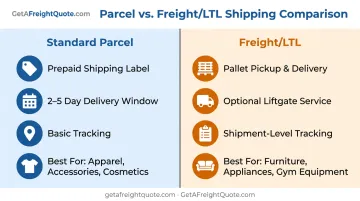
Price Tier: Standard Parcel
Standard parcel service typically includes:
- A prepaid shipping label
- A standard delivery window (usually 2-5 business days for ground)
- Basic tracking with delivery confirmation
Best for: apparel, accessories, cosmetics, and other lightweight, small-footprint products that fit easily in a poly bag or small box.
Price Tier: Freight/LTL
Less-than-truckload service is priced and structured differently. It typically includes:
- Pallet-based pickup and delivery (dock-to-dock)
- Optional liftgate service for locations without a loading dock
- Shipment tracking, though less granular than parcel tracking
Best for: furniture, appliances, gym equipment, and other bulky or palletized ecommerce goods that don't fit inside a standard parcel box.
Key Factors That Affect the Cost of Ecommerce Shipping
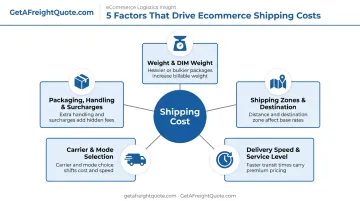
Shipping pricing depends on package characteristics, destination, service level, and which carrier or mode you choose. Here's what actually moves the needle.
Weight and Dimensional (DIM) Weight
Carriers bill whichever is higher: the actual weight or the dimensional weight calculated from the box's size. A large, lightweight box (think a lampshade or a pillow) can cost more than a small, dense one of the same weight.
Right-sizing your packaging, using a box that closely matches the product, directly lowers DIM-weight charges. This is one of the cheapest fixes available, and most sellers never bother with it.
Shipping Zones and Destination
Carriers divide the country into zones based on distance from the shipment's origin (USPS and UPS/FedEx both use multi-zone charts). The farther the package travels, the higher the rate climbs: a 20-lb package shipped to a nearby zone can cost half of what the same package costs shipping coast to coast.
International orders add another layer: customs, duties, and import taxes that vary by destination country.
Delivery Speed and Service Level
Expedited and overnight service can cost multiples of standard ground rates for the same package. Most customers, however, don't actually want to pay for that speed.
More than 95% of US consumers prefer free standard delivery over paid expedited delivery, according to McKinsey's research on US consumer delivery preferences. Nearly 90% say they're willing to wait two to three extra days to avoid a shipping charge. Offering free standard shipping usually beats subsidizing fast shipping.
Carrier and Shipping Mode Selection
USPS, UPS, and FedEx each price differently depending on weight, zone, and package profile, and none of them are uniformly cheapest. Freight carriers operate on an entirely separate rate structure built around freight class and density.
Published "rack rates" are rarely what larger shippers actually pay. Negotiated, volume-based pricing can run well below list price, which is exactly the gap that leaves smaller sellers overpaying by comparison.
Packaging, Handling, and Surcharges
Surcharges can add up quickly:
- Fuel surcharges (adjusted regularly by carriers)
- Residential delivery fees
- Address correction fees
- Oversized package fees
- Liftgate or inside delivery for freight shipments
Insurance and special handling (fragile, hazardous, or perishable goods) add further cost on top of the base rate.
How to Calculate Your Ecommerce Shipping Costs
The basic formula looks like this:
Shipping Cost = Carrier Base Rate + Surcharges + Packaging + Handling + Insurance + Duties/Taxes
Working through it step by step:
- Determine billable weight. Measure actual weight and calculate DIM weight (length × width × height ÷ carrier divisor). Use whichever is higher.
- Identify the shipping zone. Enter origin and destination zip codes into the carrier's zone chart to find the applicable rate tier.
- Select a service level and add surcharges. Ground versus expedited changes the base rate significantly; layer on fuel, residential, or oversized fees as they apply.
Worked example: Shipping a 20-lb standard parcel domestically via ground service typically lands between $20 and $70, depending on carrier and zone distance. That range assumes the box's dimensions stay within standard limits.
Oversized boxes change the math. A bulky but light item, like a patio cushion, can push the DIM weight (and the rate) noticeably higher. If the box exceeds carrier size limits, the shipment may tip into freight territory altogether.
For heavier, palletized, or multi-unit shipments, manually pulling rate charts for every carrier gets tedious fast. Freight quoting tools solve this: a platform like GetAFreightQuote.com's LTL Quote tool returns side-by-side rate and transit comparisons from over 100 LTL carriers in seconds, with no account required.
Parcel vs Freight: Choosing the Right Mode and Lowering Your Costs
When Parcel Becomes More Expensive Than Freight
Parcel carriers have hard ceilings: USPS Ground Advantage tops out at 70 lbs, while UPS and FedEx cap standard packages at 150 lbs. Cross that line, or exceed carrier dimension limits, and parcel either gets prohibitively expensive or the carrier simply won't take the shipment.
That's typically the point where LTL freight, priced by pallet rather than by package, starts making more financial sense.
Here's the catch for smaller sellers: freight pricing has historically rewarded volume. A furniture brand shipping five pallets a week has never had access to the same per-pound rates as a big-box retailer moving thousands.
That volume gap is exactly what platforms like GetAFreightQuote.com were built to close. The platform gives small and mid-sized ecommerce shippers access to pre-negotiated LTL rates plus a free TMS, regardless of how many pallets they move in a given week.
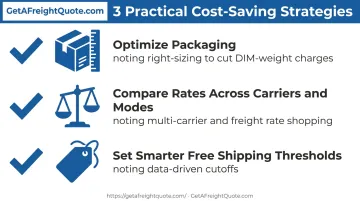
Practical Ways to Lower Ecommerce Shipping Costs
- Optimize packaging. Right-size boxes and lightweight fill materials cut DIM-weight charges directly.
- Compare rates across carriers and modes. Load your own UPS, FedEx, or LTL accounts alongside negotiated rates for a "Bring Your Own Rates" comparison, ensuring every shipment books at the lowest price.
- Set smarter free shipping thresholds. Use your actual order and shipping data to set a free-shipping cutoff, or build small cost increments into product pricing instead of shocking customers with the full charge at checkout.
Conclusion
Ecommerce shipping doesn't have one price. It's a function of weight, zone, speed, carrier, and mode, and treating it as a flat number is how margins disappear without warning. Understanding these variables, and knowing exactly when a shipment should move from parcel to freight, turns shipping from a guessing game into a budgeted line item.
The right shipping cost is the one that protects your margin without wrecking the customer experience. Whether that comes from tighter packaging, better rate access, or shifting heavier orders to freight, the fix, often available through platforms like GetAFreightQuote.com, usually costs less than the surprise did.
Frequently Asked Questions
How do I calculate shipping charges for ecommerce?
Add the carrier's base rate to surcharges, packaging costs, handling, insurance, and any duties or taxes for international orders. Start by finding your billable weight (actual vs. DIM weight, whichever is higher), then apply the zone-based rate chart.
How much would it cost to ship a 20 lb item?
Domestically via ground service, expect roughly $20 to $70 depending on carrier and zone distance. That range assumes standard dimensions. An oversized box can push the cost higher through DIM weight adjustments.
What's a reasonable shipping cost as a percentage of order value?
Many ecommerce sellers aim to keep shipping around 5-12% of cart value, since costs above that range tend to trigger checkout abandonment. There's no universal rule here, so test it against your own conversion data.
How can small ecommerce businesses get better shipping rates?
Compare rates across multiple carriers instead of defaulting to one, and negotiate based on your actual shipment volume. Platforms like GetAFreightQuote.com pool small-business volume to unlock pre-negotiated, Fortune 500-level rates without minimum shipment requirements.
What's the difference between shipping cost and shipping rate?
Shipping cost is what you actually pay the carrier to move a package. Shipping rate (or shipping charge) is what you display and collect from the customer at checkout, but the two numbers don't have to match.
Is freight shipping cheaper than parcel for large ecommerce orders?
Once a shipment crosses roughly 150 lbs or exceeds a carrier's parcel size limits, LTL freight typically becomes the more cost-effective option. It's priced by pallet and freight class rather than individual package rates, which shifts the cost math in your favor at higher weights.