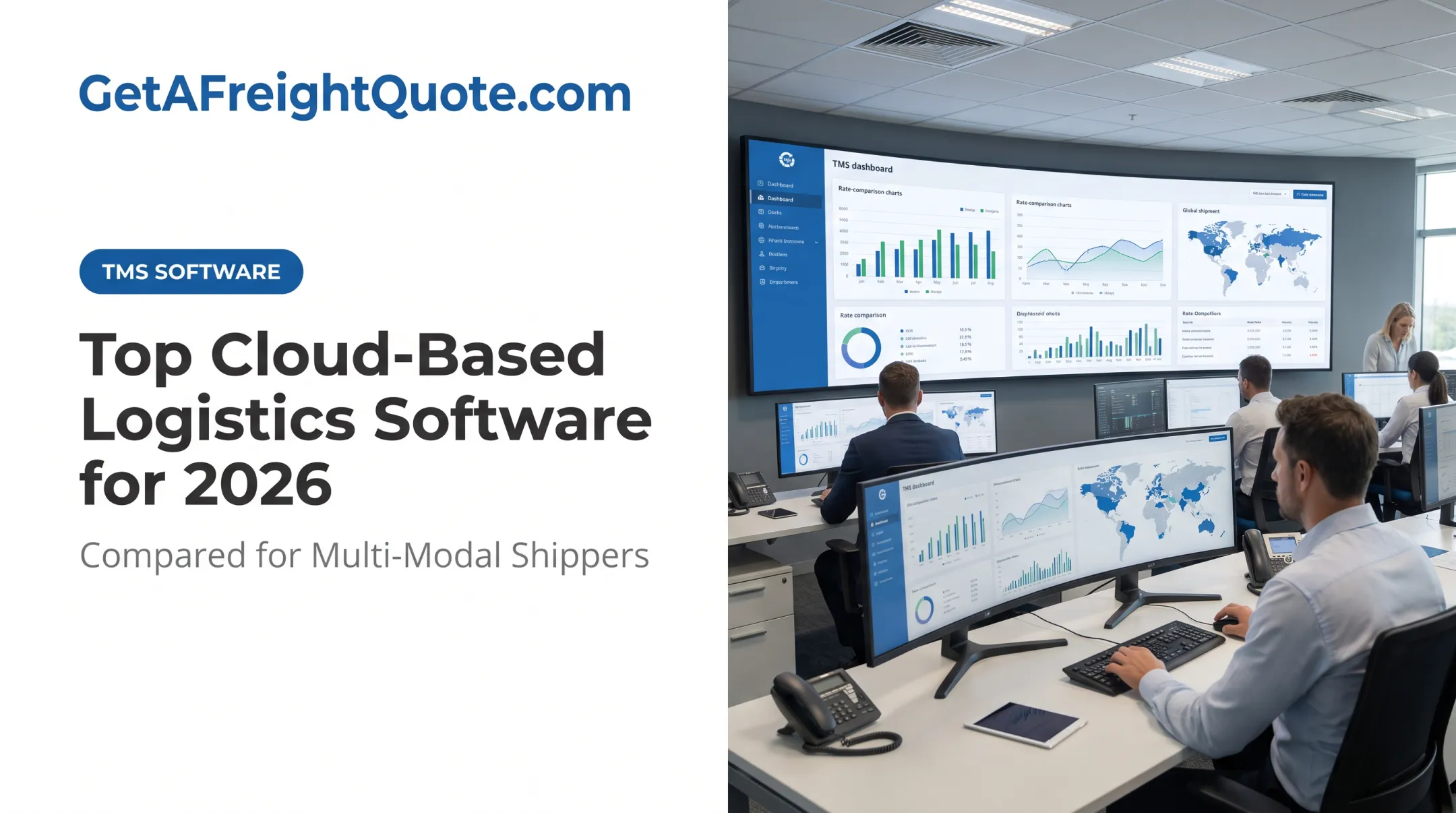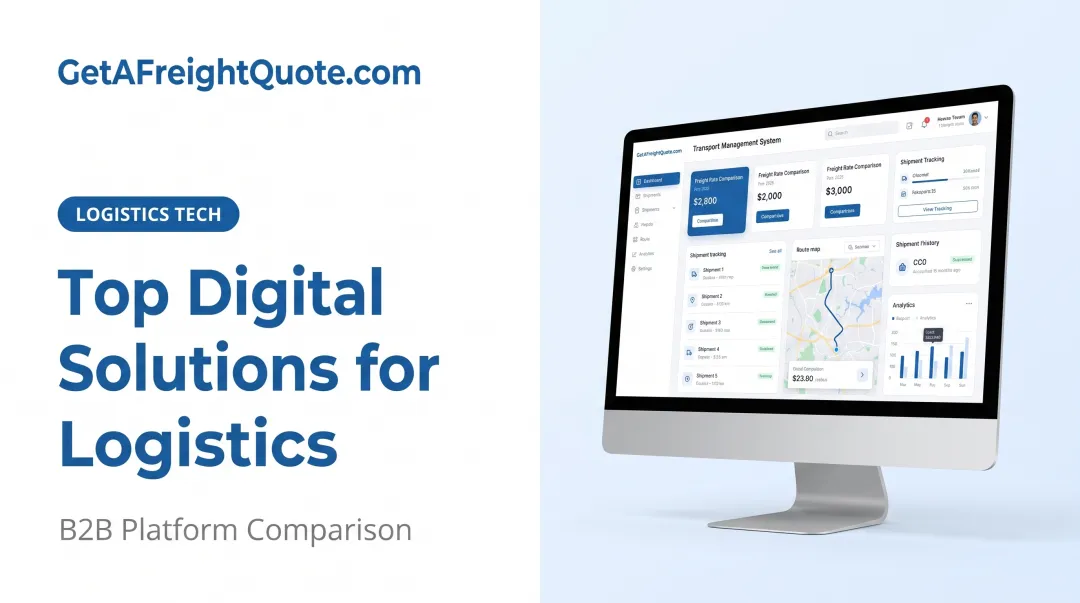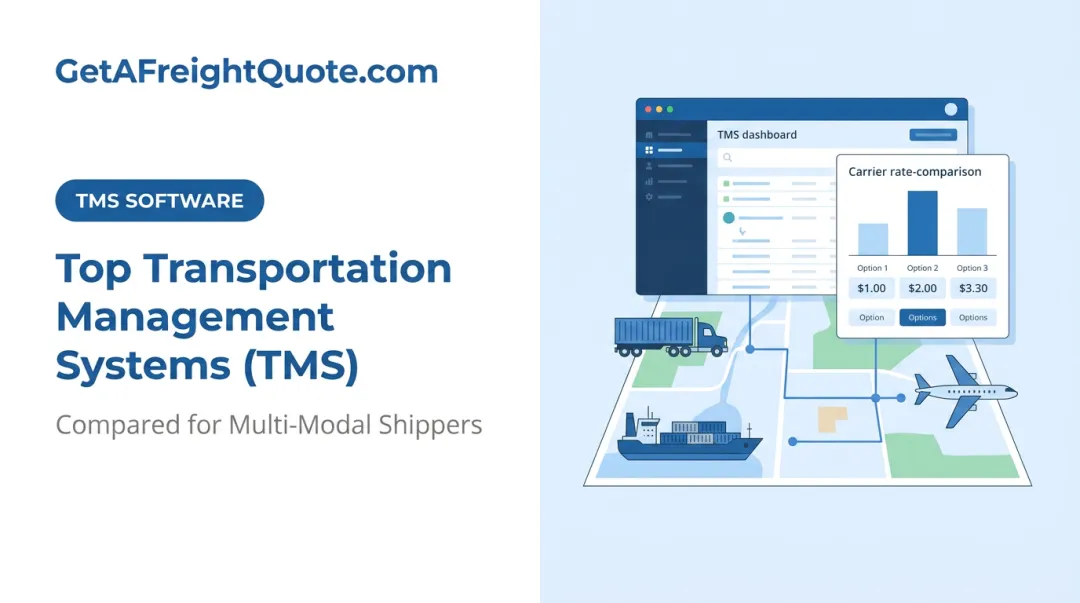
Unlike pure software vendors, today's logistics technology leaders provide integrated solutions that bundle TMS tools with freight procurement, compliance automation, and managed services. This article ranks the top 10 logistics software companies serving U.S. businesses, with special attention to solutions accessible to small and mid-sized operations that historically faced enterprise-only pricing barriers.
Key Takeaways
- Top logistics software firms combine TMS platforms, carrier networks, compliance tools, and U.S.-focused support
- Buyers can choose full TMS suites, real-time visibility, digital freight marketplaces, or platform-plus-services models
- Match software to shipment volume, modes (parcel/LTL/FTL/ocean), IT capacity, and service-model preference
- Cloud platforms and reseller partnerships put enterprise tools within reach of small and mid-sized shippers
- The right partner drives ROI with transparent pricing, scalable tech, and compliance built in from day one
Overview of Logistics Software Companies in the U.S. Market
A true logistics software company does more than license code. These providers combine technology platforms with domain expertise, pre-negotiated carrier relationships, and often managed services to solve end-to-end challenges—rate shopping, booking, tracking, compliance, analytics, and exception management—within a single ecosystem.
In 2025, 55% of supply-chain leaders increased technology investment, and 60% allocated budgets exceeding $1 million to supply chain innovation. Yet small and mid-sized businesses have historically struggled to access enterprise tools due to six-figure implementation costs and volume-based pricing models.
Cloud-based SaaS platforms, reseller partnerships, and digital freight marketplaces have since removed many of these barriers. Shippers of all sizes can now use the same automation, visibility, and rate optimization that Fortune 500 companies rely on.
The ranking below evaluates companies on:
- Technology capabilities and service models
- U.S. market presence and regulatory compliance support
- Accessibility from startups shipping five pallets per week to enterprises managing thousands of daily shipments
Top 10 Logistics Software Companies for U.S. Businesses
Top 11 Logistics Software Companies for U.S. Businesses
Companies were selected based on technology innovation, carrier network breadth, integration capabilities, U.S. regulatory expertise, scalability, and customer support quality.
GetAFreightQuote.com
GetAFreightQuote.com is an authorized reseller of an established TMS platform, built as "the equalizer" for small and mid-sized businesses shut out of Fortune 500 carrier pricing. By pooling volume across hundreds of shippers, it offers enterprise TMS tools and top-tier rates at accessible price points. The platform is self-funded: carrier savings of 20–50% typically exceed the 5–9¢ per-label fee by 20–40 times, so most shippers recover costs within their first few shipments.
Key differentiators:
- Pre-negotiated carrier rates typically reserved for high-volume shippers, across 100+ LTL/FTL carriers plus FedEx, UPS, and USPS parcel options
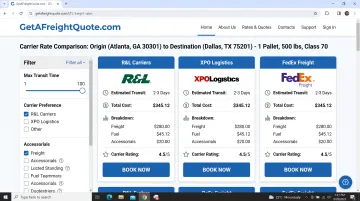
- Side-by-side rate comparison—customers can connect their own carrier accounts alongside GetAFreightQuote.com rates to select the lowest cost for each shipment
- Full rate transparency—all-in pricing displayed before booking, with no hidden fees
- Hybrid model—self-service TMS technology combined with hands-on logistics support for special requests, HAZMAT compliance, and complex shipments
| Feature Category | Details |
|---|---|
| TMS Platform Features | Multi-carrier rate shopping across parcel/LTL/FTL, real-time shipment tracking, automated documentation and tendering, carrier performance analytics, WMS and ERP integration (NetSuite, SAP, QuickBooks), consolidated e-billing |
| Carrier Network & Pricing | Access to negotiated rates across 100+ domestic LTL/FTL carriers and major parcel providers; ability to add own carrier accounts for comparison; transparent all-in pricing shown before booking; typical savings of 20–50% |
| Best For | Small to mid-sized U.S. manufacturers, distributors, ecommerce sellers, and wholesalers seeking enterprise TMS capabilities without enterprise costs; companies shipping inconsistent or growing volumes (5–500+ loads/month) looking to reduce freight spend while maintaining operational flexibility |
Descartes Systems Group
Descartes is a global logistics technology leader with more than 40 years in the market, offering a modular suite of solutions spanning routing, mobile workforce management, telematics, transportation management, trade compliance, and ecommerce logistics. The Descartes Global Logistics Network (GLN) connects 30,000+ customers and supports domestic and international shipping, last-mile delivery, rating, freight payment, trade research, and customs automation.
What makes Descartes stand out:
- Multimodal breadth—covers parcel, LTL, FTL, ocean, and air within a single platform ecosystem
- Trade intelligence—robust customs compliance and tariff classification modules critical for U.S. importers and exporters
- Proven scalability—serves businesses from SMB through enterprise, with modular deployment that grows with operational complexity
- Carrier and trading-partner network—GLN provides pre-built connectivity across thousands of logistics partners
| Feature Category | Details |
|---|---|
| Core Solutions | Transportation management, routing & mobile workforce, trade compliance & customs automation, carrier and freight-forwarder connections, telematics, ecommerce shipping |
| Integration & Network | Descartes Global Logistics Network with 30,000+ customers; API connectivity for custom workflows; cloud-based and modular architecture |
| Best For | Mid-sized to large U.S. companies with complex multimodal shipping needs; businesses engaged in international trade requiring customs and compliance automation; operations needing deep connectivity with ERP, WMS, and trading-partner systems |
Oracle Transportation Management (OTM)
Oracle OTM is the enterprise-grade TMS leader, recognized as a 2025 Gartner Magic Quadrant Leader for the 18th consecutive year. Gartner positioned it highest for execution ability and furthest for completeness of vision. Part of Oracle's broader Supply Chain Management Cloud suite, OTM is built to handle the most complex, high-volume transportation operations with advanced planning, execution, freight payment, and global trade capabilities.
Key differentiators:
- Comprehensive planning and execution for all transportation modes—truckload, LTL, parcel, ocean, air, rail, and intermodal
- Advanced optimization algorithms for load planning, route optimization, and dynamic carrier selection using machine learning
- Deep Oracle ecosystem integration—native connectivity with Oracle ERP Cloud, Order Management, and Warehouse Management
- Global trade management—embedded compliance, documentation, and duty calculation for international shipments
| Feature Category | Details |
|---|---|
| Platform Capabilities | Transportation planning and execution, freight payment and audit, global trade compliance, real-time visibility and predictive ETAs, analytics dashboards, mobile apps for drivers and operations teams |
| Technology & Deployment | Cloud-native SaaS platform; AI and ML-powered optimization; extensive API library for integrations; continuous updates without manual upgrades |
| Best For | Large enterprises with complex, high-volume shipping operations (1,000+ shipments/month); companies already using Oracle ERP systems seeking tight integration; organizations requiring sophisticated optimization, global trade management, and advanced analytics |
Blue Yonder
Blue Yonder—formerly JDA Software, rebranded in 2020—is a leading supply chain platform provider that integrates TMS, WMS, and supply chain planning into a unified suite powered by the Luminate AI platform. The company serves 3,000+ customers and processes 20 billion+ AI/ML predictions daily, combining demand forecasting, warehouse execution, transportation management, and last-mile delivery into end-to-end supply chain orchestration.
Standout features:
- End-to-end visibility—connects planning, inventory, warehouse operations, and transportation in a single platform
- AI-driven intelligence—autonomous demand forecasting, dynamic fulfillment recommendations, and real-time exception management
- Integrated warehouse + transportation—tight coordination between WMS and TMS enables optimized pick/pack/ship workflows
- Industry-specific solutions—tailored modules for retail, manufacturing, and third-party logistics providers
| Feature Category | Details |
|---|---|
| Logistics Solutions | Transportation Management System, Warehouse Management System, Yard Management, Labor Management, Parcel & Last-Mile optimization, network design |
| AI & Analytics | Luminate AI platform for predictive analytics; autonomous planning capabilities; real-time exception management; prescriptive recommendations for capacity, routing, and fulfillment |
| Best For | Mid-sized to large companies seeking an integrated supply chain and logistics platform; retailers and manufacturers needing warehouse + transportation coordination; businesses wanting AI-driven optimization across planning and execution |
project44
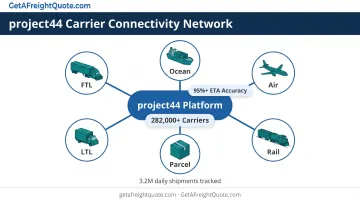
project44 is the leading advanced visibility platform, providing real-time tracking and predictive ETAs across all transportation modes by connecting directly to carriers' systems via API. The platform integrates with 282,000+ active carriers and works alongside existing TMS and ERP platforms rather than replacing them, making it a plug-and-play intelligence layer for supply chain visibility.
Key differentiators:
- Largest carrier network—282,000+ integrated carriers across truckload, LTL, ocean, air, rail, parcel, and last-mile, with API-based tracking eliminating screen scraping
- Predictive analytics—machine learning trained on billions of shipments delivers 95%+ ETA accuracy within 15 minutes, with proactive exception alerts
- Platform approach—integrates with any TMS, ERP, or WMS to add visibility without disrupting existing workflows
- Multimodal strength—particularly strong in ocean and international visibility, a common pain point for importers
| Feature Category | Details |
|---|---|
| Visibility Capabilities | Real-time tracking across ocean, air, parcel, LTL, FTL, rail, and last-mile; predictive ETAs with 95%+ accuracy; automated exception management; milestone tracking and customer alerts |
| Carrier Network & Integration | 282,000+ carrier integrations via REST API; works alongside existing TMS/ERP systems; connects ocean carriers, airlines, parcel providers, and trucking companies |
| Best For | Companies with complex multimodal supply chains needing end-to-end visibility; businesses wanting to enhance existing TMS with better tracking and predictive intelligence; importers/exporters requiring ocean and air shipment visibility |
Flexport
Flexport is a technology-enabled freight forwarder and licensed customs broker that combines full-service logistics—ocean, air, trucking, drayage, and fulfillment—with a modern digital platform. The company brings transparency, real-time visibility, and user-friendly tools to international freight forwarding, an industry historically reliant on phone calls, emails, and opaque pricing.
What makes Flexport distinctive:
- Full-service forwarding through a digital platform—ocean and air freight, customs brokerage, drayage, FTL/LTL trucking, and DTC/B2B fulfillment managed through a unified interface
- Transparent pricing and live tracking—real-time shipment visibility, SKU-level inventory tracking, and digital documentation replace traditional black-box processes
- Embedded trade compliance—licensed customs brokerage integrated with transportation, reducing handoffs and improving speed
- White-glove service model—dedicated account teams combined with self-service tools for businesses of all sizes
| Feature Category | Details |
|---|---|
| Services & Technology | Ocean and air freight forwarding, customs brokerage and import clearance, drayage and domestic trucking, DTC/B2B fulfillment services, carbon emissions tracking; all managed through unified digital platform |
| Visibility & Transparency | Real-time shipment tracking, SKU-level inventory visibility, digital documentation, predictive exception management |
| Best For | U.S. importers and exporters (especially ecommerce and DTC brands); companies seeking full-service freight forwarding with modern technology and transparency; businesses wanting customs brokerage integrated with transportation execution |
C.H. Robinson
C.H. Robinson is a top-tier North American third-party logistics provider—ranked No. 2 overall in Transport Topics' 2025 Top 100 Logistics rankings—and Navisphere is the company's proprietary TMS platform. With a network of 450,000+ carriers and 37 million annual shipments, C.H. Robinson combines massive capacity with flexible service models, enabling clients to choose full-service managed transportation, self-service TMS tools, or a hybrid approach.
Standout features:
- Extensive carrier network—450,000+ contract and spot-market carriers provide reliable capacity even during market tightness
- Service flexibility—use Navisphere as a self-service TMS, engage managed transportation teams, or blend both models based on shipment complexity
- Deep market intelligence—benchmarking data and rate insights derived from 37 million annual shipments inform pricing and routing recommendations
- Strong LTL and truckload capabilities—expertise across both modes, with freight audit and payment services included
| Feature Category | Details |
|---|---|
| Platform & Network | Navisphere TMS for self-service quoting, booking, and tracking; managed transportation services with dedicated teams; access to 450,000+ contract and spot-market carriers; real-time pricing across truckload, LTL, ocean, and air |
| Service Models | Choose between full-service brokerage with account management, self-service technology, or hybrid approach; includes freight audit, payment, and invoice reconciliation services |
| Best For | Mid-sized to large shippers needing reliable truckload and LTL capacity; companies wanting flexibility between managed services and self-service tools; businesses requiring freight payment, audit, and benchmarking |
Transfix
Transfix pivoted its business model in June 2024, selling its freight brokerage operation to NFI and refocusing as a SaaS and data platform provider for brokers, shippers, and carriers. The platform uses AI and machine learning to automate the full truckload lifecycle—pricing, carrier selection, tendering, tracking, and settlement—enabling freight brokers and shippers to manage operations more efficiently.
What makes Transfix stand out:
- AI-driven automation—machine learning algorithms analyze market conditions to generate spot quotes, optimize carrier selection, and predict capacity availability
- TMS for shipper-managed programs—shippers can use the platform to manage their own carrier networks, automate tendering, and track shipments in real time
- Broker-focused tools—supports freight brokerages with data and workflow automation to improve margin, utilization, and customer service
- Truckload specialization—deep focus on full truckload rather than attempting to serve all modes
| Feature Category | Details |
|---|---|
| Platform & Technology | SaaS TMS and data platform for brokers, shippers, and carriers; AI-powered pricing engine; automated tendering, tracking, and settlement; workflow automation across the truckload lifecycle |
| Service Model | Software and data platform (no longer operating as a freight marketplace); supports shipper-managed carrier programs and freight broker operations |
| Best For | Freight brokers seeking automation and data intelligence; shippers wanting a TMS to manage their own truckload carrier network; businesses focused on full truckload requiring workflow efficiency and pricing intelligence |
FourKites
FourKites is the leading real-time supply chain visibility platform, providing predictive tracking and exception management across all transportation modes. The platform connects 1.1 million carriers and suppliers, monitors 3.2 million daily shipments, and operates in 200+ countries and territories. FourKites integrates with existing TMS and ERP systems to add an intelligence layer on top, rather than requiring replacement of operational platforms.
Key features:
- Predictive arrival intelligence—machine learning trained on billions of shipments delivers accurate ETAs and proactive exception alerts, enabling teams to resolve issues before they impact customers
- Comprehensive modal coverage—supports truckload, LTL, ocean, rail, air, intermodal, parcel, and courier shipments in a single dashboard
- Yard and dock scheduling—coordinates inbound and outbound appointments, reducing detention and improving throughput
- Plug-and-play integration—works with any TMS or ERP, adding visibility without disrupting existing workflows
| Feature Category | Details |
|---|---|
| Visibility & Tracking | Real-time tracking for ocean, air, rail, parcel, LTL, and FTL; predictive ETAs; automated exception management; milestone-based alerts; temperature and condition monitoring |
| Network & Integration | Connects 1.1M carriers and suppliers; integrates with existing TMS and ERP platforms via API and EDI; 3.2M daily shipments tracked; yard, gate, and dock scheduling modules |
| Best For | Companies needing centralized supply chain visibility without replacing existing TMS; businesses with multimodal shipments requiring unified tracking; organizations wanting predictive analytics and proactive exception management |
Uber Freight
Uber Freight combines a digital freight network, shipper TMS platform, and managed transportation services, leveraging Uber's technology foundation to bring transparency and efficiency to trucking. The platform matches freight to carriers dynamically and adjusts pricing and routing in real time based on live market conditions, weather, traffic, and carrier availability.
Standout elements:
- On-demand freight marketplace—instant pricing and capacity for spot truckload shipments, with algorithm-generated quotes for domestic FTL
- Shipper TMS (Uber Freight+)—enterprise-grade platform for freight management, including rate shopping, booking, tracking, and analytics
- Managed transportation services—full-service support for companies wanting expert assistance rather than self-service tools
- AI-powered optimization—freight matching and route optimization using machine learning and real-time data
| Feature Category | Details |
|---|---|
| Platform & Services | Digital freight marketplace with instant pricing; shipper TMS (Uber Freight+) for freight management; managed transportation services for full-service support; real-time booking, tendering, tracking, and visibility |
| Technology & Network | AI-powered freight matching and dynamic optimization; instant spot quotes for domestic FTL; EDI and API integrations with shipper systems |
| Best For | Shippers wanting on-demand truckload capacity with transparent, algorithm-based pricing; companies seeking a modern TMS platform with marketplace access; businesses interested in managed transportation backed by technology and real-time optimization |
Manhattan Associates
Manhattan Associates is a leading supply chain execution platform provider, known for Warehouse Management and Transportation Management systems that integrate tightly to optimize fulfillment and transportation together. The Manhattan Active platform is cloud-native, continuously updated, and designed to connect planning, orders, stores, distribution centers, and transportation into unified omnichannel fulfillment.
Key differentiators:
- Unified commerce capabilities—connects stores, DCs, and transportation for omnichannel fulfillment, enabling buy-online-pick-up-in-store (BOPIS), ship-from-store, and distributed order management
- Integrated WMS + TMS—tight coordination between warehouse and transportation execution optimizes pick/pack/ship workflows, reducing handling time and improving carrier utilization
- Retail, distribution, and 3PL focus—deep functionality for retail operations, wholesale distribution, and third-party logistics providers
- Advanced labor and yard management—modules for workforce planning, task optimization, gate scheduling, and yard coordination
| Feature Category | Details |
|---|---|
| Supply Chain Execution Suite | Transportation Management, Warehouse Management (Manhattan Active WMS), Omnichannel Order Management, Labor Management, Yard Management; integrated cloud-native platform |
| Technology Approach | Cloud-native architecture with continuous updates; AI/ML-driven optimization; real-time visibility across warehouse and transportation; mobile apps for drivers and warehouse workers |
| Best For | Retailers and distributors needing integrated warehouse + transportation execution; 3PLs seeking a comprehensive platform for client services; companies pursuing omnichannel fulfillment strategies with store, DC, and transportation coordination |
How We Chose the Best Logistics Software Companies
Choosing logistics software affects cost, service levels, and how quickly you can adapt. Still, many shippers make avoidable mistakes:
- Judging vendors on feature checklists alone, without weighing implementation support
- Picking a brand name instead of a fit for business size and complexity
- Choosing platforms that need heavy IT resources when internal capacity is limited
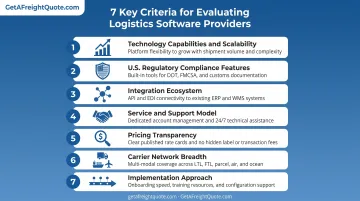
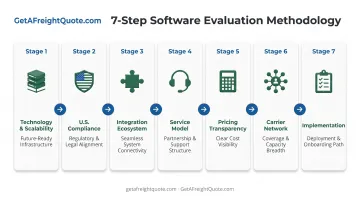
Our evaluation methodology prioritized these factors:
- Technology capabilities and scalability: Grows with you from 10 shipments a month to 1,000+ without a full migration or rebuild
- U.S. regulatory compliance features: DOT, OSHA, customs, and trade compliance built in—not bolted on
- Integration ecosystem: Pre-built connectors for major ERPs (NetSuite, SAP, Oracle), WMS, and ecommerce (Shopify, WooCommerce), plus open APIs
- Service and support model: Hands-on managed services, full self-service, or a hybrid with expert help when you need it
- Pricing transparency: Clear cost structure, upfront ROI visibility, and no hidden invoice fees
- Carrier network breadth: Enough capacity across parcel, LTL, FTL, ocean, and air to hold up when the market tightens
- Implementation approach: Realistic timelines, data migration support, training, and post-launch governance
The "best" logistics software company depends entirely on your specific requirements:
- Company size and shipment volume (5 pallets/week vs. 5,000 shipments/day)
- Modal complexity (parcel-only vs. multimodal with ocean/air)
- Internal IT capabilities (self-implementation vs. need for turnkey deployment)
- Service preference (managed vs. self-service vs. hybrid)
- Integration requirements (standalone vs. tight ERP/WMS connectivity)
- Budget constraints and ROI timelines
We recommend creating a prioritized requirements list before evaluating vendors, then focusing demo conversations on your actual workflows rather than generic product tours.
Conclusion
Selecting the right logistics software company is a strategic decision that affects freight costs, customer satisfaction, and competitive positioning. The best providers pair solid technology with domain expertise, carrier relationships, and support models that fit your business stage—not just the longest feature list or the biggest brand.
Before you talk to vendors, get clear on your logistics pain points, shipment volume projections, and internal resource limits. Then narrow the field:
- Start with 3–5 providers from the list above that match your size and modes
- Request demos built around your real workflows
- Ask for customer references at similar companies
- Confirm pricing and ROI projections reflect your shipping profile, not industry averages
For small to mid-sized U.S. businesses dealing with high freight costs and limited access to quality TMS tools, GetAFreightQuote.com combines negotiated carrier rates, rate-shopping technology, and hands-on support in one place. Transparent pricing, free shipping analysis, and a consultative fit check make it a practical starting point for many shippers.
The right logistics partner should show clear ROI, match your operational goals, and scale as you grow—without rigid contracts or solutions built for a different shipping profile.
Frequently Asked Questions
What is logistics software?
Logistics software manages the movement, storage, and tracking of goods across the supply chain. Core modules usually include TMS for shipping, WMS for inventory and fulfillment, and real-time visibility for tracking. Many vendors also layer in carrier networks, brokerage, compliance, and support.
What are the tools used in logistics?
Common tools include TMS, WMS, real-time visibility, freight audit and payment, route optimization, yard management, and order management. Leading logistics software companies bundle these into unified platforms instead of forcing separate point solutions.
What does a logistics provider do?
Logistics service providers (3PLs, freight forwarders, and carriers) physically move and store goods. Logistics software companies supply the platforms that plan and manage those operations. Some firms, including GetAFreightQuote.com, C.H. Robinson, and Flexport, combine technology, capacity, and managed execution in one partnership.
What is 1PL, 2PL, 3PL, 4PL, and 5PL logistics?
- 1PL: Company running its own logistics in-house
- 2PL: Asset-based carrier (truck, rail, air)
- 3PL: Third party for warehousing, transport, and fulfillment
- 4PL: Lead provider that orchestrates multiple 3PLs
- 5PL: Tech-led consultant managing full logistics networks
Most logistics software companies primarily serve 3PLs and shippers (1PLs).
What is the best CRM for logistics?
General CRMs like Salesforce are widely used, but platforms that pair TMS with CRM features (Descartes, Oracle OTM, or logistics-specific CRMs) usually fit better. They link accounts to shipment history, quotes, and performance so teams can send proactive updates and scorecards.
What are the 7 C's of logistics?
The 7 C's are excellence goals: the right Customer, Condition, Quantity, Product, Place, Cost, and Time. Logistics software supports them with tracking, condition monitoring, inventory control, and freight optimization. It is not a universal standard, but it is a practical lens for judging technology fit.