Introduction
Every business faces a critical question: handle logistics in-house or trust a third party with your supply chain? When business logistics costs reached $2.6 trillion (8.7% of GDP) in 2025, that choice carried real weight.
Transportation costs lead shipper challenges at 32%, followed by process improvement and visibility gaps. Full-service logistics companies manage warehousing, transportation, inventory, and fulfillment under one roof to reduce that burden.
This article covers what these providers offer, when outsourcing makes sense, and what alternatives exist if you want cost savings without giving up operational control.
Key Takeaways
- Full-service logistics firms integrate warehousing, transport, inventory, and fulfillment as 3PL or 4PL providers
- US 3PL market hit $323.4 billion in 2025, up 5.0% year-over-year, signaling strong demand for outsourced logistics
- TMS platforms deliver Fortune 500-level carrier rates and shipping tech without full logistics outsourcing
- Pick based on shipping volume, operational complexity, capital limits, and how much control you need
What is a Full-Service Logistics Company?
A full-service logistics company is a third-party provider that manages multiple supply chain functions under one relationship. Rather than contracting separately for warehousing, transportation, inventory management, and order fulfillment, businesses outsource these activities to one provider that integrates them end-to-end.
The US 3PL market hit $323.4 billion in 2025, up 5.0% from the prior year, as more companies push freight, storage, and fulfillment to specialists instead of building that infrastructure in-house.
Core Capabilities
Full-service logistics providers typically manage:
- Warehousing and storage – inventory receiving, put-away, secure storage
- Transportation management – carrier selection, routing, freight booking across modes
- Inventory control – stock tracking, replenishment planning, cycle counts
- Order fulfillment – pick, pack, ship, returns processing
- Customs and compliance – international documentation, duties, regulatory adherence
- Technology integration – WMS, TMS, real-time tracking, analytics dashboards
This differs from freight brokers or single-service providers. A freight broker arranges transportation. A full-service 3PL runs warehouses, manages inventory, handles fulfillment, and coordinates freight inside one workflow.
Who Uses Full-Service Logistics?
According to a 2025 industry survey, 3PLs serve manufacturing (83% of providers), retail (83%), wholesale/distribution (67%), and services/government (52%). Common client profiles include:
- E-commerce sellers requiring fast fulfillment and multi-channel distribution
- Manufacturers needing raw-material storage and finished-goods distribution
- Retailers managing seasonal inventory spikes and omnichannel orders
- Growing businesses lacking capital for warehouse leases and logistics staff
Understanding Logistics Service Provider Models (1PL to 5PL)
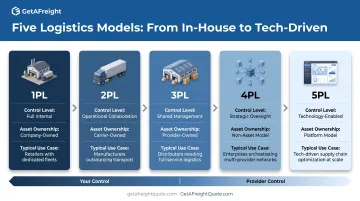
The logistics industry uses a "party" taxonomy to describe how much of your supply chain you run yourself versus hand off. Each step up the ladder means more outsourcing and less day-to-day control.
1PL (First-Party Logistics)
A 1PL handles logistics in-house: the business owns or leases trucks, operates its own warehouse, and employs drivers and warehouse staff. This model offers full control and works when operations are small, specialized, or require proprietary handling. However, it demands capital investment and internal expertise.
2PL (Second-Party Logistics)
A 2PL is an asset-based carrier (trucking companies, railroads, airlines) that moves freight but doesn't manage warehousing, inventory, or fulfillment. You're buying transportation capacity, not integrated supply chain services.
3PL (Third-Party Logistics)
A 3PL manages warehousing, transportation, and fulfillment on your behalf. This is what most people mean by "full-service logistics." 3PL users reported that 37% of their total logistics expenditures related to outsourcing. Many businesses blend in-house and outsourced operations rather than choosing one or the other.
A 3PL executes day-to-day logistics: receiving inventory, storing it, picking and packing orders, booking freight, and handling returns. You retain strategic oversight.
4PL (Fourth-Party Logistics)
A 4PL doesn't own warehouses or trucks. Instead, it designs, manages, and coordinates your entire supply chain, often orchestrating multiple 3PLs, carriers, and service providers. Gartner reported that 4PL demand grew nearly 10% in two years, and 44% of shippers planned to outsource logistics activities to a 4PL.
Think of a 4PL as a supply chain architect: they optimize your network, select and manage providers, monitor performance, and own end-to-end accountability—without executing the physical work themselves.
5PL (Fifth-Party Logistics)
A 5PL is an emerging, technology-first model. Providers use advanced platforms to optimize logistics networks across many shippers and carriers at once, with digital integration doing much of the coordination a 4PL would staff manually.
Core Services Offered by Full-Service Logistics Companies
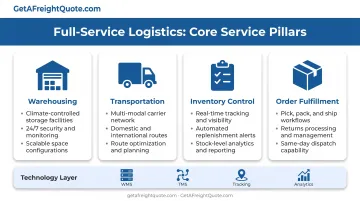
Full-service logistics providers combine core operational services and value-added capabilities under one relationship. That single-provider model is what sets them apart from vendors that only move freight or only run a warehouse.
Core Operational Services:
- Warehousing and storage – secure facilities, climate control, inventory security
- Transportation management – multi-modal carrier selection, route optimization, freight consolidation
- Inventory control – real-time stock visibility, replenishment triggers, cycle counting
- Order fulfillment – order processing, pick/pack, labeling, shipping
- Returns management – reverse logistics, product inspection, restocking, disposal
Value-Added Services:
- Kitting and assembly – bundling products, promotional packaging
- Custom packaging and labeling – branded boxes, compliance labels, gift wrapping
- Quality inspection – inbound quality checks, damage assessment
- Customs brokerage – international documentation, duty payment, regulatory compliance
Technology Integration:
Modern 3PLs provide technology platforms that integrate with your systems:
- Warehouse Management System (WMS) – inventory tracking, order routing, labor management
- Transportation Management System (TMS) – carrier rate comparison, shipment booking, route optimization
- Real-time tracking – shipment visibility across carriers and modes
- Data analytics – cost analysis, performance dashboards, predictive insights
A 2025 study found that 67% of shippers and 73% of 3PLs used AI and machine learning. Adoption is climbing, but many shippers still find 3PL tools weaker than expected on real-time visibility and analytics.
Key Benefits of Partnering with Full-Service Logistics Providers
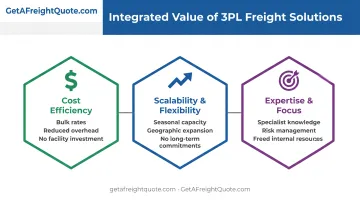
Partnering with a full-service logistics provider (3PL) shifts day-to-day shipping, storage, and coordination off your plate. The payoff shows up in three places most shippers care about: cost, flexibility, and focus.
Cost Efficiency
Outsourcing consolidates spend you would otherwise carry in-house:
- Secure bulk shipping rates by tapping volume the provider aggregates across clients
- Skip warehouse leases, material-handling equipment, and facility overhead
- Move warehouse labor, drivers, and logistics managers off your payroll
- Reduce carrier and claims admin that quietly inflates landed cost
Eighty percent of surveyed shippers said 3PLs helped reduce overall logistics costs. Exact savings still depend on freight mix, lanes, and how much you ran in-house before.
Scalability and Flexibility
You can flex capacity without buying buildings or signing long-term labor commitments. Add space and hands for peak season, then scale back when demand drops. Enter new regions through the provider’s network instead of standing up your own nodes. Absorb sudden order spikes without permanent hires or multi-year leases.
Expertise and Focus
Specialists handle inventory discipline, freight optimization, and carrier negotiations you may not staff full-time. They also own much of the operational risk—compliance, insurance, claims, and carrier disputes—so your team is not stuck firefighting every exception.
That handoff frees you to put energy into product, sales, and customer experience while the provider runs logistics execution.
When to Use Full-Service Logistics vs. Alternative Solutions
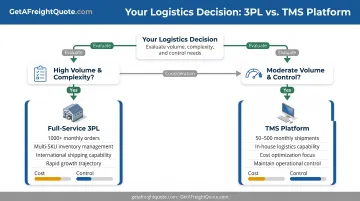
Scenarios Where Full-Service Logistics Makes Sense
High-volume, complex operations requiring multiple services
If you're shipping hundreds or thousands of orders weekly, managing inventory across multiple SKUs, and coordinating LTL and parcel shipments, a 3PL's integrated platform simplifies execution.
Rapid growth requiring immediate scalable infrastructure
Startups and fast-growing businesses often lack capital for warehouses and logistics staff. A 3PL provides instant capacity without multi-year lease commitments or hiring cycles.
International shipping with complex customs requirements
Cross-border logistics involves tariff classification, duty calculation, documentation, and regulatory compliance. Full-service 3PLs with customs brokerage expertise reduce delays and errors.
When Alternative Solutions May Be Better
Small to mid-sized businesses with moderate shipping volumes
If you ship 50–200 packages weekly and manage limited inventory, the cost of full 3PL outsourcing may exceed the benefit. You might need better carrier rates, not full logistics outsourcing.
Companies wanting to maintain direct control over carrier relationships
Some businesses prefer selecting carriers, managing shipments, and owning customer communication. Full outsourcing removes this control.
Businesses seeking technology-driven cost savings without surrendering operational control
If your team can handle day-to-day shipping but lacks access to competitive carrier rates and enterprise-grade tools, a TMS platform may deliver savings without operational transfer.
The TMS Alternative for Small and Mid-Sized Businesses
A Transportation Management System (TMS) provides enterprise-grade shipping technology and negotiated carrier rates without full logistics outsourcing. Instead of transferring operations to a 3PL, you retain control while accessing tools and rates previously reserved for Fortune 500 companies.
What a TMS Provides:
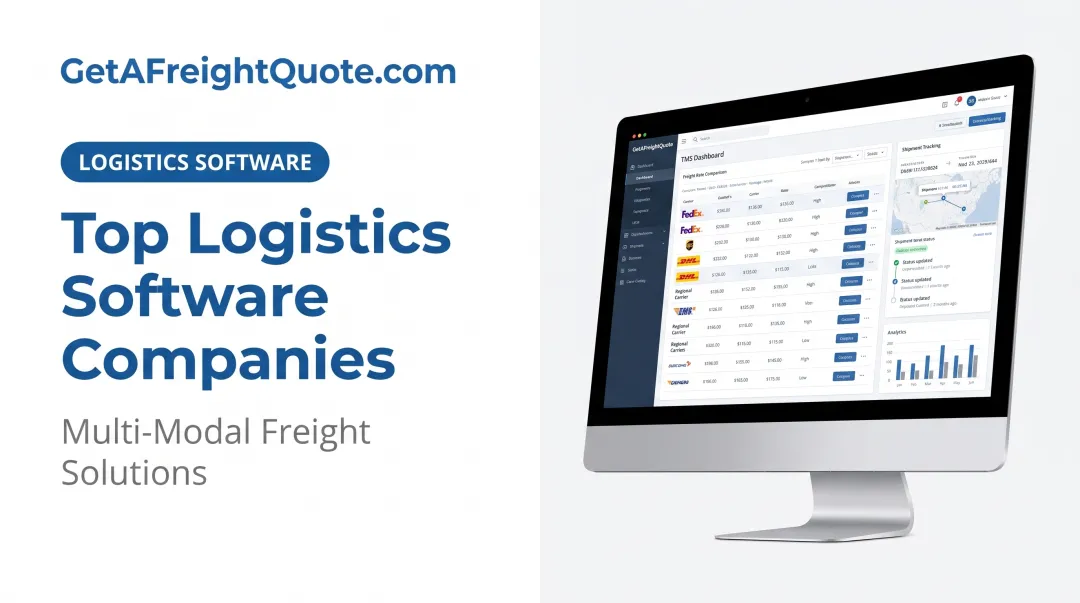
- Compare UPS, FedEx, USPS, LTL, and FTL rates in one dashboard
- Access negotiated discounts typically 20–50% below retail pricing
- Quote, book, track, and manage shipments online 24/7
- See every rate before booking, with no hidden fees
GetAFreightQuote.com is an authorized TMS reseller that gives businesses of any size access to negotiated carrier rates and the same class of shipping tools large shippers use. On the platform you can:
- Compare your own carrier accounts against pre-negotiated platform rates and choose the lowest-cost option
- Use 24/7 self-service tools plus support for HAZMAT, cross-border, and volume freight
- Pay clear per-label pricing (as low as 5¢), separate from transparent carrier rates
- Reach 100+ national, regional, and local LTL and FTL carriers, plus parcel options
This approach fits teams that want lower rates and stronger tools while keeping shipping in-house instead of handing fulfillment and warehousing to a 3PL.
How to Choose the Right Full-Service Logistics Provider
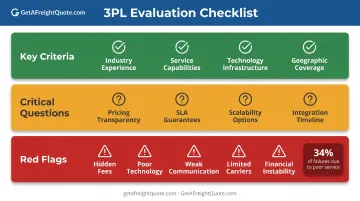
Choosing a full-service logistics provider affects your costs, delivery speed, and customer experience. Match each candidate against the criteria and questions below before you sign.
Key Evaluation Criteria
Industry experience
Does the provider understand your product type, order profile, and seasonal patterns? A 3PL experienced in e-commerce fulfillment may struggle with industrial B2B distribution.
Service capabilities
If you require kitting, international shipping, and temperature-controlled storage, confirm the provider offers them, not just warehousing and basic fulfillment.
Technology infrastructure
Can the 3PL integrate with your ERP, e-commerce platform, or accounting system? Does their WMS and TMS provide real-time visibility and reporting?
Geographic coverage
Where are their warehouses located? Can they reach your customers cost-effectively inside your delivery windows?
Questions to Ask
- Pricing structure transparency: What are storage fees, fulfillment fees, transportation costs, and accessorial charges? Can you convert projected volume into expected cost?
- SLA guarantees: What performance metrics do they commit to, such as on-time shipment rates, order accuracy, and dock-to-stock cycle time?
- Scalability options: Can they handle seasonal peaks? What's the process for adding capacity?
- Integration capabilities: How long does system integration take? What platforms do they support?
Red Flags to Watch For
According to a 2025 industry survey, poor customer service drove 34% of partnership failures, followed by unmet expectations at 28% and cost at 22%. Shippers ranked service over price 72% to 28%.
Warning signs include:
- Hidden fees – unclear pricing, vague "accessorial charges," or invoices that don't match proposals
- Lack of technology – manual processes, limited visibility, no integration capabilities
- Poor communication – slow response times, unwillingness to provide references, or blocked facility tours
- Limited carrier networks – reliance on a single carrier or narrow geographic coverage
- Weak financial stability – insufficient insurance, short client tenure, or reluctance to share financial references
Frequently Asked Questions
What is a full-service logistics company?
A full-service logistics company is a third-party provider managing multiple supply chain functions (warehousing, transportation, inventory control, order fulfillment, and returns) through one integrated platform, rather than separate contracts for each service.
What are 1PL, 2PL, 3PL, 4PL, and 5PL logistics?
These terms describe logistics outsourcing levels:
- 1PL: In-house logistics managed by your own team
- 2PL: Asset-based transportation only
- 3PL: Comprehensive outsourced operations
- 4PL: End-to-end supply chain orchestration across multiple providers
- 5PL: Technology-driven network optimization
What is a logistics fee?
A logistics fee is the charge for outsourced logistics services, which may include warehousing storage fees, order fulfillment fees, transportation costs, handling charges, and management fees. Transparent pricing that separates each component before you commit is essential.
What's the difference between 3PL and 4PL?
A 3PL executes logistics operations such as running warehouses, managing inventory, and booking freight. A 4PL coordinates your entire supply chain—including multiple 3PLs and carriers—without owning physical assets.
When should a small business consider using a full-service logistics company?
Consider a 3PL when shipping volume justifies the cost, operational complexity exceeds internal capacity, or rapid growth demands scalable infrastructure without capital investment. For moderate volumes, a TMS platform may deliver savings without full outsourcing.
Ready to reduce shipping costs without outsourcing your entire logistics operation? GetAFreightQuote.com provides Fortune 500-level carrier rates, enterprise-grade TMS technology, and transparent pricing accessible to businesses of all sizes. Compare your own carrier rates against our pre-negotiated discounts and choose the lowest-cost option for every shipment.