In 2026, that system is under real strain. Carriers pushed through another round of rate hikes, AI-driven automation is reshaping how shipping decisions get made, and small and mid-sized sellers face growing pressure to match the delivery speed and pricing of Amazon-scale competitors.
This article breaks down the five trends reshaping ecommerce shipping this year, what's fueling them, and how businesses of any size can adapt without bleeding margin.
Key Takeaways
- AI-powered platforms now auto-select carriers by rate and speed
- TMS resellers give small businesses Fortune 500-level shipping rates
- Multi-carrier diversification is now standard risk management, not optional
- Sustainable last-mile delivery is now a baseline expectation
- Returns are being redesigned as a loyalty driver, not just a cost
Key Ecommerce Shipping Trends in 2026
Five forces stand out this year, driven by a mix of new technology, cost pressure, and shifting customer expectations. Here's what's actually changing on the ground.
AI-Powered Automation and Smart Carrier Selection
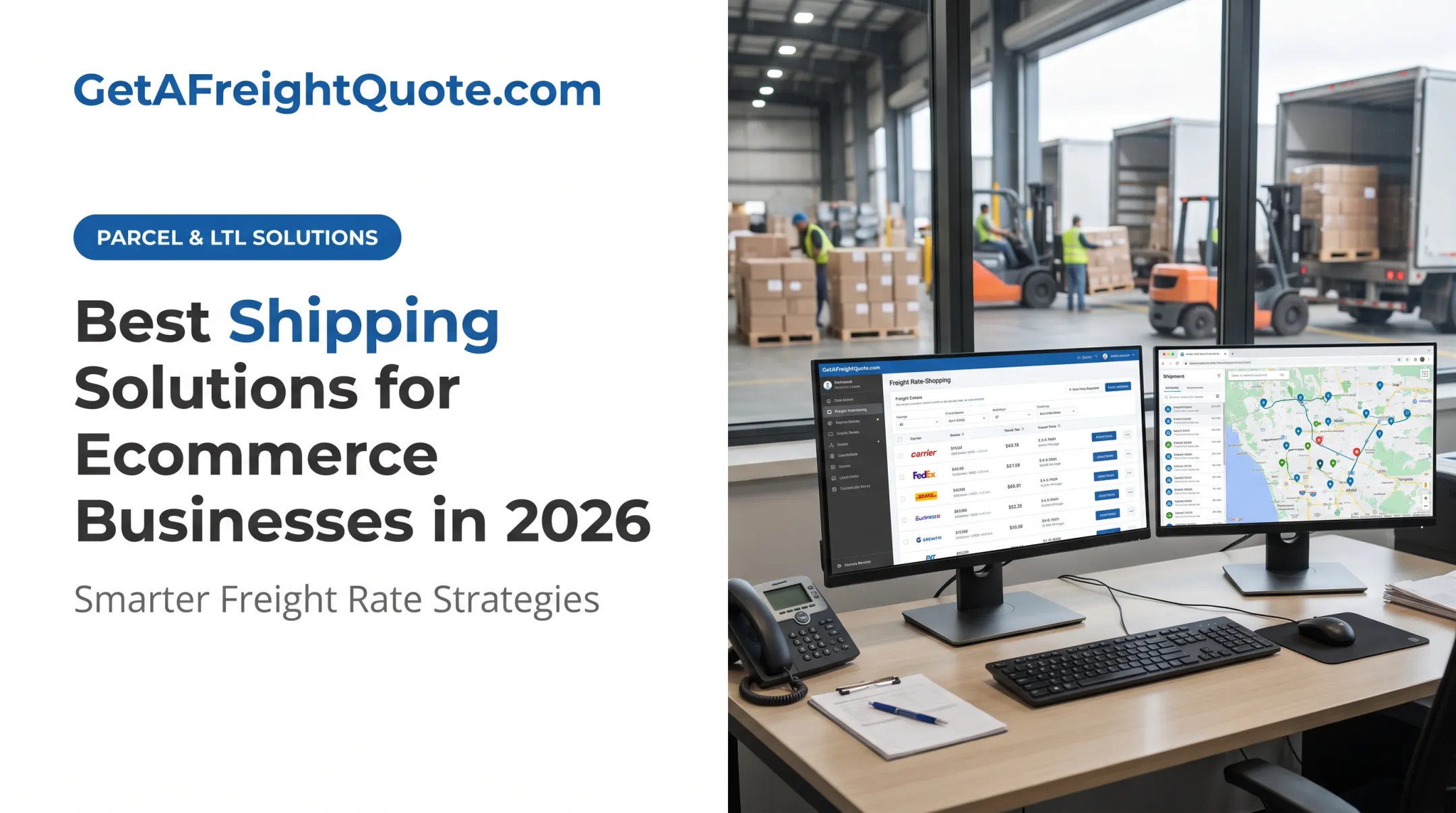
Shipping software has stopped being just a label printer. Modern platforms now evaluate weight, dimensions, and destination in real time, then automatically route each shipment to the cheapest or fastest carrier available.
Some platforms have pushed this further with natural-language shipping rules: telling the system "always use ground for orders under 5 lbs unless the customer paid for expedited" instead of building complex rule trees manually.
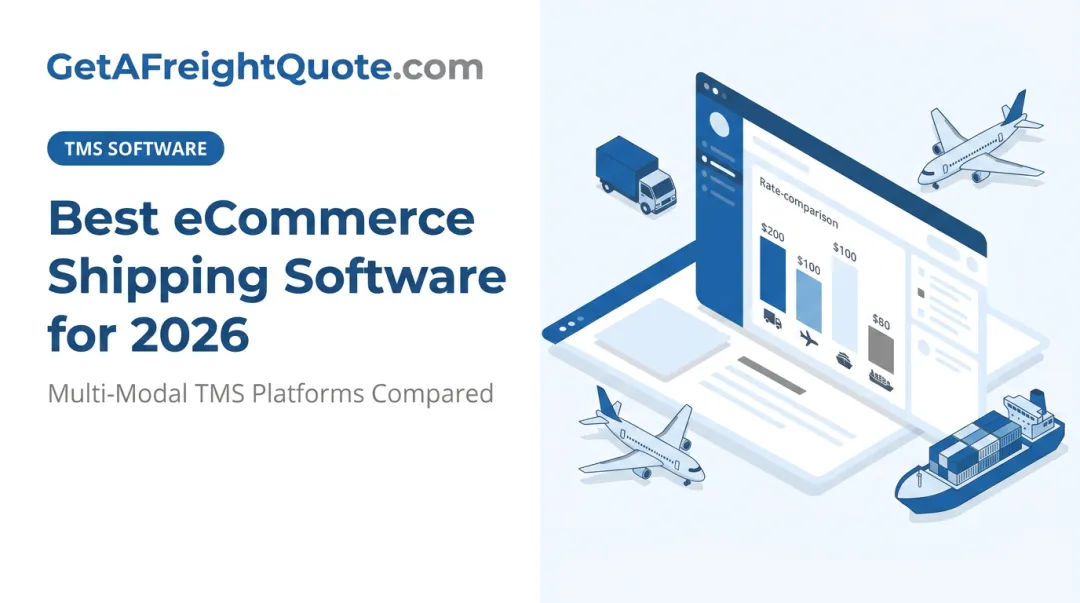
ReadyShipper X markets this exact "Ship With AI" capability, alongside a rate-comparison engine that weighs carrier cost, delivery estimate, and transit time side by side.
The payoff shows up on the bottom line. A properly selected transportation management system (TMS) has the potential to cut freight spend by 3% to 7% through automation and smarter shipment optimization, according to Supply & Demand Chain Executive.
That's real money on a business shipping thousands of packages a month, and it comes without adding headcount.
Democratized Access to Enterprise-Grade Carrier Rates for SMBs
For decades, shipping rates rewarded volume. A retailer moving 50,000 packages a week negotiated pennies-on-the-dollar deals that a 200-shipment-a-week seller could never touch. That gap is closing.
TMS resellers and rate-aggregation platforms now pool shipping volume across thousands of smaller businesses, then pass those negotiated rates through to individual sellers. GetAFreightQuote.com works this way: businesses can stack their own existing carrier accounts alongside the platform's pre-negotiated rates, then compare both side by side to pick whichever is cheapest for that specific shipment.
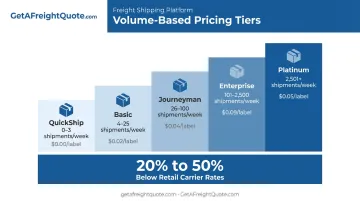
Pricing typically scales with volume rather than locking sellers into one flat cost:
| Tier | Weekly Volume | Per-Label Fee |
|---|---|---|
| QuickShip | 0–3 shipments | No fee |
| Basic | 4–100 shipments | $0.09 |
| Journeyman | 101–500 shipments | $0.08 |
| Enterprise | 501–1,000 shipments | $0.07 |
| Platinum | 2,501+ shipments | $0.05 |
The label fee is small on purpose. Carrier rate savings, commonly 20% to 50% below retail on parcel shipments, typically run 20 to 40 times larger than the platform fee itself, so most sellers recover the cost within their first few shipments. Closing this pricing gap protects margins that would otherwise erode with every rate increase.
Multi-Carrier and Regional Carrier Diversification
Relying on just two or three national carriers used to be standard practice. It's now a liability. Capacity crunches, surprise surcharges, and service disruptions hit hardest when a business has nowhere else to turn.
Regional carriers have become a real alternative rather than a backup plan. Pitney Bowes' 2026 Parcel Shipping Index found alternative carriers were the fastest-growing segment of the U.S. parcel market in 2025, with volume climbing 127% as these carriers competed hard on price and regional delivery speed.
The strategic move now: keep national carriers for broad, unpredictable coverage, but route dense regional lanes (say, a Southeast distribution center shipping mostly within a five-state radius) to a regional carrier that knows that territory better and prices it more competitively.
This approach reduces dependence on national carriers without cutting ties with UPS or FedEx entirely.
Sustainable and Green Last-Mile Delivery
Electric delivery vans, optimized routing, and carbon offset programs have become standard line items in last-mile contracts rather than premium add-ons. Retailers now advertise carbon-neutral shipping or EV-delivered orders right at checkout as a way to differentiate.
The shift is customer-driven, not just operational. DHL's 2024 survey of 12,000 shoppers across 24 countries found 59% rated sustainability as very or quite important when buying online, and 46% said they'd accept a longer delivery window in exchange for a greener shipping option, according to DHL's E-Commerce Trends Report.
That said, willingness to pay more remains mixed. Only 20% of shoppers said they'd always pay extra for green delivery, and 38% said they never would. The practical takeaway: sustainable delivery needs to be built into standard operations, not sold as a costly upgrade.
Returns Management as a Strategic Growth Lever
Reverse logistics used to mean one thing: minimize the cost of processing sent-back merchandise. That framing is shifting. Retailers now design returns around speed, restock rate, and whether a customer comes back to buy again.
Self-service return portals, automated restocking decisions, and fraud-pattern detection are now built directly into shipping platforms rather than bolted on as separate tools. A customer who can print a return label in 30 seconds and get a refund confirmation the same day is far more likely to shop that brand again.
The stakes are high. DHL's 2025 survey of 24,000 shoppers found 71% would stop shopping with a retailer if the return process didn't meet their expectations, and 73% wouldn't buy at all without trust in a retailer's delivery-and-returns process, per the DHL 2025 E-Commerce Trends Report.
Returns are shifting from a back-office function to a frontline retention tool.
What's Driving These Ecommerce Shipping Trends
A mix of technology maturity, rising costs, and shifting customer patience is pushing these shifts faster than most sellers expected.
- Technology advances: Cloud-based TMS platforms and automation tools have made enterprise-level optimization accessible at price points small businesses can actually afford
- Customer expectations: Fast delivery is now the default. OnTrac research shows 86% of consumers define it as two days or less, and 63% will switch retailers if that window slips
- Cost pressure: UPS and FedEx announced average rate hikes near 5.9% for 2026, and USPS added its own service-specific increases. Unrenegotiated contracts compound this cost year after year
- Regulatory shifts: U.S. Customs suspended the de minimis exemption in 2025, and the EU is removing its €150 duty-free threshold in 2026, adding friction to cross-border shipments
- Competitive dynamics: Smaller sellers are judged against marketplace giants on speed and price, driving wider adoption of shared rate platforms and TMS tools once reserved for larger shippers
How These Trends Are Impacting the Ecommerce Industry
These shifts aren't abstract. They're changing daily workflows, budget decisions, and staffing needs across the industry.
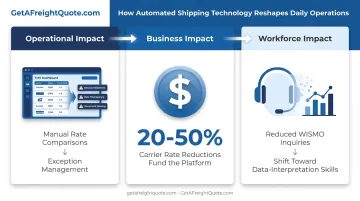
Operational Impact
Automated carrier selection and multi-carrier routing have changed what a fulfillment day actually looks like. Staff spend less time manually comparing rates label by label and more time managing exceptions and reviewing performance data.
Routing decisions that once took a person several minutes now happen instantly. This shift frees warehouse teams to focus on packing accuracy and shipment volume instead.
Business Impact
Budget conversations have shifted too. Instead of defaulting to a single-carrier contract and absorbing whatever increase comes next, businesses now direct spend toward rate-shopping technology and carrier diversification.
The math supports the shift:
- Carrier rate reductions typically fall in the 20% to 50% range on parcel shipments
- These savings usually dwarf the cost of the software generating them
- The result: rate-shopping technology becomes self-funding rather than a new expense line
Workforce Impact
Logistics and customer service teams need different skills now. Instead of manually comparing carrier quotes, staff need to interpret shipping analytics dashboards and manage platform settings.
This same shift is cutting down time spent on WISMO ("where is my order") inquiries. Automated tracking and proactive alerts now answer many of those questions before a customer has to ask.
Future Signals for Ecommerce Shipping in 2026 and Beyond
A few early indicators point to where ecommerce shipping heads over the next one to three years.
- Subscription shipping: DTC brands are testing flat annual membership fees that bundle reduced-rate or free shipping, following the loyalty-membership playbook popularized by Walmart+ and similar programs.
- Predictive analytics: More platforms are layering in decision-support tools. A 2025 PARCEL Industry survey found over 60% of shipping and operations leaders investing in prescriptive analytics and real-time modeling.
- Zone-skipping: Consolidating parcels and line-hauling them closer to their destination region before handoff to a local carrier helps shippers cut transit time and avoid extra zone-based fees.
- Rate access consolidation: Platforms that pool small-business shipping volume continue to grow, making enterprise-grade pricing the norm rather than a Fortune 500 exclusive, a shift GetAFreightQuote.com has championed since day one.
Conclusion
The 2026 ecommerce shipping story comes down to five threads: automation, rate accessibility, carrier diversification, sustainability, and smarter returns. None of these are hypothetical — they're already reshaping day-to-day fulfillment operations.
Businesses that adapt early gain a real cost advantage and a better customer experience than competitors still locked into single-carrier contracts and manual processes. The gap between the two groups will only widen as rates climb and customer patience for slow, clunky delivery keeps shrinking.
Strategic foresight, paired with the right technology and carrier partnerships, separates shippers thriving in this environment from those still absorbing rising costs. Platforms like GetAFreightQuote.com make that technology and carrier access available to businesses of any size.
Frequently Asked Questions
What is ecommerce shipping?
Ecommerce shipping is the end-to-end process of moving an online order from storage to the customer's door. It covers fulfillment, carrier handoff, tracking, and returns handling.
How much does ecommerce shipping cost?
Costs vary by weight, dimensions, and destination zone. The true cost usually runs higher than the quoted carrier rate once packaging, fulfillment labor, and surcharges get factored in.
Which shipping company is best for ecommerce?
There's no single best carrier — it depends on package weight, destination, and shipment volume. Most successful sellers use a multi-carrier strategy instead of relying on just one company.
What's the difference between ecommerce parcel shipping and freight shipping?
Parcel shipments are generally under 150 lbs and ship individually. Freight (LTL or FTL) covers bulk or oversized goods, with rates set by lane, freight class, and carrier capacity.
How can small businesses get better shipping rates in 2026?
Partnering with a TMS reseller like GetAFreightQuote.com gives smaller shippers pre-negotiated rates without negotiating alone, and lets them compare existing carrier accounts to find the best price on every shipment.
What technology trends will shape ecommerce shipping the most in 2026?
AI-driven carrier selection, multi-carrier diversification tools, and real-time tracking and analytics are having the biggest impact. Together, they're cutting manual work while giving businesses more control over cost and delivery speed.