Introduction
Michigan freight shipping happens at the crossroads of America's industrial heartland. The state channels over 1.1 million inbound trucks annually through Detroit and more than a million through Port Huron, connecting U.S.-Canada trade, Great Lakes logistics hubs, and the I-75/I-94/I-96 interstate network.
Whether you're moving automotive parts through just-in-time supply chains, shipping agricultural commodities across the Midwest, or coordinating cross-border freight via the Ambassador Bridge, the wrong carrier partner drives up cost and puts transit reliability and service quality at risk.
Choosing the right Michigan freight company means matching your shipment profile—LTL consolidation, full truckload, specialized equipment, or expedited delivery—to a provider's actual lane coverage, technology capabilities, and pricing transparency.
Key Takeaways
- Michigan freight moves on I-75, I-94, I-96, and I-69, with Detroit and Grand Rapids as primary hubs
- Options span asset-based LTL/FTL, regional truckload, expedited services, and TMS rate platforms
- Freight platforms give small and mid-sized shippers enterprise rates via volume aggregation and live comparison
- Prioritize lane coverage, all-in pricing, tracking, and carrier metrics over brand name alone
Overview of Freight Shipping in Michigan
Freight shipping companies move commercial goods via truck across regional, national, or cross-border routes. The Michigan market includes four primary provider types:
- Asset-based carriers that own trucks and terminals
- Freight brokers that connect shippers with third-party capacity
- Third-party logistics providers (3PLs) offering warehousing and multi-modal services
- TMS platform providers that deliver rate-shopping technology with pre-negotiated carrier rates
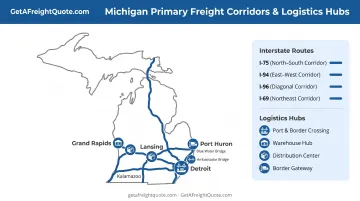
Michigan's infrastructure makes it a strategic freight gateway. The state sits at the center of U.S.-Canada commerce, with 1,132,114 inbound trucks entering through Detroit and 1,060,776 through Port Huron in 2025.
The Interstate network—I-75, I-94, I-96, and I-69—forms the Primary Highway Freight System designated by FHWA. Logistics hubs in Detroit, Grand Rapids, and Lansing anchor high-volume domestic and international freight movement.
Michigan's freight demand stems from a diverse industrial base. Automotive supply chains drive just-in-time LTL and truckload volumes, with components frequently crossing borders multiple times before final assembly.
Manufacturing, agriculture, construction, and wholesale distribution create steady demand for dry van, refrigerated, flatbed, and specialized equipment across intrastate, Midwest regional, and long-haul lanes.
Top Michigan Freight Shipping Companies
This list includes asset-based carriers, freight brokers, and technology-enabled platforms selected based on verified Michigan coverage, service reliability, pricing transparency, and documented capabilities.
GetAFreightQuote.com
GetAFreightQuote.com is an authorized reseller of a leading TMS platform. It gives small and mid-sized businesses enterprise freight tools and pre-negotiated carrier rates typically reserved for Fortune 500 shippers.
The platform offers full pricing transparency with no hidden fees. Businesses can compare their own carrier accounts alongside GetAFreightQuote.com's negotiated rates for best-price optimization.
Key differentiators include self-service TMS technology with hands-on logistics support, access to over 100 national and regional LTL carriers, and a model funded by the savings it generates. Most shippers recover the platform fee within their first few shipments.
| Feature | Details |
|---|---|
| Service Coverage | Nationwide shipping with strong Michigan coverage (Detroit, Grand Rapids, Lansing); LTL, FTL, reefer, flatbed, hazmat; 100+ carriers |
| Technology & Pricing | Cloud TMS with real-time rates, tracking, invoice transparency, and API/EDI; no volume commitments; 5–9¢ per-label fee; 20–50% average carrier rate savings |
| Target Customer | Small to mid-sized businesses and shippers without Fortune 500 volume who want competitive rates, clear billing, and enterprise tools without upfront software cost |

XPO (Major LTL Carrier)
XPO, headquartered in Greenwich, CT, operates as an asset-based LTL carrier following its 2022 spinoff. The company acquired Con-way Freight in 2015.
Verified Michigan service centers include 5350 Kraft Ave SE, Grand Rapids and 6000 Middlebelt Rd, Romulus. XPO covers 99% of U.S. ZIP codes and extends service into Canada, Mexico, and the Caribbean.
Differentiators include terminal density across Michigan and the Midwest, plus API tools for rate quoting, spot quotes, tracking, pickup scheduling, and BOL generation, with EDI connectivity. In 2024 the company added 2,300+ tractors and 4,400+ trailers to support day-definite LTL and cross-border freight.
| Feature | Details |
|---|---|
| Service Coverage | National LTL with Michigan terminals in Grand Rapids and Romulus; 99% U.S. ZIP coverage; Canada, Mexico, Caribbean |
| Pricing & Service Level | Class-based LTL with fuel surcharges and GRIs; standard, guaranteed, and expedited options; claims via account teams |
| Equipment & Capacity | Asset-based fleet; 2,300+ tractors and 4,400+ trailers added in 2024; dry van with cross-border coordination |
Universal Logistics Holdings (Major FTL/Truckload Carrier)
Universal Logistics Holdings, headquartered in Warren, MI, is a publicly traded transportation and logistics provider operating since 2005. The company runs a hybrid model of company-owned assets, owner-operators, partner carriers, and brokerage capacity across the U.S., Canada, and Mexico.
Universal's 2025 fleet includes 2,461 company-owned/leased tractors, 1,128 owner-operator tractors, 4,793 company trailers, and 471 owner-operator trailers. Equipment spans dry van, refrigerated, flatbed, and heavy haul, with automotive making up about 45% of revenue alongside machinery, building materials, food, and steel.
Technology options include EDI, API, or custom dashboards, with GPS tracking on dedicated service.
| Feature | Details |
|---|---|
| Service Coverage | North American FTL and dedicated lanes across U.S., Canada, and Mexico; Michigan HQ with strong regional coverage |
| Pricing & Service Level | Mixed capacity (assets, owner-operators, partners, brokerage); contract and spot rates with fuel surcharges; no public spot-rate formula |
| Equipment & Capacity | 2,461 company/leased and 1,128 owner-operator tractors; 4,793 company and 471 owner-operator trailers; dry van, reefer, flatbed, heavy haul |
Kuperus Trucking (Regional Carrier)
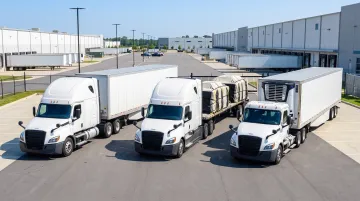
Kuperus Trucking, based in Jenison, MI, provides regional truckload, dedicated fleet, and contract carriage across Michigan, Illinois, Indiana, Ohio, and Wisconsin. The company emphasizes personalized service and local market knowledge for Great Lakes freight.
FMCSA SAFER lists Kuperus as ACTIVE with 22 power units. It states satellite and computerized tracking, though full fleet specs are not publicly documented.
Shippers should verify insurance, authority, and safety records on FMCSA SAFER before contracting.
| Feature | Details |
|---|---|
| Service Coverage | Five-state Great Lakes region (MI, IL, IN, OH, WI); regional lane knowledge and local support |
| Pricing & Service Level | Competitive regional pricing; flexible contracts; no public rate schedule; quotes via account management |
| Technology & Support | Satellite/computerized tracking stated; confirm current tech and claims support directly with the carrier |
Load One (Specialized/Expedited Carrier)
Load One, founded in 2003 and headquartered in Taylor, MI, specializes in time-critical ground expedite, truckload, dry van, flatbed, heavy haul, and production-line-critical freight across the U.S., Canada, and Mexico. It offers 24/7 tracking and asset-backed capacity for urgent shipments.
FMCSA SAFER lists Load One as ACTIVE with 483 power units. Services include guaranteed expedite windows, flatbed and heavy-haul for oversized loads, and handling built for automotive and manufacturing supply chains.
Obtain shipment-specific written quotes and verify current SAFER records for authority, insurance, and safety ratings.
| Feature | Details |
|---|---|
| Service Coverage | North American expedite and truckload across U.S., Canada, and Mexico; Michigan base with expedited-lane focus |
| Pricing & Service Level | Quote-based expedited pricing by urgency, distance, and equipment; 24/7 tracking; no public accessorial schedule |
| Equipment & Expertise | 483 FMCSA-listed power units; expedited van, dry van, flatbed, step deck, heavy haul; production-line-critical freight |
How to Choose the Right Freight Shipping Company in Michigan
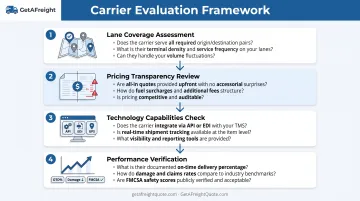
Many businesses pick freight carriers on the lowest quoted rate alone. That often backfires when hidden accessorials (liftgate, redelivery, reweigh, detention, limited access) show up on invoices. A cheap rate also fails when the carrier lacks lane coverage, equipment, or cross-border authority.
Weigh price against service reliability, technology, and total cost transparency.
Key evaluation criteria include:
- Michigan-specific lane coverage: Confirm terminals or partner capacity in Detroit, Grand Rapids, Lansing, Flint, and rural zones—plus service frequency, transit times, and peak-season backup.
- Pricing transparency: Demand all-in quotes (linehaul, fuel, accessorials). Multi-carrier rate benchmarking shows whether you're at market or paying markup.
- Technology capabilities: Confirm real-time tracking, automated BOL/POD retrieval, TMS or ERP integration (API/EDI), and invoice audit tools before you commit.
- Customer support quality: Require a dedicated account manager, 24/7 dispatch, and clear SLAs for response times and claims resolution.
Request performance metrics before you sign. On-time delivery, damage/claims per 100 shipments, FMCSA safety ratings, and tender acceptance rates show how a carrier actually runs.
Use industry benchmarks to pressure-test what they share:
- A 2025 shipper study found a 1.24% average LTL damage rate
- ATRI estimated 2023 detention drove $3.6 billion in direct expense
Ask for lane-specific data and references from shippers moving similar freight in Michigan.
Conclusion
Michigan's position at the intersection of U.S.-Canada trade, Great Lakes logistics, and Midwest manufacturing creates real freight opportunity. Success still depends on carriers that fit your operations, cost goals, and service expectations—not brand name alone.
Evaluate providers on total cost of ownership: transparent rates, accessorials, technology, and service quality. Prioritize scalability for volume swings and real-time visibility that supports faster decisions.
Ready to access enterprise-grade freight rates and TMS tools built for small and mid-sized businesses? GetAFreightQuote.com brings negotiated carrier rates, TMS technology, and hands-on support together in one place. Get a free freight quote today and see how much you can save.
Frequently Asked Questions
What are the major freight companies in Michigan?
Major options include national LTL carriers with Michigan terminals (XPO, Old Dominion, Estes Express), truckload providers like Universal Logistics Holdings, regional carriers such as Kuperus Trucking, and expedited specialists like Load One. Platforms like GetAFreightQuote.com also connect you to 100+ carriers through one TMS.
What are some major trucking companies in Grand Rapids, Michigan?
Grand Rapids is a significant West Michigan logistics hub served by XPO (5350 Kraft Ave SE), Old Dominion (4317 68th Street), Estes Express (4600 Clyde Park Ave. SW, Wyoming), and Kuperus Trucking in nearby Jenison. Businesses can access these carriers through direct contracts or freight platforms that aggregate capacity across multiple providers.
Does Michigan have an international port?
Yes. Michigan has Great Lakes ports such as Detroit and Muskegon for maritime cargo. For trucking, it is a major U.S.–Canada gateway via the Ambassador Bridge (Detroit) and Blue Water Bridge (Port Huron), which process over 2.1 million inbound trucks annually.
What is the difference between LTL and FTL freight shipping in Michigan?
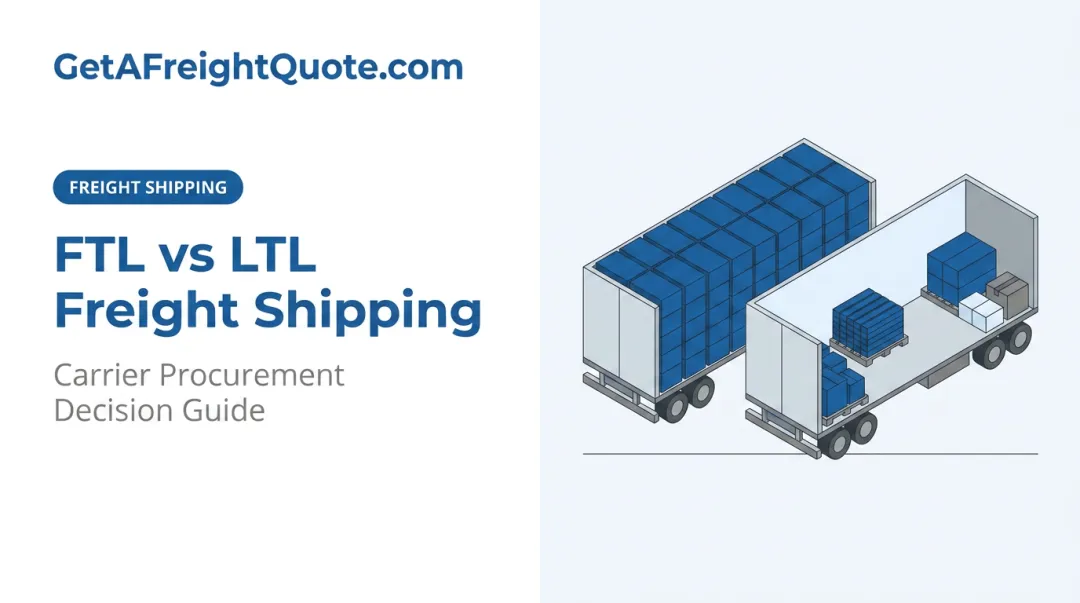
LTL (Less-Than-Truckload) consolidates multiple shippers' freight in one truck and is cost-effective for shipments typically ranging from 150 to 10,000 pounds. FTL (Full Truckload) dedicates an entire truck to one shipper and is better for larger volumes exceeding 10,000 pounds, time-sensitive freight, or shipments requiring exclusive use to prevent handling damage.
How can small businesses in Michigan get better freight rates?
Use a freight broker or TMS platform like GetAFreightQuote.com to tap shared volume, negotiated carrier rates, and side-by-side quotes. That offsets the usual low-volume penalty and opens access to 100+ LTL and FTL carriers in one place.
What should I look for in a Michigan freight shipping company?
Match lane coverage and terminal locations to your origins and destinations, and insist on transparent all-in quotes with no hidden accessorials. Confirm real-time tracking and TMS tools, then check on-time rates, claims ratios, FMCSA safety scores, and references from similar shippers.