Many shippers still struggle with the same headaches: manual dispatch calls, scattered spreadsheets, and carrier invoices that never quite match the quoted rate. A TMS fixes that by centralizing load planning, carrier selection, tracking, and invoicing into one system.
This guide breaks down what a TMS actually does, compares the platforms worth your attention, and shows how businesses without massive shipment volume can still access enterprise-grade tools and rates.
Key Takeaways
- TMS platforms replace spreadsheets and emails with centralized planning, tracking, and invoicing
- Options span enterprise giants like Oracle and Blue Yonder to SMB tools like MyCarrier and Tai TMS
- Volume, integrations, and total cost of ownership matter more than feature count
- Small shippers now access enterprise-grade rates via platforms like GetAFreightQuote.com
Overview of TMS in the Freight & Logistics Industry
A Transportation Management System is software that plans, executes, and audits the movement of freight, built for shippers, brokers, and carriers juggling multiple carriers and modes at once.
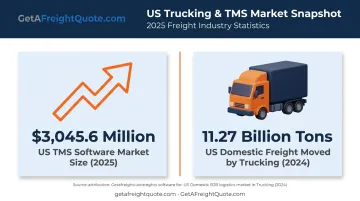
The scale behind this category is hard to ignore. US trucking alone moved 11.27 billion tons of domestic freight in 2024, per the American Trucking Associations. That kind of volume overwhelms manual coordination fast — phone calls and email simply can't keep pace, which is exactly why the market has shifted to software.
Below, we compare the top TMS platforms worth evaluating, spanning enterprise, mid-market, and SMB-friendly options. Each one serves a genuinely different type of shipper, so the "best" platform depends entirely on your operation.
Top Transportation Management Systems (TMS) to Consider
We evaluated each platform on five criteria: reliability, feature depth, scalability, integration ecosystem, and market reputation.
Oracle Transportation Management (OTM)
Oracle has anchored the enterprise TMS space for decades, serving some of the world's most complex shippers and logistics providers. It was named a Leader in the 2025 Gartner Magic Quadrant for TMS — its 18th consecutive Leader recognition.
What sets OTM apart is depth. It handles multimodal planning across regions, languages, and currencies, plus integrated global trade management for cross-border compliance. That configurability comes with a learning curve.
| Category | Details |
|---|---|
| Best For | Large enterprises with complex, high-volume, global freight networks |
| Key Features | Planning and optimization, tendering, freight audit, global trade management |
| Considerations | High implementation cost and complexity, often requiring dedicated IT/logistics staff |
Blue Yonder
Blue Yonder is another global TMS heavyweight, and like Oracle, it's been named a Gartner TMS Leader for 14 straight years. It's built for shippers who need both tactical execution and strategic network modeling.
Its differentiators are breadth and flexibility: broad modal coverage, AI-assisted analytics, and the choice between cloud or on-premises deployment depending on your IT strategy.
| Category | Details |
|---|---|
| Best For | Large shippers needing tactical and strategic network modeling |
| Key Features | Rate procurement, planning/execution, visibility, advanced analytics |
| Considerations | Built for scale; may be more platform than smaller shippers need |
MyCarrier
MyCarrier takes a different approach entirely. It's built specifically for SMB and mid-market LTL shippers, not global enterprises. Setup is fast, and the interface doesn't require weeks of training.
The platform's strength is real-time rate comparison across your carrier list, plus dispatch, tracking, and integrations with tools like NetSuite and QuickBooks. It's the kind of stack a growing business actually runs on.
| Category | Details |
|---|---|
| Best For | Small shipping teams and growing mid-market businesses |
| Key Features | Rate comparison, quoting/booking, ERP integrations (NetSuite, QuickBooks, etc.) |
| Considerations | Focused on LTL/multi-carrier shipping rather than complex global freight |
Turvo
Turvo is a collaboration-first TMS. Instead of building around one company's internal workflow, it connects brokers, carriers, and shippers in a shared, real-time view of every shipment.
That makes it a strong fit for teams juggling multiple external stakeholders who all need visibility into the same load, at the same time, without a dozen status-check phone calls.
| Category | Details |
|---|---|
| Best For | Teams prioritizing cross-party visibility and communication |
| Key Features | Shared shipment tracking, collaborative workflows, carrier/shipper portals |
| Considerations | Best suited to operations juggling multiple external stakeholders |
Tai TMS
Tai TMS is built primarily for freight brokers, with automation woven into every step. It automatically handles quote creation, tracking, invoicing, and proof-of-delivery across truckload, LTL, and drayage.
The pitch here is scale without headcount growth. If your team wants to move more freight without hiring proportionally more coordinators, automation is the lever.
| Category | Details |
|---|---|
| Best For | Brokers and shippers wanting to grow volume without proportional headcount growth |
| Key Features | Automated quoting, booking, and tracking workflows |
| Considerations | Best fit for operations ready to lean heavily on automation |
How to Choose the Right TMS for Your Business
The most common mistake? Picking a TMS based on the longest feature list instead of matching it to your actual shipment volume and lanes. A platform built for global multimodal networks is overkill for mostly domestic LTL.
Once volume and lanes are dialed in, integration compatibility matters just as much. A TMS that doesn't talk to your accounting software or ERP just creates a new manual re-entry problem instead of solving the old one. Before committing, confirm:
- Does it connect to your accounting platform (QuickBooks, NetSuite, Sage)?
- Can it pull from your existing load boards or ERP system?
- Will your team need to double-enter data anywhere in the workflow?
There's a bigger gap most small and mid-sized businesses overlook entirely: rate access. A full-featured TMS doesn't help much if the negotiated carrier rates behind it are still priced for low-volume shippers. Feature depth and rate depth are two separate problems, and solving only one leaves money on the table.
Platforms like GetAFreightQuote.com pair TMS software with carrier rates typically reserved for Fortune 500-level volumes, closing that gap directly.
Why Small and Mid-Sized Businesses Choose GetAFreightQuote.com
Enterprise shippers get better rates for one reason: volume. That's the gap GetAFreightQuote.com was built to close.
The platform operates as an authorized reseller of a high-performance TMS platform, pairing that enterprise-grade technology with carrier rates typically reserved for Fortune 500-level shipping volume. Instead of building software from scratch, GetAFreightQuote.com focused its energy on making an already-proven system accessible and affordable.
A few things set the model apart:
- Full rate transparency: no hidden fees, with the option to add existing carrier accounts for direct, side-by-side comparison
- Tiered pricing that scales with volume: QuickShip ships free for occasional shippers; Platinum drops to 5¢ per label for high-volume distributors
- Self-funded economics: negotiated carrier savings typically outweigh the label fee many times over, so the tool pays for itself
- Managed LTL clients: get the TMS implementation included at no cost, a system otherwise valued at $150,000 to $250,000
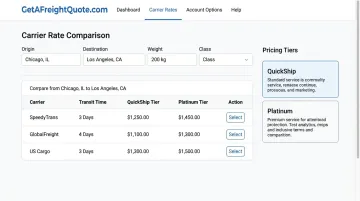
For businesses that don't have an in-house logistics team or the leverage to negotiate carrier contracts directly, this is a practical middle ground: enterprise tools, without the enterprise price tag or the multi-month implementation.
Conclusion
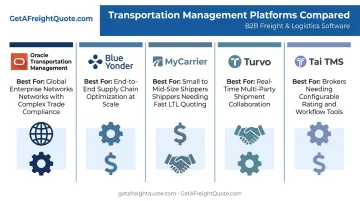
There's no single "best" TMS. The right choice depends on your shipment volume, your lanes, and the tools you already run. Oracle and Blue Yonder make sense for complex global networks. MyCarrier, Turvo, and Tai fit different mid-market and broker workflows.
Before committing to any platform, weigh scalability, integration depth, and true cost of ownership, including whether the rates behind the technology are actually competitive for your volume.
Ready to see what enterprise-grade TMS technology paired with negotiated rates looks like for your business? Get a freight quote and compare for yourself.
Frequently Asked Questions
What is a Transportation Management System (TMS)?
A TMS is software that centralizes load planning, dispatch, carrier management, tracking, and invoicing for shippers, brokers, or carriers. It replaces manual processes with one connected workflow.
What is the difference between a TMS and a load board?
A load board is where freight gets posted and carriers get found. A TMS takes over after booking — managing documents, tracking, and invoicing through delivery.
How much does a TMS cost for a small business?
Pricing varies widely by provider, deployment type, and shipment volume. Confirm setup fees, per-user costs, and subscription terms directly with each provider before committing.
Do small businesses need a TMS?
Once you're managing more than a handful of shipments regularly across multiple carriers, a TMS typically saves more time and money than manual tracking through spreadsheets and email.
What is the difference between a TMS and an ERP or WMS?
A TMS manages transportation and shipment movement specifically, while an ERP covers broader business functions like accounting and procurement. A WMS, by contrast, manages warehouse storage and fulfillment.
Can small businesses get the same freight rates as large enterprises?
Shipment volume traditionally determines carrier rates. Platforms like GetAFreightQuote.com give smaller shippers access to negotiated rates and technology previously reserved for high-volume enterprises.