This distinction matters because choosing the wrong partner or misunderstanding their capabilities creates real operational gaps. A freight forwarder can expertly coordinate your international shipment and clear customs but has no warehouse to store your inventory once it arrives. A 3PL can manage your fulfillment and distribution beautifully but may lack the international expertise to navigate complex cross-border regulations. Understanding where each provider fits prevents service mismatches that lead to unexpected costs, delays, and customer dissatisfaction.
Key Takeaways
- Freight forwarders arrange international transportation and customs clearance between shippers and carriers
- 3PLs manage warehousing, inventory, order fulfillment, and domestic distribution
- Choose a forwarder to move goods across borders; choose a 3PL to store, fulfill, and distribute after arrival
- Many importers use both services in sequence—or find hybrid solutions combining elements of each
- Modern TMS platforms let small businesses access competitive freight rates without Fortune 500 volumes
Freight Forwarder vs 3PL: Quick Comparison
| Dimension | Freight Forwarder | 3PL |
|---|---|---|
| Primary Focus | Cross-border transport and customs coordination | Warehousing, fulfillment, and domestic distribution |
| Core Services | Cargo booking, customs docs, carrier deals, multi-modal moves | Receiving, storage, pick/pack, ship, returns, inventory tracking |
| Asset Ownership | Usually non-asset; books common carriers | Often own or lease warehouses; asset mix varies |
| Geographic Strength | Cross-border and international movements | Domestic distribution and last-mile delivery |
| Best For | International moves and complex multi-modal shipments | Storage, inventory control, and post-arrival fulfillment |
In short, freight forwarders handle how goods move across borders. 3PLs handle storage, fulfillment, and distribution once those goods arrive.
What is a Freight Forwarder?
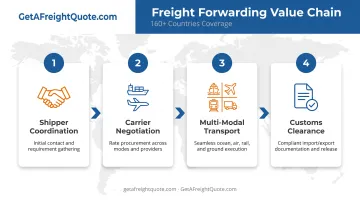
A freight forwarder arranges the movement of goods internationally, acting as a logistics coordinator between shippers and carriers. The Federal Maritime Commission defines a U.S. ocean freight forwarder as an entity that arranges international cargo movement, books common-carrier space on behalf of shippers, and prepares shipment documents—all without owning transportation assets.
Forwarders create value through carrier relationships and regulatory expertise. They negotiate better rates, consolidate shipments, and help small businesses navigate international rules they couldn't access on their own. According to FIATA, the international freight forwarding association, the industry includes roughly 40,000 firms and about 10 million employees across 160 countries.
Core Services Freight Forwarders Provide
Transportation Coordination:
- Multi-modal routing across ocean, air, rail, and ground
- Carrier selection based on cost, transit time, and reliability
- Shipment consolidation to improve rates for smaller shippers
- Space booking and cargo reservation
Customs & Documentation:
- Export documentation preparation
- Customs clearance coordination
- Bills of lading and commercial invoice processing
- Compliance with import/export regulations across jurisdictions
Risk Management:
- Cargo insurance coordination
- Claims management for damaged or lost shipments
- Regulatory compliance support
When Freight Forwarders Make Sense
International Shipping Needs: Businesses importing products from overseas manufacturers or exporting to global markets benefit from forwarders' customs expertise and carrier relationships. The National Customs Brokers & Forwarders Association of America reports its members serve more than 250,000 importers and exporters.
Multi-Modal Requirements: When freight moves ocean-to-rail-to-truck, someone has to coordinate carriers and keep costs in line. Freight forwarders arrange those handoffs and consolidate the documentation.
Volume-Independent Access: Federal regulations permit forwarders to earn carrier compensation after certifying they've reserved vessel space and processed required shipping documents. This structure lets smaller shippers access consolidated volume rates without needing Fortune 500 shipping levels themselves.
What is a 3PL (Third-Party Logistics Provider)?
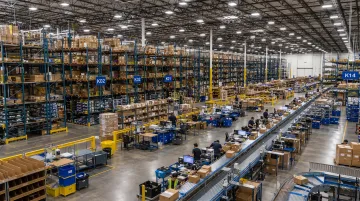
A 3PL is a logistics provider that manages warehousing, inventory, order fulfillment, and distribution—typically owning or leasing the physical infrastructure required. Unlike freight forwarders, who mainly coordinate how freight moves, 3PLs run the physical operations that store, pick, pack, and ship goods.
They take on day-to-day supply chain execution so your team can stay focused on sales and growth, often with systems that give real-time inventory and order visibility.
Armstrong & Associates reports the U.S. Value-Added Warehousing and Distribution segment (the category closest to this model) reached $72.7 billion in 2025.
Core Services 3PLs Provide
Warehousing and inventory
- Receiving and storage
- Real-time inventory tracking
- Cycle counts and accuracy controls
- SKU and lot tracking
Order fulfillment
- Pick, pack, and ship
- Kitting and light assembly
- Custom packaging and branded inserts
- Returns (reverse logistics)
- Quality checks before ship-out
Distribution
- Domestic moves via LTL, FTL, and last-mile carriers (owned fleets or preferred networks)
- Multi-location distribution management
- Direct-to-consumer and retail channel fulfillment
When 3PLs Make Sense
- E-commerce and DTC: High order volume, fast turnaround, and tracking matter. A 3PL supplies space, labor, and systems so you can scale without building a warehouse.
- Retail distribution: Brands shipping to many stores lean on 3PL know-how for retailer compliance, routing guides, and labeling rules.
- Variable capacity: Fixed warehouse and labor costs become variable. Per Inbound Logistics, that also opens technology and infrastructure that would be hard or costly to build in-house.
Freight Forwarder vs 3PL: What's Better?
Neither option is universally better. The right choice depends on where your primary logistics challenges exist. Think of your supply chain as a relay race: freight forwarders handle the international leg, and 3PLs handle domestic distribution and customer delivery.
Situational Recommendations
Choose a freight forwarder when:
- Your main challenge is getting products across borders cost-effectively
- You need customs clearance expertise and documentation support
- International shipping coordination consumes significant internal time
- Multi-modal transportation requires carrier negotiation across ocean, air, and ground
Choose a 3PL when:
- You need warehousing and inventory management after goods arrive
- Order fulfillment speed and accuracy directly impact customer satisfaction
- Seasonal volume fluctuations make fixed warehouse costs inefficient
- You lack capital to invest in warehouse space, equipment, and fulfillment staff
The Hybrid Approach
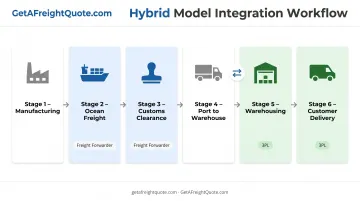
Many businesses use both services in sequence: freight forwarders handle international inbound shipping to get products to the U.S., then 3PLs receive the goods and manage domestic warehousing and distribution to customers or retail locations.
This model separates international expertise from domestic operations. The forwarder coordinates ocean freight, clears customs, and delivers the container to the 3PL's warehouse. The 3PL then receives inventory, manages storage, fulfills orders, and handles returns from their distribution facility.
Technology as the Bridge
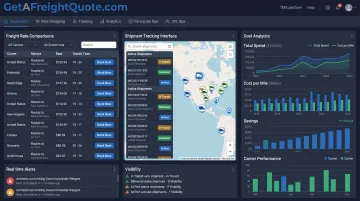
Modern Transportation Management System (TMS) platforms increasingly bridge these gaps. Small businesses can access competitive freight rates and visibility tools that were once available only to large enterprises with dedicated logistics teams.
For example, GetAFreightQuote.com provides small and mid-sized businesses with negotiated carrier rates typically available only to Fortune 500 shippers. That access delivers 20–50% savings on parcel and LTL freight without requiring massive volumes.
The platform combines rate shopping, booking, tracking, and spend analytics in one dashboard, so you can coordinate international and domestic freight more efficiently.
Real-World Example: E-Commerce Importer
Scenario: A growing e-commerce business imports home goods from manufacturers in Asia and sells directly to U.S. consumers through its website.
The Challenge:
- Products manufactured overseas need to reach U.S. customers quickly and cost-effectively
- The company lacks customs expertise and international carrier relationships
- Fulfillment volume fluctuates seasonally, making warehouse ownership impractical
- Customer expectations demand fast shipping and accurate order tracking
The Solution: The importer pairs a freight forwarder for the international leg with a 3PL for domestic fulfillment.
Freight Forwarder Role:
- Coordinates ocean freight from Asia to West Coast ports
- Consolidates shipments to reduce per-unit transportation costs
- Manages customs clearance and documentation
- Arranges drayage from port to the 3PL warehouse
Once freight clears the port, the 3PL takes over inventory and order fulfillment:
3PL Role:
- Receives containers at their distribution facility
- Unloads, inspects, and stores inventory
- Integrates with the company's e-commerce platform for real-time order flow
- Picks, packs, and ships individual customer orders within 24 hours
- Processes returns and restocks sellable items
Results: The freight forwarder's carrier relationships and customs expertise cut international shipping costs and clearance delays. The 3PL's fulfillment network then delivers the speed and tracking accuracy DTC customers expect, without capital spent on warehouse space or staff.
That same split model helps shippers who lack Fortune 500 volume. TMS platforms surface competitive freight rates and real-time visibility on both the international and domestic legs. You can coordinate the forwarder and 3PL in one view and keep cost control without building the stack yourself.
Conclusion
The freight forwarder versus 3PL decision is rarely an either/or choice for growing businesses. Understanding both services and how they work together creates a complete supply chain strategy.
Practical next steps:
- Map your biggest logistics pain points: international shipping and customs, or warehousing and fulfillment
- Weigh shipping volumes and growth plans to see if fixed infrastructure or variable-cost services fit better
- Use technology to compare rates and gain shipment visibility at any company size
Strong logistics programs pair the right expertise at each stage of the supply chain. GetAFreightQuote.com helps shippers access competitive multi-modal rates and TMS tools without forcing a single provider model.
Frequently Asked Questions
What is 1PL, 2PL, 3PL, and 4PL in logistics?
- 1PL: You run logistics in-house with your own fleet and staff
- 2PL: A carrier moves the freight; you manage everything else
- 3PL: An outsourced partner handles warehousing, fulfillment, and/or transportation
- 4PL: A lead partner coordinates the full supply chain from planning through execution
Can a small business afford a 3PL or freight forwarder?
Yes. Both can be cost-effective for small shippers by unlocking negotiated carrier rates and removing the need to invest in warehouses or a private fleet—often at a lower total cost than running logistics in-house.
Do I need both a freight forwarder and a 3PL?
Importers often use both. A freight forwarder handles international transport and customs to a U.S. port or warehouse; a 3PL then stores inventory and fulfills domestic orders.
What's the main difference between a freight forwarder and a 3PL?
Freight forwarders coordinate international transportation and customs clearance between shippers and carriers. 3PLs manage broader supply chain work—warehousing, inventory, and order fulfillment—once goods reach their destination.
Which is better for international shipping: freight forwarder or 3PL?
Freight forwarders are usually the better fit for international moves. Their carrier networks, customs know-how, and cross-border processes are built specifically for getting freight across borders compliantly.
How do freight forwarder and 3PL pricing models differ?
Freight forwarders usually bill freight costs plus customs brokerage, often in one bundled quote. 3PLs bill storage (per pallet or sq. ft.), per-order fulfillment (receive, pick, pack, ship), and add-ons like kitting or special packaging.