The result is thin margins, unpredictable freight budgets, and a real competitive disadvantage against companies with volume-based leverage. But here's the thing: shipping itself isn't the expensive part. Costs balloon because of poor rate access, inefficient decisions, and a lack of ongoing oversight.
This article breaks down seven practical strategies across three levers, decisions, active management, and the surrounding context, that any business can use to lower shipping costs, regardless of shipment volume.
Key Takeaways
- Freight costs build up through small, hidden inefficiencies, not one big line item
- Packaging, freight class, and carrier contract terms set your base rate
- Seven strategies span three buckets: pre-shipment, active management, and structural context
- Small and mid-sized shippers can access enterprise-grade rates without enterprise volume
How Shipping Costs Typically Build Up
Freight costs almost never show up as one dramatic expense. They accumulate shipment by shipment, through small inefficiencies that compound at scale.
A few extra pounds of dimensional weight here, a misapplied freight class there, an accessorial fee for residential delivery that nobody flagged. None of these look significant on a single invoice, but multiply them across hundreds or thousands of shipments a year, and they add up fast.
This buildup is usually gradual, but it can spike suddenly:
- Contract renewal periods, when carriers adjust terms with little notice
- Peak shipping season, when accessorial fees increase
- General rate increases, which carriers apply annually regardless of your negotiated discount
Most businesses don't notice these costs until something forces the issue: an invoice audit, a jump in shipment volume, or a missed delivery window that exposes a gap in service. By then, the overspend has often been happening for months.
Key Cost Drivers for Shipping
Not every dollar in a freight invoice comes from the actual cost of moving a product. Several structural factors influence what carriers bill, and they matter more or less depending on a business's size.
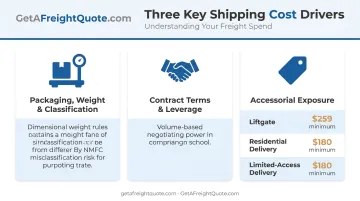
Packaging, Weight, and Classification
Dimensional weight and freight classification directly shape carrier billing, regardless of what's inside the box. A poorly packed shipment with excess void space can get billed at a higher "dimensional weight" than its actual scale weight. For LTL freight, an inaccurate NMFC class assignment does the same thing from a different angle.
Contract Terms and Negotiating Leverage
Carrier contract terms, and the negotiating leverage tied to shipment volume and consistency, heavily influence the base rate a business pays. This is exactly what drives the volume-discount structure carriers like UPS build into their pricing, where consistency and scale unlock better numbers.
Accessorial Exposure
Shipment consolidation, scheduling consistency, and accessorial exposure round out the picture. Residential delivery, liftgate service, and limited-access delivery all carry real charges that add up fast.
Under one current LTL tariff:
- Liftgate service: $259 minimum charge
- Residential delivery: $180 minimum
- Limited-access delivery: $180 minimum
A single unplanned accessorial can wipe out the savings from an otherwise good rate.
Smaller shippers tend to be more exposed to this rate inequity than larger ones, simply because they lack the volume to negotiate around it.
7 Shipping Cost Strategies
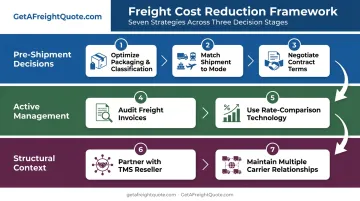
These seven strategies fall into three groups: changing decisions made before a shipment leaves the dock, changing how shipments are managed day-to-day, and changing the broader context in which a business ships.
Strategies That Reduce Costs by Changing Decisions Before Shipping
Strategy 1: Optimize Packaging and Freight Classification
Dimensional weight and NMFC misclassification are two of the most common, and most preventable, sources of overcharges. Right-sizing packaging reduces dimensional weight billing, while getting the freight class correct up front avoids a costly carrier-initiated reclassification later.
This has gotten more urgent recently. UPS and FedEx now round all fractional package measurements up to the next whole inch, so an 11.1-inch package bills as 12 inches.
The NMFC system itself shifted to a density-based classification methodology in mid-2025, meaning shippers who haven't updated their measurement practices are more likely to face reclassification charges. As NMFTA notes, misclassified freight leads to reclassification charges, delivery delays, or damage claims.
Strategy 2: Match the Shipment to the Right Mode
Parcel, LTL, and FTL each have a sweet spot, and defaulting to whatever mode you're used to often costs more than necessary.
- Parcel: Best for individual packages generally under 150 lb
- LTL: Typically covers 150 to 15,000 lb, or fewer than 16 pallets
- FTL: Most efficient when volume is consistent enough to keep a trailer full
UPS itself warns against treating 150 lb as an automatic cutoff for freight. Some multi-package shipments up to 1,000 lb can still stay in a small-package network through bridge pricing options, which means the "right" mode depends on more than just total weight.
Strategy 3: Negotiate Contract Terms and Accessorial Caps Upfront
Accepting a carrier's first published rate is one of the most expensive habits a business can keep. Using shipment volume forecasts and shipping history as leverage, even a modest one, changes the negotiating conversation entirely.
Capping accessorial charges matters just as much as negotiating the base rate. Without a cap, fees like liftgate or residential delivery can be applied at full tariff rate every time, eroding whatever discount was negotiated on paper.
Strategies That Reduce Costs by Changing How Shipping Is Managed
Strategy 4: Conduct Regular Freight Invoice Audits
Billing errors are far more common than most shippers assume. A Journal of Commerce study of 77 shippers found an average invoice inaccuracy rate of 20.8%.
Nearly three-quarters of those respondents had $1 billion or more in annual revenue, so the figure reflects enterprise billing complexity rather than an SMB-specific benchmark. Even so, it shows that invoice errors are a persistent problem across the industry, not an edge case.
Common errors worth auditing for include:
- Incorrect weights or freight classifications applied at billing
- Duplicate charges for the same shipment leg
- Outdated tariff rates instead of negotiated contract rates
- Unauthorized accessorial charges for services never rendered
- Missed contract discounts
- Fuel surcharge miscalculations
Even a modest 2 to 3% billing error rate adds up to real money over a year of freight spend. Regular audits, ideally a blend of automated flagging and human review, catch these before they become sunk costs.
Strategy 5: Use Rate-Comparison Technology
Defaulting to a single carrier relationship means never knowing if you're leaving money on the table. A transportation management system (TMS) that shops multiple carriers per shipment in real time solves that blind spot.
Rate-shopping technology gives visibility into both cost and service level for every shipment, side by side, rather than relying on memory or a single account rep's pricing. That visibility alone often surfaces savings that manual processes never would have caught.
Strategies That Reduce Costs by Changing the Context Around Shipping
For many small and mid-sized shippers, the real cost driver is limited access to the rate tiers and technology that larger shippers take for granted.
Strategy 6: Partner with an Authorized TMS/Freight Rate Reseller
Platforms like GetAFreightQuote.com operate as authorized resellers of enterprise-grade TMS technology, giving smaller businesses access to pre-negotiated carrier rates without needing Fortune 500-level volume. GetAFreightQuote.com's Managed LTL Services, for example, bundle full-cycle carrier procurement, 6 to 12 months of benchmarking against shipment-level data, and a TMS implementation valued between $150,000 and $250,000, included at no additional cost.
Because the model runs on an Off-Bill Incentive structure, fees are paid by carriers rather than the client, meaning clients keep 100% of the savings with zero impact on their P&L.
Strategy 7: Maintain Active Relationships with Multiple Carriers
Relying on a single carrier removes your leverage the moment renewal season arrives. Keeping multiple active relationships, including the ability to add your own existing carrier accounts alongside a reseller's negotiated rates, creates ongoing competitive tension.
GetAFreightQuote.com's platform supports this directly through a "Bring Your Own Rates" feature. Businesses connect their existing UPS, FedEx, or LTL accounts into the TMS, and the system automatically compares those rates against the platform's negotiated pricing on every shipment. You book whichever option is cheapest, whether it's yours or theirs, without giving up the carrier relationships you've already built.
Conclusion
Cutting freight costs effectively means identifying where the cost actually originates, whether that's a packaging decision, a management gap, or a structural access problem, and addressing that root cause directly, not slashing spend blindly.
Effective cost reduction is strategic and ongoing, not a one-time fix. For businesses without an in-house logistics team, platforms that combine negotiated rates with hands-on support, like GetAFreightQuote.com, can shortcut much of this work while still delivering full invoice transparency.
Frequently Asked Questions
How do I optimize shipping costs?
Optimization comes from combining smarter packaging and freight classification, regular invoice audits, and access to better carrier rates through negotiation or a reseller platform. No single fix works alone.
What is the most cost-efficient shipping method?
It depends on shipment size, weight, and destination. LTL suits partial loads, FTL suits full trailers, and parcel works best for small packages. Comparing rates across modes for each shipment is the only way to know for sure.
What is the formula for shipping cost?
Shipping cost is based on billable weight (the greater of actual weight and dimensional weight), the distance or zone, the selected service level, and any applicable accessorials or surcharges.
How much does shipping typically cost for a small business?
Costs vary widely by industry, shipment weight, and carrier mix, so there's no single reliable national average. What's consistent is that low-volume shippers pay noticeably more per shipment than businesses with negotiated, volume-based contracts.
What is freight class and how does it affect shipping cost?
Freight class, or NMFC classification, ranks LTL shipments from class 50 to 500 based on density, handling, stowability, and liability. Misclassification is one of the most common causes of billing overcharges.
Is it cheaper to use a freight broker or reseller instead of shipping direct with carriers?
For businesses without high shipment volume, working with a reseller like GetAFreightQuote.com often secures better rates than going direct. High-volume shippers may eventually negotiate comparable rates on their own, but most small and mid-sized businesses aren't there yet.