Introduction
Freight is one of the largest controllable costs any shipping business carries, and how you price it can make or break your margins. Many shippers default to spot rates for every shipment without realizing this could mean paying far more than a competitor moving identical freight on the same lane.
During tight-capacity periods, spot rates have run about $0.22 per mile higher than contract rates on a fuel-adjusted basis, according to FreightWaves' analysis of the spot-to-contract spread. Across hundreds of shipments a year, that gap adds up quickly.
This guide defines contract freight pricing, explains how it works, and compares it against spot pricing. You'll also see how businesses of any size, not just Fortune 500 shippers, can access contract-level rates today.
Key Takeaways
- Contract freight pricing locks in negotiated rates for a set period, covering specific lanes, volumes, and service levels
- It trades flexibility for cost predictability and priority capacity during peak seasons
- Rate-aggregation platforms are changing who qualifies for contract pricing, once reserved for high-volume shippers
- Most successful shippers blend contract and spot pricing rather than choosing one exclusively
What Is Contract Freight Pricing?
Contract freight pricing is a negotiated transportation rate agreed upon between a shipper and a carrier, broker, or 3PL for a defined period. It covers specific lanes, expected volumes, and service commitments, rather than pricing each shipment individually as it comes up.
Unlike a one-time quote, a freight contract represents an ongoing commercial relationship with obligations on both sides. The shipper commits to routing a certain amount of freight through the agreement, while the carrier commits to a price and, in many cases, prioritized capacity.
Most freight contracts, however, are binding on price rather than volume. Carriers aren't always obligated to accept every load offered under the agreement, a distinction confirmed by DAT's shipper RFP guide.
The core purpose is balancing two competing needs: cost control and service reliability. This matters most for shippers moving large or recurring freight volumes, where even small rate swings translate into significant budget impact.
Key Elements of a Contract Freight Agreement
A standard contract freight agreement typically includes:
- Base rate — the linehaul cost, calculated separately from fuel and accessorials
- Lane and region specifications — which origin-destination pairs the rate applies to
- Volume commitments — expected shipment counts or weight per lane
- Fuel surcharge clauses — a formula tying fuel costs to a baseline diesel price
- Accessorial fee terms — detention, liftgate, and other add-on charges
- Service-level agreements (SLAs) — on-time delivery expectations and performance standards
- Contract duration — the length of the commitment
Contract length commonly runs anywhere from a few months to a full year. Negotiating during off-peak months, rather than scrambling right before peak season, tends to yield better terms because carriers have more bandwidth to evaluate lane data and aren't pricing in scarcity.
How Contract Freight Pricing Works
Setting up a contract freight agreement involves several distinct stages, and skipping any of them usually leads to disputes down the line.
- Rate negotiation: Shippers and carriers review historical volumes, lane data, equipment needs, and current market conditions to land on a starting price.
- Agreement formalization: Both parties document which lanes, modes, and regions are covered, along with any SLA or performance clauses.
- Capacity assurance: Carriers reserve priority for the shipper's contracted volume, which reduces (though doesn't eliminate) reliance on the spot market during demand spikes.
- Execution: Shipments move under the agreed rates and conditions for the life of the contract.
- Performance tracking: Both sides monitor metrics to confirm the agreement is working as intended.
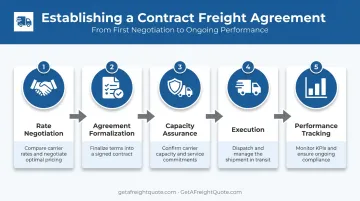
That last step deserves more attention than most shippers give it. A contract that isn't actively monitored tends to drift: rates creep, service quality slips, and costs spike before anyone notices.
Metrics Worth Tracking
| Metric | What it measures |
|---|---|
| On-time delivery rate | Percentage of shipments arriving within the agreed window |
| Primary tender acceptance | How often the primary carrier accepts loads on first offer |
| Dwell time | Time a driver spends waiting at pickup or delivery |
| Cost per mile | Total freight spend divided by total miles moved |
Reviewing these monthly or quarterly, rather than only at renewal, gives shippers leverage to renegotiate mid-cycle if a carrier's performance or a market shift no longer justifies the original rate.
Contract Freight vs. Spot Freight Pricing
Spot freight pricing is the real-time, per-shipment rate set by current supply and demand. It's the go-to option for short-notice shipments, one-off moves, or freight that doesn't fit neatly into an existing contract lane.
The two models solve different problems:
- Rate stability: Contract pricing holds steady for the term of the agreement; spot pricing moves daily, sometimes hourly
- Capacity access: Contracted shippers get priority routing; spot shippers compete for whatever capacity is available
- Flexibility: Spot freight adapts instantly to changing needs; contract freight requires more lead time to adjust
- Predictability: Contract rates support cleaner budgeting; spot rates make forecasting harder
The gap between the two isn't theoretical. From July 2020 through May 2022, spot rates averaged roughly $0.22 per mile above contract rates on a fuel-adjusted basis, per FreightWaves' spot-to-contract spread data.
More recently, DAT reported dry-van spot rates hitting $3.00 per mile against a $2.89 per mile contract average in June 2026, the first time spot topped contract since February 2022. That crossover doesn't happen often, and when it does, contracted shippers are the ones protected from the spike.
Choosing Between the Two
Base your decision on:
- Shipment frequency and volume: Regular, high-volume lanes favor contracts
- Lead time: Last-minute freight often has no choice but spot
- Budget stability needs: Contracts support predictable forecasting
- Service requirements: Contracts allow you to build in specific SLAs
Most experienced shippers don't pick a side. They lock in contracts for core, predictable lanes and use spot capacity for overflow, seasonal surges, or freight outside their normal network. That blend is usually the most cost-effective approach available.
Benefits of Contract Freight Pricing (and Who Should Use It)
Contract pricing offers three clear advantages: cost predictability for budgeting, stronger access to capacity during peak seasons, and better long-term carrier relationships built on consistent volume.
Here's the catch. Contract pricing has historically required high, consistent shipment volumes to negotiate favorable terms. A shipper moving five loads a week simply hasn't had the leverage that a shipper moving five hundred loads a week brings to the table.
Inbound Logistics has documented how forwarders and intermediaries aggregate freight volume to secure rates most individual shippers can't access on their own, and that dynamic has shut smaller businesses out of contract-level pricing for years.
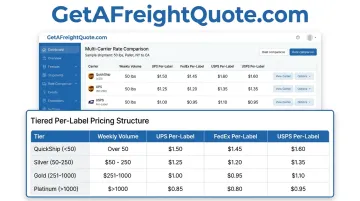
This is precisely the gap GetAFreightQuote.com was built to close. As an authorized reseller of a TMS platform, it pools shipment volume across its entire customer base, then negotiates carrier rates on behalf of everyone using the platform. A small shipper effectively borrows the buying power of hundreds of other businesses.
Practical features that make this work:
- Bring Your Own Rates (BYOR): connect your existing carrier accounts and compare them side-by-side with negotiated platform rates
- Multi-carrier rate shopping: parcel, LTL, and FTL rates displayed simultaneously in one dashboard
- Consolidated e-billing: one audit-friendly invoice instead of fragmented carrier statements
- No long-term commitments or minimums required to get started
The platform's tiered pricing reflects this scaling approach:
| Tier | Weekly volume | Per-label fee |
|---|---|---|
| QuickShip | 0-3 shipments | No fee |
| Basic | 4-100 shipments | 9¢ |
| Journeyman | 101-500 shipments | 8¢ |
| Enterprise | 501-1,000 shipments | 7¢ |
| Premiere | 1,001-2,500 shipments | 6¢ |
| Platinum | 2,501+ shipments | 5¢ |
Shippers with heavier freight needs can also work directly with the GetAFreightQuote.com team to structure dedicated lane or volume-based FTL arrangements. The team draws on platform analytics covering lane history and carrier performance to build the case for better terms.
Common Types of Freight Contracts
Not every freight agreement looks the same. Shippers generally encounter four overlapping categories:
- Spot-rate agreements — a transaction for a specific shipment, without a long-term lane commitment
- Dedicated fleet/lane contracts — a carrier dedicates vehicles and drivers exclusively to one shipper's freight
- Volume-based truckload/LTL contracts — negotiated pricing tied to recurring lanes or shipment characteristics
- Brokerage/3PL agreements — a broker arranges transportation with an authorized carrier on the shipper's behalf
Each fits a different need:
- One-off shipments work best with spot-rate flexibility
- Manufacturers with steady daily volume on the same route benefit from dedicated lane contracts
- Retailers with seasonal LTL patterns typically do best with volume-based agreements
Most contracts also reference a Bill of Lading for each individual shipment. This document serves as the actual "contract of carriage," confirming shipment terms, condition at pickup, and delivery obligations, distinct from the broader pricing agreement governing the relationship overall.
For FTL specifically, the path to a dedicated or volume-based contract usually starts differently than parcel or LTL. Rather than instant self-service quoting, it typically involves registering an account and working with a logistics team to structure lane-specific terms based on equipment type and expected volume.
Frequently Asked Questions
What is the difference between spot freight and contract freight?
Spot freight is priced in real time per shipment based on current market conditions. Contract freight locks in a fixed rate over a set period for defined lanes and volumes.
What is contract freight?
Contract freight is a negotiated, longer-term pricing agreement between a shipper and a carrier, broker, or 3PL. It covers rates, expected capacity, and service terms for a defined period.
What are the four types of freight contracts?
The four common categories are spot-rate agreements, dedicated fleet/lane contracts, volume-based truckload or LTL contracts, and brokerage/3PL agreements. Each suits different shipping patterns and volume levels.
How long do contract freight agreements typically last?
Most run several months to a full year, with many shippers using annual planning cycles. Some include mini-bid or renewal clauses that allow adjustments if market conditions shift significantly.
Can small businesses access contract freight rates?
Yes. While contracts traditionally favored high-volume shippers, platforms like GetAFreightQuote.com pool volume across many businesses to access negotiated rates and enterprise-grade technology for smaller shippers too.
Do contract freight rates include fuel surcharges and other fees?
Most contracts include a separate fuel surcharge clause and defined accessorial fee terms. Always confirm full rate transparency, including how these charges are calculated, before signing any agreement.