Introduction
You open an email from your carrier and see three letters that weren't there last year: GRI. Below it, a percentage. Below that, an effective date that's closer than you'd like.
If you run a small or mid-sized business, this notice probably raised more questions than it answered. What exactly is a General Rate Increase? Do you have to pay it? Is there any wiggle room?
GRIs are one of the most routine, and most misunderstood, parts of freight pricing. Left unchecked, they gradually inflate shipping budgets year after year.
This guide breaks down what a GRI actually is, why carriers use it, how it differs from surcharges like Peak Season Surcharge (PSS), and what your business can do to soften the blow.
Key Takeaways
- A General Rate Increase (GRI) raises a carrier's base freight rates on specific lanes
- GRIs differ from fuel and accessorial surcharges, which move independently and cost more
- GRIs have no fixed schedule — they can hit annually, quarterly, or with little warning
- Fixed-rate contracts, carrier diversification, and negotiated pricing help offset GRI impact
What Is a General Rate Increase (GRI)?
A General Rate Increase is an across-the-board adjustment to base freight rates that carriers impose to account for rising costs and shifting market conditions. Ocean lines, LTL and FTL trucking carriers, and parcel companies like UPS and FedEx all use them.
Here's the part that trips people up: a GRI rarely touches every rate a carrier offers. Instead, it typically applies to:
- Specific trade lanes (ocean freight)
- Certain service types or weight tiers (LTL)
- Particular shipment categories or zones (parcel)
Carriers announce GRIs in advance, giving shippers time to prepare. A typical notice includes the effective date, the percentage or dollar increase, and specific terms defining what's covered.
Where GRIs Show Up Across Freight Modes
Each freight mode structures its GRI a little differently:
- Ocean carriers apply GRIs per container (often per TEU) on specific trade lanes. Hapag-Lloyd, for example, announces these with a defined origin/destination scope and dollar amount per container type.
- LTL and truckload carriers apply general rate increases to their published tariffs, which then get adjusted by whatever negotiated discount a shipper has on file.
- Parcel carriers (FedEx, UPS) apply an annual average percentage increase to published base and standard-list rates, varying by service, zone, and weight.
Regardless of mode, a GRI is just the starting point. It doesn't include fuel surcharges, accessorials, or peak charges layered on top — those move separately, which we'll get into shortly.
How Often Do GRIs Happen?
There's no universal calendar for GRIs. They can happen annually, semi-annually, quarterly, or on shorter notice depending on capacity constraints and demand.
A few real examples show just how inconsistent the timing is:
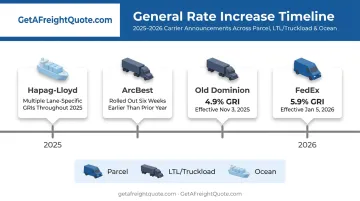
- FedEx implemented a 5.9% average GRI effective January 5, 2026, according to its Q1 earnings release
- Old Dominion Freight Line announced a 4.9% GRI effective November 3, 2025, covering specific tariffs
- ArcBest rolled out a GRI six weeks earlier than its previous year's increase, proving these adjustments aren't always spaced exactly 12 months apart
Ocean carriers move even faster. Hapag-Lloyd has issued separate GRI notices for different trade lanes within the same calendar year, each with its own effective date and dollar amount.
Why Do Carriers Implement General Rate Increases?
Carriers don't raise base rates arbitrarily. GRIs typically respond to a handful of recurring pressures:
- Rising fuel costs that squeeze margins on long-haul lanes
- Labor and equipment expenses, including driver wages, dockworker retention, and new trailer or vessel investments
- Capacity constraints during periods when demand outpaces available truck, rail, or vessel space
- Inflation across real estate, technology, and network infrastructure
- Shifts in supply and demand on specific trade lanes, especially in ocean freight
Old Dominion's 2025 GRI notice cited exactly this mix: covering costs for real estate, new equipment, technology upgrades, and competitive wages. Rather than adjusting pricing shipment by shipment, carriers use a GRI to protect margins in one broad move during high-demand or capacity-constrained periods.
However, an announced GRI isn't always guaranteed to hold.
FreightWaves reported that an Asia-to-US West Coast ocean rate retreated 6% partway through the month after an initial GRI bump, landing at $1,963 per FEU.
This shows how quickly market pressure can offset a rate increase.
Despite that volatility, carriers still communicate these increases through official notices, industry publications, or direct client announcements, almost always with advance notice of both the percentage and effective date.
GRI vs. PSS: What's the Difference?
These two terms get confused constantly, but they solve different problems for carriers.
A General Rate Increase changes the underlying base rate structure. It's a longer-term adjustment that sticks around, often described in ocean notices as effective "until further notice."
A Peak Season Surcharge (PSS), by contrast, is a temporary fee carriers layer on top of the base rate during high-volume periods, like the holiday shipping rush. It's designed to manage capacity strain, not to permanently reset pricing.
| Attribute | GRI | PSS |
|---|---|---|
| What it changes | Base rate / tariff | Separate charge on top of base rate |
| Duration | Ongoing, longer-term | Temporary, tied to specific dates |
| Trigger | Cost inflation, capacity, market conditions | Seasonal demand spikes |
UPS's demand surcharge notices, for example, defined three separate peak windows for the 2025 holiday season, each with its own surcharge amount stacked on top of standard rates. The takeaway: a GRI resets your baseline, while PSS and other accessorials pile on independently. You need to track both to understand your true landed shipping cost.
How General Rate Increases Impact Your Shipping Costs
A GRI's real-world effect depends heavily on your shipping profile, but the math adds up fast. Say your business ships pallets via LTL at a published tariff rate of $85 per hundredweight before a 5.9% GRI. After the increase, that same shipment runs roughly $90, before any fuel surcharge or accessorial fee gets added.
Multiply that across hundreds of shipments a month, and the gap becomes real money.
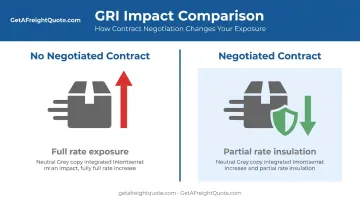
Who feels it most? Businesses without negotiated contracts or volume-based agreements. If you're paying full published or tariff rates, a GRI hits you at full strength. Shippers with contracted pricing often have more insulation, since their negotiated discount applies against the revised base rate. Platforms like GetAFreightQuote.com negotiate these discounts on behalf of small and mid-sized businesses, extending that same rate protection to shippers who don't have Fortune 500-level volume.
A few other factors complicate the picture:
- Accessorials move separately. Detention, demurrage, and fuel surcharges follow their own schedules and need a separate line in your budget, apart from the GRI itself.
- Not every dollar of revenue is exposed. FreightWaves reported that only 20–25% of revenue at LTL carriers like Saia and ArcBest was actually subject to the published GRI — the rest sits under individually negotiated contracts.
- Someone has to absorb it. Freight forwarders and shippers face a real decision: absorb the GRI to stay price-competitive, or pass it on to customers and risk losing business.
That third point matters more than it seems. Absorbing a GRI protects customer relationships but eats into margin. Passing it along protects margin but risks losing price-sensitive accounts to a competitor who negotiated better terms. Neither option is free.
How Small and Mid-Sized Businesses Can Prepare for and Minimize GRI Impact
Large enterprises have long used volume leverage to blunt GRI impact. Smaller shippers can close that gap with the right strategy and the right tools.
Practical steps that help:
- Monitor carrier announcements proactively. Don't wait for the effective date to hit your invoice. Carriers publish GRI notices weeks or months ahead.
- Negotiate fixed-rate or volume-based contracts. Locking in pricing before a GRI takes effect has historically been a large-shipper advantage, but it's increasingly accessible to smaller operations too.
- Diversify carrier relationships. Depending on one carrier means absorbing whatever rate decision they make. Spreading volume across multiple carriers creates competitive pressure.
- Book ahead of the effective date whenever your inventory and cash flow allow it, to lock in current pricing before the increase kicks in.
This is exactly where GetAFreightQuote.com levels the playing field. Small and mid-sized businesses get access to pre-negotiated carrier rates typically running 20–50% below retail pricing, achieved by pooling shipment volume across the entire customer base rather than requiring each business to hit enterprise volume alone.
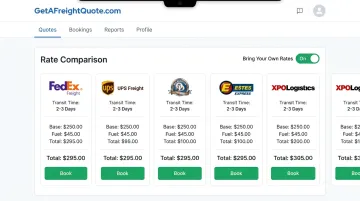
Beyond pooled pricing, the platform's Bring Your Own Rates feature lets you connect your existing UPS, FedEx, or LTL accounts and shop them side by side against GetAFreightQuote.com's negotiated rates in real time. The system books whichever rate is cheaper, no matter the source.
For LTL shippers specifically, Managed LTL Services adds carrier procurement across 100+ national, regional, and local carriers. Ongoing rate governance flags cost creep, including GRI-driven increases, before it compounds.
Full rate transparency backs every one of these steps. Every rate is visible before you book, so you can see exactly how a GRI or surcharge affects your true shipping cost, rather than discovering it after the invoice lands.
Frequently Asked Questions
What is a General Rate Increase (GRI)?
A GRI is a carrier-imposed adjustment to base freight rates, applied across specific trade lanes or service types to account for rising fuel, labor, and capacity costs. It's announced in advance with a set percentage and effective date.
What are GRI and PSS in shipping?
A GRI adjusts the base rate structure and tends to stick around long-term. A PSS (Peak Season Surcharge) is a temporary surcharge added on top of the base rate during high-volume periods, like the holiday season, to manage capacity.
How often do General Rate Increases occur?
There's no fixed schedule. Parcel and LTL carriers often issue GRIs annually, but ocean carriers and some trucking companies adjust more frequently based on market conditions.
Can shippers negotiate around a General Rate Increase?
GRIs generally apply broadly across published tariffs, but shippers with volume commitments or long-term contracts often secure more favorable terms or partial insulation from the full increase.
Does a GRI affect fuel surcharges and other accessorial fees?
No. GRIs typically apply only to base rates. Fuel surcharges, detention, demurrage, and other accessorials are calculated and adjusted independently, on their own schedules.
How can small businesses reduce the impact of GRIs on their shipping budget?
Monitor carrier announcements, diversify carrier relationships, and use platforms like GetAFreightQuote.com to access negotiated rates, compare carriers in real time, and see full pricing transparency before booking.