Introduction
U.S. business logistics costs hit $2.58 trillion in 2024, up 5.4% year-over-year and now equal to 8.8% of GDP, according to Kearney's 2025 State of Logistics report. That's the national backdrop.
For a small or mid-sized shipper, the pressure hits differently than it does for a company moving thousands of pallets a week.
Without Fortune 500 volume, you don't get Fortune 500 rates. Every fuel surcharge, accessorial fee, and rate increase eats a bigger slice of margin.
Here's the good news: freight shipping isn't expensive by nature. Costs balloon because of decisions made before a shipment leaves the dock, poor visibility once it's moving, and a lack of leverage at the negotiating table.
This article breaks down how freight costs build up, what drives them, and a three-tier framework for cutting them.
TL;DR
- Freight costs build through accessorials, inefficient packing, and rate creep
- Weight, density, mode choice, and carrier leverage are the main cost drivers
- Reduction strategies span smarter decisions, better management, and market context
- Small and mid-sized shippers can now access enterprise-grade rates and tools
How Costs Around Freight Shipping Typically Build Up
Freight costs rarely arrive as one dramatic expense. They accumulate invoice by invoice: a fuel surcharge here, an unplanned accessorial fee there, a few extra cubic feet of dunnage on every pallet. Individually, none of it looks alarming, but over a year of shipments, it adds up fast.
This buildup follows three patterns:
- Gradual and compounding: small inefficiencies repeat on every shipment, slowly inflating your average cost per pound
- Episodic and sudden: costs spike during peak season, contract renewals, or capacity crunches when carriers have the upper hand
- Hidden and overlooked: extra fees sit buried in the fine print of carrier invoices, unnoticed until you run an audit
Most businesses don't catch these charges until they scale, audit their freight spend, or feel enough margin pressure to look closely at what they're actually paying for.
Key Cost Drivers for Freight Shipping
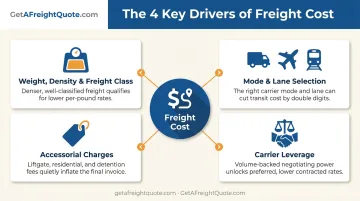
Not every shipment gets expensive for the same reason. Four factors typically do the heavy lifting.
Weight, Density, and Freight Class
A shipment's weight, dimensions, and density determine its freight class, and class drives the baseline rate. Denser, well-packed freight generally costs less per pound because it uses trailer space efficiently.
Classification standards recently shifted too: the NMFTA's 2025 update moved many commodities toward a standardized density-based scale. Packaging decisions now carry more direct weight on your invoice than they used to.
Mode and Lane Selection
LTL, FTL, air, rail, and ground each carry different price-to-speed tradeoffs. Defaulting to the same mode for every shipment, regardless of size or urgency, almost always leaves savings on the table.
Accessorial Charges
Detention, liftgate service, residential delivery, and limited-access fees sit outside the base rate and can swing a bill unpredictably. These charges are common, but they're also negotiable and, in many cases, avoidable with better scheduling and dock coordination.
Carrier Leverage
This is the driver most small shippers underestimate. Carriers have historically quoted smaller shippers higher rates simply because they lack volume, not because their freight is harder to move.
Platforms like GetAFreightQuote.com address this directly by pooling shipping volume across their entire customer base, creating negotiating leverage no individual small business could build alone. That aggregation is what allows access to rates typically reserved for Fortune 500-level shippers.
No single driver dominates every shipment. A pallet of dense machine parts and a truckload of empty-but-bulky packaging face completely different cost pressures, so the fix depends on your specific shipment profile.
Cost-Reduction Strategies for Freight Shipping
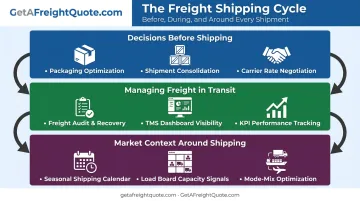
Effective cost reduction depends on which lever you're pulling: the decisions made before a shipment ships, the way it's managed once it's moving, or the external market conditions surrounding it. Here's how each tier works.
Strategies That Reduce Costs by Changing Decisions
These are the choices made before a shipment ever leaves your dock.
- Right-size packaging. Excess dunnage adds dead weight and wastes trailer space. Since dimensional weight can exceed actual scale weight, tighter packaging often lowers the billed weight directly.
- Consolidate smaller shipments into fuller loads. Paying LTL rates on what's really an FTL load wastes money, since LTL is built for splitting trailer space, not filling it alone.
- Negotiate using aggregated volume. Smaller shippers can plug into a platform with pre-negotiated carrier rates, like GetAFreightQuote.com's parcel advisory team, which earns through carrier-funded compensation instead of upfront fees.
- Select the optimal mode and carrier per shipment instead of defaulting to last time's choice. A rate-shopping platform that displays parcel, LTL, and FTL rates side by side, including your own carrier accounts, cuts this decision to seconds.
Strategies That Reduce Costs by Changing How Freight Is Managed
Once shipments are moving, visibility and consistency matter more than any single upfront choice.
- Run a freight audit process. Transportation Insight reports that 3% to 6% of freight invoices contain errors from misclassification, duplicate charges, or missed discounts. Catching these before payment protects your margin.
- Use a transportation management platform to compare live carrier rates before booking. Full rate transparency, with no hidden fees buried in a quote, removes the guesswork from every shipping decision.
- Track KPIs consistently: cost per shipment, on-time delivery rate, and accessorial charge frequency. Watching these numbers weekly, not quarterly, catches cost drift before it compounds into a real problem.
- Maintain carrier scorecards and centralize communication. Inconsistent service and last-minute rate surprises usually trace back to fragmented carrier relationships. One point of contact reduces both.
Strategies That Reduce Costs by Changing the Context Around Freight Shipping
Sometimes the freight itself isn't the problem. Empty miles, rigid scheduling, or an unbalanced carrier network often cost more than the shipment does.
- Offer off-peak shipping times and flexible pickup windows. Carriers can fill backhauls at a discount when your schedule isn't rigid, and that flexibility gets rewarded with lower rates.
- Use load boards or regional carriers strategically, particularly on lanes where national carriers charge a premium simply because they dominate that corridor.
- Diversify your mode mix. Intermodal or rail works well for longer, less time-sensitive lanes, cutting dependency on volatile trucking capacity, while FTL options like flatbed and refrigerated cover everything else.
- Improve dock and loading efficiency. Faster loading reduces detention fees and, over time, positions your business as a preferred shipper that carriers want to prioritize when capacity gets tight.
Conclusion
Reducing freight costs starts with pinpointing exactly where the cost originates:
- Packaging and weight inefficiencies
- Mode selection mismatches
- Limited carrier leverage
- Invoice errors and overcharges The answer determines the fix, and it's rarely as simple as shipping less or cutting service quality.
Sustainable freight cost reduction is continuous, not a one-time project. It combines smarter upfront decisions, active in-transit management, and awareness of the market conditions surrounding your shipments. Do these three consistently, and savings compound the way costs once did. GetAFreightQuote.com pairs TMS technology with managed services to keep all three working together automatically.
Frequently Asked Questions
How can I reduce my freight costs?
Focus on three areas: optimize packaging and consolidation decisions before shipping, actively manage and audit shipments while they're in transit, and account for external factors like timing and mode mix. Combining all three delivers the most sustainable savings.
What is a freight deduction?
A freight deduction typically refers to shipping costs subtracted from an invoice, revenue, or taxable income as a legitimate business expense. It's a tax and accounting concept, separate from operational cost-reduction strategies.
Are freight costs going up?
It's mixed. Total freight expenditures fell in 2023 and 2024, but inferred cost per shipment rose roughly 3.5% year-over-year in early 2025 as volumes dropped faster than spending. Fuel prices and capacity swings remain the biggest wildcards.
What is the cheapest way to ship freight?
Rail and ocean modes, along with full-load consolidation, tend to be the lowest-cost options for large, non-urgent shipments. But "cheapest" always depends on shipment size, urgency, and destination, so there's no universal answer.
How much can a small business realistically save on freight shipping?
Savings vary by shipment profile, but negotiated rate access combined with consistent audit practices commonly produces double-digit percentage reductions. Platforms like GetAFreightQuote.com give smaller shippers access to pooled-volume carrier rates, often producing even larger gains compared to standard retail pricing.
Does shipment consolidation always reduce freight costs?
Consolidation usually lowers per-unit cost, but it requires enough compatible volume and aligned destinations to work. Without that, forcing consolidation can create delays that offset any savings.