Add to that a Q1 2026 US retail eCommerce figure of $326.7 billion, up 9.8% year over year (US Census Bureau), and it's clear why shipping technology has stopped being a back-office decision. Many online sellers struggle with rising per-label costs, fragmented carrier accounts, and slow manual fulfillment that frustrates customers who expect next-day updates.
The right shipping software fixes both problems at once: it automates the busywork of printing labels and comparing rates, while also shaping how fast and reliably packages actually arrive. This guide covers the top parcel-focused platforms for 2026, how to evaluate them, and why oversized or palletized shipments usually need a different kind of tool entirely.
Key Takeaways
- Shipping software automates label printing, rate shopping, tracking, and returns across carriers and channels.
- Order volume, carrier mix, and package size determine which platform fits best.
- Pricing transparency and scalability matter more than brand recognition.
- Bulky or palletized items typically require a freight-specific solution alongside your parcel tool.
Overview of eCommerce Shipping Software in the US Market
eCommerce shipping software connects an online store to multiple carriers through one dashboard. It handles label generation, rate comparison, tracking, and returns without forcing a seller to log into UPS, USPS, and FedEx separately.
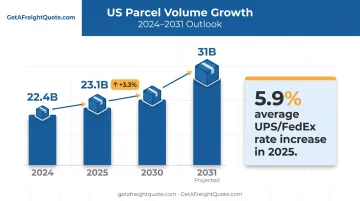
This consolidation matters more each year. 23.1 billion parcels moved through the US market in 2025, and UPS and FedEx both raised shipping rates by an average of 5.9% that same year, according to Supply Chain Dive. Sellers who still print labels one at a time are absorbing costs they don't have to.
That volume and cost pressure is exactly why rate-shopping platforms have become standard operating equipment rather than a nice-to-have. Below are the top-rated tools US sellers are using in 2026 to automate fulfillment and shrink their per-order shipping spend.
Top 5 Best eCommerce Shipping Software for 2026
These picks are weighed on carrier reach, automation depth, integration ecosystem, and value across business sizes, from a solo Shopify seller to a multi-warehouse Amazon operation.
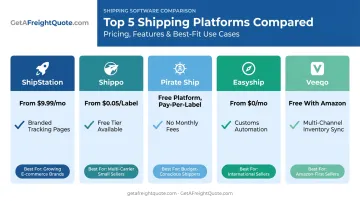
ShipStation
ShipStation is a widely used multi-carrier platform built for sellers managing orders across several sales channels at once. It connects to hundreds of stores, marketplaces, and carriers, which makes it a go-to for brands that don't want to juggle separate dashboards for Shopify, Amazon, and eBay.
What sets it apart is depth of automation: batch label printing, custom automation rules, and branded tracking and returns pages that keep the post-purchase experience on-brand rather than generic.
| Category | Details |
|---|---|
| Pricing | Plans start at $14.99/month for 50 shipments, scaling up through enterprise tiers for high-volume shippers (verify current rates before purchase) |
| Key Features | Batch printing, automation rules, multi-channel order import, branded tracking pages |
| Best For | Multi-channel sellers managing orders across Shopify, Amazon, and eBay simultaneously |
Shippo
Shippo is built for developers and lean teams that want discounted multi-carrier rates without a forced monthly commitment. Its API-first design makes it a favorite for custom storefronts and startups that need flexibility over polish.
The free starter tier is the real draw here: a limited number of labels per month at no cost, with paid tiers unlocking higher volume and branded tracking.
| Category | Details |
|---|---|
| Pricing | Free tier covers up to 30 labels/month; paid plans start around $17–19/month for higher volume (confirm current pricing) |
| Key Features | Multi-carrier rate comparison, API access, branded tracking, return label generation |
| Best For | Startups and low-volume sellers wanting to avoid fixed monthly fees |
Pirate Ship
Pirate Ship is a completely free, web-based tool offering USPS Commercial Pricing and UPS discounts with no subscription and no per-label markup. There's nothing to install — just a browser and an account.
For sellers shipping mostly domestic USPS parcels, the savings add up fast. Pirate Ship's own marketing claims discounts of up to 87% off standard USPS and UPS rates, a difficult price point for small operations to match elsewhere.
| Category | Details |
|---|---|
| Pricing | Free software with no monthly or hidden fees; you only pay the discounted carrier rate |
| Key Features | USPS/UPS discounted rates, batch printing, address book, simple dashboard |
| Best For | US-based small businesses and marketplace sellers shipping primarily domestic parcels |
Easyship
Easyship is a cloud-based platform built specifically for cross-border eCommerce, connecting sellers to 550+ courier services worldwide. If international orders are a growing part of your business, this is the one built around that problem.
The standout feature is automated customs documentation and duty/tax calculation at checkout, solving a major friction point for first-time international shippers.
| Category | Details |
|---|---|
| Pricing | Free plan available; paid plans start at $29/month, scaling to $99/month for higher shipment volume |
| Key Features | 550+ global courier services, automated customs forms, multi-currency checkout, discounted international rates |
| Best For | Sellers shipping cross-border who need automated duties, taxes, and customs compliance |
Veeqo
Veeqo is a free multichannel shipping platform backed by Amazon, built for sellers who need more than just labels. Its free Shipping plan includes unlimited users and unlimited shipments, a rare combination in this space.
Beyond cost savings, Veeqo includes built-in Amazon account health protection, an important safeguard for sellers whose entire business rides on maintaining seller metrics.
| Category | Details |
|---|---|
| Pricing | Free Shipping plan with unlimited shipments; paid tiers from $19/month add inventory and warehouse management |
| Key Features | Discounted rates from major US/UK carriers, batch printing, shipping automations, inventory sync |
| Best For | Amazon-heavy multichannel sellers wanting a no-cost shipping layer |
Why Freight & LTL Shipping Needs More Than Parcel Software
Every platform above handles only small packages within carrier weight limits. None of them handle Less-Than-Truckload (LTL) or Full-Truckload (FTL) freight — meaning furniture, appliances, or palletized inventory fall outside their scope entirely.
This creates a real gap for growing brands. Sellers moving oversized goods often run into the same wall smaller shippers face industry-wide: they get quoted higher freight rates simply because they don't ship at Fortune 500 volume.
This is the exact space GetAFreightQuote.com was built to fill. As an authorized reseller of a TMS platform, it brings negotiated carrier rates and full pricing transparency to businesses that don't have enterprise-level shipment counts. A few things worth knowing:
- Tiered pricing that scales with you: Six tiers range from QuickShip (0–3 shipments/week, no label fee) to Platinum (2,501+ shipments/week, 5¢/label), so shippers of any size pay a fair rate.
- Bring Your Own Rates (BYOR): Add your existing UPS, FedEx, or LTL accounts into the TMS, and it rate-shops each shipment against your contracts and GetAFreightQuote.com's pricing, then books whichever costs less.
- Managed LTL Services: Full carrier negotiation plus TMS implementation (a $150,000–$250,000 value) at no added cost, funded through the Off-Bill Incentive model.
- Full equipment coverage: Dry van, flatbed, refrigerated, specialized/oversized, and hazmat, with FTL quotes available through free account registration.
The practical takeaway: if your catalog includes both small parcels and bulky items, pair a parcel tool from the list above with a freight-specific platform like GetAFreightQuote.com. This combination covers your full 2026 shipping stack without overpaying on either side.
How We Chose the Best eCommerce Shipping Software
The most common mistake sellers make is picking software based on the sticker price alone. Many get hit with per-label fees, carrier surcharges, or volume caps once they scale past the free tier.
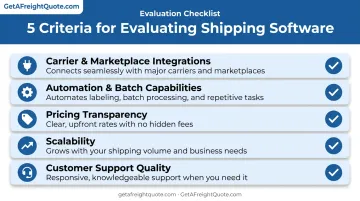
We weighed each platform on:
- Carrier and marketplace integrations: how many carriers and storefronts connect natively
- Automation and batch capabilities: how much manual work the platform actually removes
- Pricing transparency: whether the advertised price reflects what you'll pay at real volume
- Scalability: can it grow from your first 10 orders to your 10,000th without a painful migration
- Customer support quality: response times and available channels when something breaks mid-shipment
Conclusion
The best eCommerce shipping software for your business depends on your order volume, carrier mix, and growth plans. A solo seller shipping 20 USPS packages a week has different needs than a multichannel brand moving thousands of units across three marketplaces.
Before committing long-term, pilot a platform's free tier or trial. Pull real invoices and check for hidden per-label fees or surcharges that don't show up on the pricing page.
Once you've vetted a platform for hidden costs, consider whether your catalog includes bulky or freight-class items. Pairing your parcel software with a transparent freight partner like GetAFreightQuote.com rounds out a complete, cost-efficient shipping strategy heading into 2026.
Frequently Asked Questions
Which ecommerce platform has the best shipping?
Shopify, BigCommerce, and WooCommerce all support third-party shipping software integrations. The "best" setup depends on connecting your platform to a multi-carrier tool that matches your volume and shipping mix.
Which shipping company is best for ecommerce?
There's no single best carrier. Most sellers combine USPS, UPS, and FedEx through rate-shopping software to select the cheapest, fastest option for each individual shipment.
What is the best free shipping software for ecommerce?
Pirate Ship (free USPS/UPS labels, no monthly fee) and Veeqo (unlimited free shipments) are the strongest no-cost starting points for small sellers.
How do I choose the right ecommerce shipping software for my business?
Weigh your order volume, required carrier and platform integrations, automation needs, and the total cost once hidden fees are factored in.
Can ecommerce shipping software handle freight or LTL shipments?
Most parcel shipping software does not support LTL or FTL freight. Businesses shipping bulky items need a dedicated freight/TMS solution, like GetAFreightQuote.com, alongside their parcel tool.
What's the difference between shipping software and a freight quote/TMS platform?
Shipping software automates small-package labels and tracking. A TMS or freight platform manages negotiated LTL/FTL carrier rates and logistics for larger, heavier shipments.