Introduction
A small business owner packs up an order, only to have it bounce back from the carrier with a rejection notice: too heavy, too big, wrong service.
Or worse, they book it as parcel anyway, eat a $200 oversize fee, and still have to re-ship it as freight.
This mix-up happens constantly, and rising shipment volumes make it worse. In 2025, U.S. parcel shipments hit 23.1 billion, up 3.3% from the previous year according to Pitney Bowes' 2025 Shipping Index — that's over 63 million packages moving every single day.
As B2B and e-commerce shipping both scale, knowing exactly where parcel ends and freight begins isn't optional. It directly controls your shipping budget.
This guide breaks down both methods, compares them side by side, and gives you a practical framework for picking the cheaper, smarter option on every shipment.
Key Takeaways
- Parcel shipping covers individual packages under 150 lbs via USPS, UPS, FedEx, and DHL
- Freight shipping moves palletized or bulk loads as LTL, partial, or full truckload
- Weight, dimensions, frequency, and destination type matter more than price when choosing a method
- Rate-shopping parcel and freight side by side with TMS tools consistently cuts shipping spend
What Is Parcel Shipping?
Parcel shipping moves individual packages — typically under 150 lbs — that one person can load without a forklift or pallet jack. These shipments travel through ground or air networks run by major national carriers.
Who handles parcel shipments:
- USPS — best for lightweight packages, caps out at 70 lbs
- UPS and FedEx — domestic ground and air networks, up to 150 lbs
- Regional carriers — OnTrac, LSO, and GLS handle specific U.S. zones
- International parcel — DHL, FedEx International, and UPS Worldwide manage cross-border deliveries
Weight and Size Limits That Trigger Rejection
Every carrier sets its own ceiling, and it's not a single universal number. USPS stops at 70 lbs and 130 inches of length plus girth. UPS and FedEx Ground allow up to 150 lbs, 108 inches in length, and 165 inches in length plus girth.
Go over those limits, and you're not just paying more: the package may get flagged, held, or returned at your expense.
Both UPS and FedEx also apply oversize surcharges once a package exceeds 96 inches in length or 130 inches in length plus girth, even if it's under the absolute maximum. That's the trap many shippers fall into: the box gets accepted, but the surcharge quietly eats the margin.
Parcel works best for:
- Direct-to-consumer e-commerce orders
- Small B2B shipments (samples, spare parts, documents)
- Anything a single person can carry to a drop-off counter
How Parcel Delivery Works
Parcel shipments follow a fairly predictable path. Once labeled, the package enters a hub-and-spoke network with several transfer points before it reaches the final address:
- Packaging and labeling — box is sealed, weighed, and assigned a tracking number
- Pickup or drop-off — carrier collects the package, or it's left at a staffed counter
- Conveyor sorting — scanned and routed at a regional sort facility
- Line-haul transport — moved between hubs, often overnight
- Last-mile delivery — final leg to the business or residential address
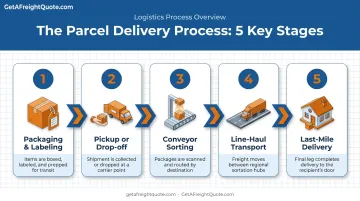
Because tracking numbers update at each scan point, parcel shipments offer near real-time visibility, something that becomes noticeably less precise once you move into freight.
What Is Freight Shipping?
Freight shipping covers shipments too large or heavy for a parcel network, the ones that need a forklift, pallet jack, or dock to load and unload. Once a shipment crosses roughly 150 lbs or exceeds a carrier's dimensional limits, it has to move as freight instead.
Freight moves by truck, rail, ocean, or air, and it works differently than parcel in one key way: freight capacity depends on carrier networks and available trailer space, not fixed daily delivery routes. That's why freight transit windows are less exact than parcel's next-day or two-day guarantees.
Freight generally splits into three categories based on shipment size.
Full Truckload (FTL)
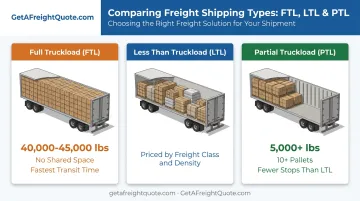
FTL means your shipment is large enough to fill an entire trailer — commonly in the 40,000 to 45,000 lb range, though this varies by trailer type, equipment, and route. Federal interstate rules cap gross vehicle weight at 80,000 lbs, so actual cargo capacity depends on the tractor and trailer combined.
Why shippers choose FTL:
- No shared trailer space with other freight
- Minimal handling reduces damage risk
- Fastest transit time among freight options
- Ideal for single-destination bulk orders
Less Than Truckload (LTL)
LTL consolidates your pallets with other shippers' freight inside the same trailer. Pricing is based on pallet count, weight, and freight class, as determined by the National Motor Freight Classification (NMFC), the industry standard used to classify commodities moving through LTL networks.
Freight class is set using four factors: density, handling, stowability, and liability. Density (weight divided by cubic footage) usually drives the classification, but oddly shaped or fragile freight can bump the class (and the price) even at low weight.
Get the weight or dimensions wrong on your bill of lading, and the carrier can reweigh, remeasure, and reclassify your shipment mid-transit. That reclassification fee is one of the most common, and most avoidable, costs in LTL.
Despite this pitfall, LTL remains the most common entry point for small businesses shipping palletized goods, though rates have historically favored shippers with higher volume.
Partial Truckload (PTL)
PTL sits between LTL and FTL. You're using a full trailer, but you're not filling it, generally more than 5,000 lbs and around 10 or more pallets, without touching all the available cargo space.
Because PTL freight passes through fewer terminals and transfer points than LTL, it usually means less handling and lower damage risk. It's a solid fit for shippers who've outgrown LTL volume but don't have enough freight to justify a dedicated trailer.
Parcel vs. Freight Shipping: Key Differences
Here's how the two methods stack up across the factors that actually affect your shipping budget:
| Factor | Parcel | Freight |
|---|---|---|
| Weight/size | Under ~150 lbs, within dimensional limits | Palletized or bulk, exceeding parcel limits |
| Pricing | Per package: weight, dimensions, zone | Per pallet/weight: freight class, density, negotiated rates |
| Delivery speed | Fixed daily routes, predictable windows | Space-dependent, can vary by demand and lane |
| Handling | Direct routing, fewer touchpoints | Multiple dock and transfer points |
| Tracking | Scan updates at every stage | Available, but often less granular |
Pricing structure creates the biggest surprises. Parcel rates are straightforward, calculated by weight, dimensions, and delivery zone. Freight pricing depends on several variables that can swing costs dramatically:
- Pallet count and total shipment weight
- Freight class assigned to the goods
- Density of the palletized freight
- Negotiated rate with the carrier
Two nearly identical pallets can price out completely differently if one triggers a higher freight class.
Beyond pricing, delivery predictability diverges just as sharply. Parcel carriers run fixed daily routes, so transit windows stay consistent. Freight capacity fluctuates with demand: a pandemic-era survey of 91 LTL shippers found that 87.9% reported transit extensions, with most citing one to two extra days.
Most established shippers don't pick one method exclusively. They run freight for bulk B2B replenishment and parcel for direct-to-consumer orders, optimizing total shipping cost across both channels rather than forcing every shipment through a single mode.
How to Choose the Right Shipping Method for Your Business
Before booking, run every shipment through a quick checklist:
- Weight and dimensions: Under 150 lbs and within carrier limits? Parcel likely wins.
- Order frequency to the same destination: Frequent small orders may still favor parcel; consolidated volume can justify PTL or FTL.
- Delivery speed requirements: Need next-day certainty? Parcel's fixed routes typically outperform freight scheduling.
- Recipient type: Residential deliveries usually mean parcel; commercial docks can handle freight.
The gray area sits at 70-150 lbs. Either method can technically work here, and this is where shippers most often overpay. At this weight range, shipment volume and destination type usually decide it. A single 120 lb box to a residence is often cheaper as parcel, while five 120 lb boxes to one commercial address may cost less consolidated as PTL.
Shipping patterns shift as your business grows, and carrier rates change with them. What made sense as pure parcel last year might now qualify for PTL. Reviewing your shipping mix regularly (parcel, LTL, PTL, and FTL) keeps you from leaving savings on the table simply because nobody revisited the decision.
How GetAFreightQuote.com Helps You Ship Smarter Across Parcel and Freight
Small and mid-sized shippers have historically paid more per pound than large enterprises simply because they lack the shipment volume to negotiate better rates. GetAFreightQuote.com was built to close that gap, giving businesses of any size access to the same negotiated carrier rates and TMS technology that Fortune 500 shippers use.
What that looks like in practice:
- Parcel rate reductions of 20-50% below retail carrier pricing on FedEx, UPS, and USPS shipments
- LTL negotiation services averaging 15-35% savings, built through an 8-10 week benchmarking and bid process
- Bring Your Own Rates: connect existing UPS, FedEx, or LTL accounts to the TMS, and it books whichever rate is cheaper in real time
- Full rate transparency: no hidden fees, every rate visible before you commit
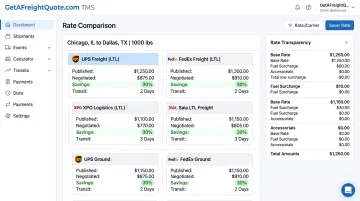
The platform covers parcel, LTL, partial, and full truckload in one dashboard, so you're not toggling between five carrier portals to find the cheapest option for a single shipment.
Subscription tiers scale from QuickShip (0-3 shipments a week, no label fee) up to Platinum (2,501+ shipments a week at 5¢ per label), meaning even occasional shippers get access without a large upfront commitment.
Behind the software sits a 24/7 team that provides hands-on support:
- Reviews shipment details before they ship
- Flags NMFC classification issues before they turn into reclassification fees
- Audits every invoice line item for errors
That combination of technology and hands-on support is what lets a business owner book the right method every time without becoming a logistics expert first.
Frequently Asked Questions
What is considered parcel shipping?
Parcel shipping refers to individual packages, generally under 150 lbs and within standard dimensional limits, shipped via carriers like USPS, UPS, FedEx, or DHL.
How does parcel delivery work?
Packages are labeled and picked up or dropped off, then sorted through carrier hubs before final delivery to the recipient. Tracking numbers update at each scan point along the way.
What's the difference between parcel and LTL freight shipping?
Parcel moves individual small packages through a fixed daily network. LTL consolidates palletized freight into shared trailer space, priced by freight class and weight rather than by package.
Is it cheaper to ship freight or parcel?
It depends on size. Parcel is typically cheaper for small, light packages, while freight becomes more cost-effective per pound as weight and pallet count increase.
Can I combine parcel and freight shipping for my business?
Yes. Many businesses use freight for bulk B2B replenishment and parcel for direct-to-consumer orders, balancing cost against delivery speed across both channels.
What weight requires freight shipping instead of parcel?
Shipments generally exceeding 150 lbs, or surpassing a carrier's dimensional limits, need to move as freight rather than parcel.