But stacking goods onto a pallet is the easy part. What happens next determines everything: your cost, your damage risk, and whether the shipment arrives on schedule. Pallet choice, packing method, weight distribution, and carrier selection all play a role.
Many shippers lose money or damage freight without realizing why. This guide walks through the exact steps to ship a pallet, what you need beforehand, the variables that drive cost and safety, and the mistakes that cost businesses the most.
Key Takeaways
- Pallet type, stacking method, and wrapping technique directly affect damage risk and cost.
- Most billing surprises stem from inaccurate weight or freight class declarations.
- Column stacking preserves compression strength; overhang cuts it by nearly a third.
- Comparing carrier rates before booking is the single biggest lever for cutting pallet shipping costs.
How to Ship a Pallet: Step-by-Step
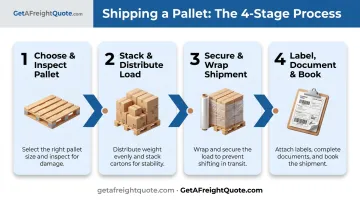
Step 1: Choose and Inspect Your Pallet
Pallet selection should match your product's weight, moisture sensitivity, and industry requirements:
- Wood — general dry goods and manufactured products
- Plastic — food, beverage, and pharmaceutical shipments where sanitation matters
- Metal — heavy or industrial loads requiring extra durability
Before loading anything, inspect the pallet. It needs to be free of broken boards, protruding nails, or any structural damage that could fail mid-transit.
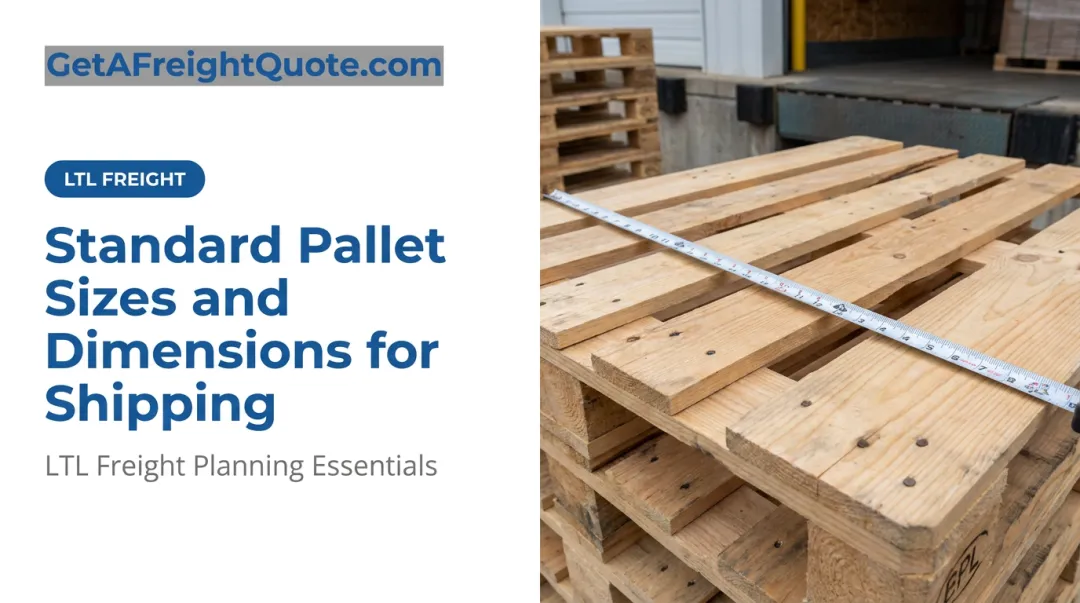
Size matters, too. The 48"x40" GMA pallet is the standard footprint across North American freight equipment, which means it's handled smoothly by forklifts and pallet jacks at every touchpoint in the supply chain. Stick with this size unless your product or receiver specifically calls for something else.
Step 2: Stack and Distribute the Load Correctly
Place heavier items on the bottom, lighter ones on top. This prevents crushing and keeps the load from tipping during transit.
For stacking pattern, you have two main options:
- Column stacking — boxes stacked directly on top of one another, maximizing compression strength
- Interlocking stacking — staggered for lateral stability, though it sacrifices compression strength
A Cal Poly study on palletized box compression found interlocking reduced compression strength by 45% compared to column stacking. If your cartons are uniform and rigid, column stack them and add external containment for stability instead.
Stacking pattern isn't the only factor affecting compression strength. Overhang matters too, so never let goods extend past the pallet edges. According to FedEx's freight packaging guidelines, overhang can reduce package compression strength by as much as 32%. That's a lot of structural integrity to give up for a few extra inches of space.
Step 3: Secure and Wrap the Shipment
Wrapping starts at the base. Work upward with stretch wrap, overlapping each layer and anchoring the film to the pallet itself so the load can't shift independently. FedEx's guidelines call for a minimum of three stretch-wrap layers, with more added depending on load weight and geometry.
For shipments needing extra stability:
- Loop straps through the pallet's forklift openings
- Ratchet tight on at least two sides
- Add corner guards, edge boards, or load protector pads to prevent shifting and protect top and bottom layers
Keep the forklift entry points clear when banding. Whether your pallet uses 2-way or 4-way entry, blocked openings slow down handling at every stop.
Step 4: Label, Document, and Book the Shipment
Labels go on the side of the pallet and must include:
- Sender and receiver addresses with zip codes
- Handling instructions ("Fragile," "This Side Up")
- PO number or reference ID for tracking
Double-check these before the driver arrives. A mislabeled pallet gets misrouted, and misrouting means delays.
On the documentation side, accurate weight and freight class on the Bill of Lading is non-negotiable. Get either wrong, and you're looking at a reclassification fee after pickup. That's an avoidable cost with correct measurements upfront.
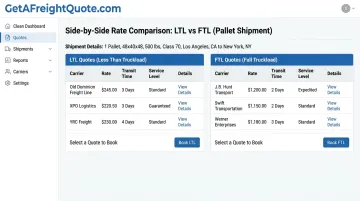
Before booking, get quotes from more than one carrier. Rates for the identical pallet, same lane, same weight, can vary by hundreds of dollars between providers. Platforms like GetAFreightQuote.com let shippers compare carrier rates side by side before committing, so you're not stuck taking whatever number the first carrier quotes.
What You Need Before Shipping a Pallet
Preparation determines whether your shipment arrives on time, intact, and at the price you were quoted. Skip this step, and you're rolling the dice.
Equipment and Material Requirements
At minimum, you'll need:
- A pallet in sound condition (no cracks, no exposed nails)
- Stretch wrap or strapping material
- Access to a pallet jack or forklift for loading and unloading
That's the baseline. Anything beyond it, like corner guards or edge boards, is situational based on product fragility and transit distance.
Documentation and Freight Class Readiness
With the pallet itself squared away, the next requirement isn't physical, it's paperwork. Before you request a quote, you need accurate weight, dimensions, and NMFC freight class in hand. Misclassification remains one of the leading causes of surprise invoice adjustments in LTL freight.
This got more complicated in 2025. The NMFC system shifted to a density-based model, meaning your freight class now hinges on the precise weight-to-volume ratio of your shipment rather than just the commodity type. Get the measurements wrong, and a carrier reweigh at the dock can trigger a reclassification you didn't budget for.
This is exactly where upfront rate transparency matters. GetAFreightQuote.com's platform includes density calculation tools and guidance on NMFC accuracy before you even request a quote.
It also runs automated auditing that flags unwarranted accessorial charges before you pay them, catching classification errors at the source instead of after the invoice lands.
Key Factors That Affect Pallet Shipping Cost and Success
A handful of controllable variables determine whether your shipment arrives on budget and undamaged. Understanding them helps you achieve both outcomes.
Pallet Type and Size
Material affects durability, moisture resistance, and price. Size affects how many pallets fit per trailer.
Larger or non-standard pallets often cost more to ship and waste trailer space that a standard 48"x40" footprint would have used efficiently. If your receiver doesn't require something specific, standard sizing keeps costs predictable.
Weight and Freight Class Accuracy
Freight class is set by density, stowability, handling requirements, and liability. Under the current NMFC structure, 70-80% of LTL freight is now classified by density alone, according to FreightWaves reporting.
That shift raises the stakes on accuracy. A declared weight or dimension that doesn't match what the carrier measures at the dock can trigger reweighing, redimensioning, and a rate adjustment you didn't see coming.
Packaging and Load Security
Proper stacking, wrapping, and bracing prevent shifting, tipping, and damage claims. As discussed earlier, interlocking stacking and overhanging cartons both measurably reduce compression strength. Industry association NMFTA notes that poor packaging costs the LTL sector billions annually in claims and wasted trailer space, though it doesn't break that cost down per shipment.
Carrier and Service Selection (LTL vs. FTL)
| Service | Typical Volume | Best For |
|---|---|---|
| LTL | 1-6 pallets, under 12 linear feet | Smaller shipments sharing trailer space |
| FTL | Fills most of a 53-foot trailer (roughly 26-30 pallets) | Larger volume, dedicated transit |
Choosing the wrong service level means either paying for capacity you don't use or facing longer transit times than necessary. Pallet count is a useful benchmark, but always get a lane-specific quote rather than assuming a fixed break-even point. A multi-carrier rate-shopping platform, like the TMS tool behind GetAFreightQuote.com, pulls LTL and FTL quotes side by side so you can see the real cost difference before booking.
Common Pallet Shipping Mistakes to Avoid
Most pallet shipping problems trace back to one of these four errors:
- Skipping the pre-shipment inspection: a cracked board or exposed nail discovered at the dock delays the whole shipment
- Letting goods overhang the pallet edges: weakens compression strength and increases damage risk
- Under-wrapping or under-strapping the load: insufficient containment lets the shipment shift in transit, and shifted freight often arrives damaged
- Providing inaccurate weight or freight class: the single most common cause of costly billing adjustments after pickup
Every one of these is preventable with a five-minute check before the carrier arrives.
How to Ship Pallets Cheaply: Cost-Saving Strategies
The biggest cost-saving lever most shippers overlook is how carrier rates are sourced and compared.
Compare Multiple Carriers Before Booking
Rates for the same lane and pallet weight can vary widely between carriers. This should be standard practice for every shipment, not just large ones.
The trade-off: manually requesting quotes from five different carriers eats up hours you don't have. That's the exact problem a comparison tool solves.
Use a TMS Platform for Negotiated Rates
Small and mid-sized businesses typically lack the shipment volume to negotiate Fortune 500-level rates on their own. That's where a TMS platform changes the equation.
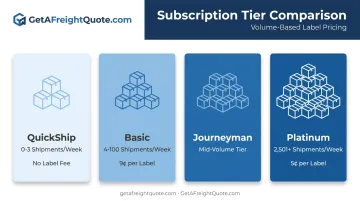
GetAFreightQuote.com gives shippers of any size access to pre-negotiated carrier rates alongside enterprise-grade TMS technology, with full rate transparency and no hidden fees. Subscription tiers scale with volume:
- QuickShip (0-3 shipments/week): no label fee at all
- Basic (4-100 shipments/week): 9¢ per label, the most popular tier for small e-commerce shippers
- Journeyman through Platinum: per-label fees drop as low as 5¢ for shippers moving 2,501+ shipments weekly
Shippers can also connect their own existing carrier accounts alongside the platform's negotiated rates. The system rate-shops both simultaneously on every shipment, so you always book the cheaper option, whether it's yours or the platform's.
Consolidate Shipments or Ship Off-Peak
Beyond rate shopping, timing and shipment volume offer another lever for savings. For businesses with flexible timing, shipping mid-week or combining multiple smaller shipments into one pallet load reduces per-unit cost.
Planning is the catch: consolidation requires more advance inventory coordination than reactive, last-minute shipping, but the savings usually justify the extra scheduling work.
Frequently Asked Questions
How can I ship pallets cheaply?
Compare multiple carrier rates, ensure accurate freight class, and use a platform with pre-negotiated volume rates, like GetAFreightQuote.com, to consistently lower pallet shipping costs.
What is the standard pallet size for freight shipping?
The most common size in North America is 48"x40", often called the GMA or CBA pallet. 42"x42" and 48"x48" pallets are also used for specific industries like paint or liquid drums.
How much weight can a standard pallet hold?
Capacity varies widely by material, construction, and support condition, so there's no single universal number. Always check the specific manufacturer rating for the pallet design you're using rather than relying on a generic figure.
What's the difference between LTL and FTL for pallet shipments?
LTL suits shipments of roughly 1-6 pallets and shares trailer space with other shippers' freight. FTL becomes more cost-effective for larger loads, generally in the range of 26-30 pallets.
How should I label a pallet shipment?
Labels go on the pallet's side and should include sender and receiver details, zip codes, and handling instructions. Check them twice before pickup to avoid delays or misrouting.
What's the biggest factor that affects pallet shipping cost?
Weight and freight class accuracy, along with pallet dimensions, are the primary cost drivers. Carrier selection determines how much markup gets added on top of those base factors.