This article breaks down both pricing models, explains when each makes sense, and shows how technology platforms now give businesses of any size access to competitive rates that were once reserved for Fortune 500 companies.
Key Takeaways
- Spot rates move daily with supply and demand—use them for one-off or overflow freight
- Contract rates lock fixed prices and capacity on agreed lanes for 12–24 months
- Contracts usually win on average cost and guaranteed capacity; spot can undercut when markets soften
- Smaller shippers can still get contract-like pricing through platforms and 3PLs that pool volume
- Best approach: contract steady lanes, use spot for variable routes and backup capacity
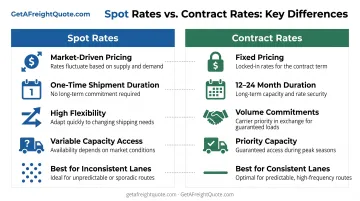
Spot vs Contract Rates: Quick Comparison
Here’s how spot and contract freight rates compare on cost, commitment, and capacity:
| Factor | Spot Rates | Contract Rates |
|---|---|---|
| Cost | Variable and market-driven; spikes in tight capacity, drops in soft markets | Fixed for the contract term; more stable and often lower on average |
| Duration | One-time move with no ongoing commitment | Long-term agreement (typically 12–24 months) with committed volumes |
| Flexibility | High flexibility to shift demand or test new lanes | Lower flexibility; volume commitments in exchange for capacity guarantees |
| Capacity Access | No guaranteed availability; depends on real-time market conditions | Priority access and preferred capacity, even in tight markets |
| Best For | Inconsistent lanes, freight surges, low-volume routes, new market testing | High-volume consistent lanes, budget forecasting, strategic carrier partnerships |
What Are Spot Rates?
Spot rates are the immediate, on-demand price a carrier or freight broker charges to move a specific shipment right now. Unlike contracted pricing, spot rates reflect real-time market conditions at the moment of booking, much like airline tickets that fluctuate with seat availability and travel dates.
These rates can change daily or even hourly. Several factors drive spot rate calculations:
- Current fuel prices and diesel market volatility
- Available trucking capacity in the origin region
- Freight demand in the destination region
- Equipment type required (dry van, reefer, flatbed)
- Lane popularity and backhaul opportunities
- Seasonality and disruptions such as weather events, natural disasters, or regulatory changes
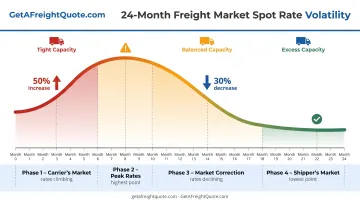
Supply and demand cycles directly impact spot pricing. In a "carrier's market" with tight capacity, spot rates surge as shippers compete for limited trucks. Conversely, in a "shipper's market" with excess capacity, spot rates drop as carriers compete for available freight.
DAT's 2024 market analysis documented extreme volatility: spot rates climbed more than 50% year-over-year at the pandemic-cycle peak and dropped more than 30% at the trough. While that represents an unusual cycle, it illustrates the pricing swings spot shippers can face.
Use Cases for Spot Rates
Spot rates work best in specific situations:
- Low freight volumes — If you ship 1-5 loads per month, volume commitments don't make sense
- Unexpected freight surges — Seasonal spikes, promotional campaigns, or emergency shipments that exceed your contract carrier capacity
- Testing new lanes — Evaluate demand and pricing before committing to long-term contracts in unfamiliar markets
- Backup capacity — When contract carriers reject loads due to capacity constraints, spot markets provide critical fallback options
What Are Contract Rates?
Contract rates are pre-negotiated, fixed prices for freight transportation covering agreed-upon lanes and volumes over a defined period. Most shippers establish these through an annual RFP (Request for Proposal) process where they present forecasted shipping volumes and lanes to carriers, who then offer committed pricing in exchange for volume commitments.
Standard contract structure: A base rate plus a fuel surcharge (FSC) that adjusts with diesel prices. This structure ensures carriers can maintain profitability despite fuel volatility while shippers retain rate stability for the base price.
Contract duration: Traditional annual RFPs establish rates for 12 months or more, with many contracts covering 12-24 months. Mini-bids can reset selected lanes on shorter 3-6 month intervals without reopening the entire contract.
Price vs. capacity: Contract rates guarantee price, not necessarily capacity. Contracted carriers typically prioritize your loads, but they still cannot promise a truck on every future date, especially during extreme market tightness.
Access for smaller shippers: You don't need Fortune 500 volume to secure contract rates. Many 3PLs and freight platforms pool volume from multiple shippers to negotiate competitive rates, then extend those rates to smaller customers.
GetAFreightQuote.com, for example, combines volume across hundreds of shippers to unlock negotiated contract pricing across LTL, truckload, and parcel. Businesses of any size commonly see 20-50% savings versus retail rates.
Use Cases for Contract Rates
Contract rates deliver the most value when:
- You ship consistent volumes — Regular shipments from distribution centers to retail locations or recurring customer deliveries
- You need budget certainty — Fixed rates eliminate pricing volatility, making financial planning and forecasting more accurate
- You need priority capacity access — Contracts improve your odds of coverage during peak seasons when spot capacity gets scarce and expensive
- You want strategic partnerships — Long-term contracts build carrier relationships that often mean better service, faster help during disruptions, and fewer recurring pickup issues
Spot vs Contract: Which Should You Choose?
Most shippers get the best results from a mix of both. Your freight profile, volume, and current market conditions set the right balance.
Recommended approach:
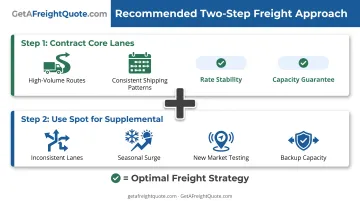
Contract your core lanes: Lock in contract rates on high-volume lanes with steady shipment patterns to secure rate stability, capacity guarantees, and scale pricing.
Use spot for supplemental needs: Keep spot for inconsistent lanes, seasonal surges, new-market tests, or backup when contract carriers cannot cover a load.
Decision framework:
Choose contract rates if you:
- Prioritize predictable costs and budget certainty
- Need guaranteed capacity during peak periods
- Ship consistent volumes on repeating lanes
- Want to build strategic carrier partnerships
Spot fits better when your network looks different:
Choose spot rates if you:
- Need maximum flexibility for variable demand
- Have unpredictable shipping patterns
- Ship low volumes that don't justify commitments
- Want to capture lower spot pricing when markets soften below your contract rates
Market timing matters. In December 2023, DAT reported national van spot rates at $2.10 per mile versus $2.49 contract, a 39-cent spot advantage. Soft-market gaps like that do not hold on every lane or in every period. When capacity tightened, rejection rates briefly topped 10% and spot rates jumped.
Lane-level analysis beats averages. Even in nationally soft markets, individual lanes can post spot premiums. In late October 2024, FreightWaves reported Los Angeles–Dallas spot rates at $2.55 per mile, 10 cents above contract on that lane. Source each lane on its own numbers, not the national average.
Monitor key metrics:
- First-tender acceptance rates on contract lanes
- Spot-to-contract rate gaps on your specific lanes
- Rejection rates and backup-carrier performance
- Fuel-normalized rate comparisons (contract rates typically separate fuel surcharges; spot rates include fuel)
Real-World Example: Small Manufacturer Optimizes Freight Costs
A mid-sized equipment manufacturer shipping 15-20 truckloads per month relied exclusively on spot rates because they believed their volume was too small for contract pricing. That choice created rate volatility that made budgeting difficult and left them short on capacity during peak periods.
The solution: The manufacturer partnered with GetAFreightQuote.com to access a TMS platform with pre-negotiated carrier rates and market benchmarks. Comparing those rates against their existing carrier relationships showed a clear path forward.
They locked in quarterly contract commitments on their three highest-volume lanes and kept spot market flexibility for less frequent routes.
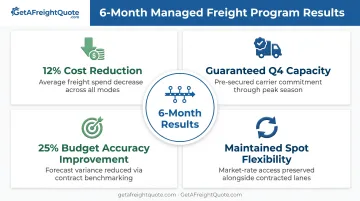
Measurable results within six months:
- Reduced average freight costs by 12% on contracted lanes
- Secured guaranteed capacity during Q4 peak season, avoiding costly last-minute spot rates
- Improved budget accuracy by 25% through rate predictability
- Retained flexibility to use spot rates for variable-volume lanes
Key takeaway: Shippers with modest volumes can still get contract-like pricing and rate transparency. The right technology platform and freight partnership remove a disadvantage that once favored only large-volume shippers.
Conclusion
Neither spot nor contract rates win in every situation. Each serves a distinct purpose in a balanced freight strategy. The right mix depends on your shipping patterns, volume consistency, and current market conditions.
Small and mid-sized shippers who understand these pricing mechanisms and use modern freight technology platforms can get cost predictability and competitive rates once limited to Fortune 500 companies. They also keep the flexibility to adjust when markets shift or the business grows.
Frequently Asked Questions
What is the difference between spot rate and contract rate?
Spot rates are one-time, market-driven prices for individual shipments that change based on current supply and demand. Contract rates are pre-negotiated, fixed prices for committed freight volumes over 12-24 months, offering stability in exchange for volume commitments.
What do spot rates mean?
Spot rates are the immediate, on-demand price to ship freight right now, reflecting real-time market conditions. Similar to surge pricing for ride-sharing, spot rates fluctuate based on available truck capacity and current freight demand.
What are contract rates?
Contract rates are freight prices set through a bid process for a set term. Shippers commit to volume; carriers commit to fixed pricing and guaranteed capacity, typically for 12-24 months.
How are spot rates calculated?
Spot rates are priced in real time from current market conditions. Main drivers include fuel, truck capacity at origin, demand at destination, equipment type, lane distance, and short-term factors like weather or seasonality.
When should I use spot rates vs. contract rates?
Use contract rates for your core, high-volume lanes with consistent shipping patterns where you need rate predictability and guaranteed capacity. Use spot rates for variable-volume lanes, unexpected freight surges, new route testing, or when market conditions make spot pricing more favorable.
Can small businesses get contract rates?
Yes. Small businesses can secure contract rates directly with carriers when lane volume is high enough, or through 3PLs and freight platforms that pool shipper volume. TMS platforms like GetAFreightQuote.com also open enterprise-level pricing to businesses of any size.