This scenario plays out daily across thousands of small and mid-sized businesses. While Fortune 500 companies employ dedicated logistics teams to monitor carrier performance and enforce contract terms, small shippers often lack the resources, systems, and expertise to prevent money from leaking through poor contract oversight. The result: paying for services they didn't receive, absorbing charges they didn't authorize, and renewing agreements without evidence of whether the carrier earned another year.
Key Takeaways:
- Small shippers typically lack TMS systems (only 10% adoption) to enforce negotiated rates, creating billing gaps
- Transportation Insight reports 3-6% of freight invoices contain errors, usually from accessorials or misapplied discounts
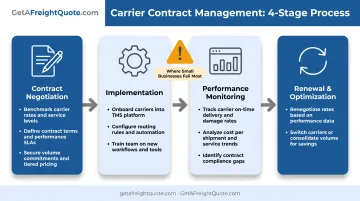
- Carrier contract management spans four stages: negotiation, implementation, monitoring, and renewal—most small businesses fail at monitoring
- Negotiation leverage comes from data, not just volume—historical shipment analysis and lane density matter more than size
- Platforms like GetAFreightQuote.com aggregate volume across hundreds of shippers to unlock Fortune 500-level pricing for small businesses
What is Carrier Contract Management and Why It Matters
Carrier contract management is the process of negotiating, executing, monitoring, and optimizing agreements with freight carriers throughout the contract lifecycle. It covers defining rates and service-level agreements, validating invoices against those terms, and preparing data-driven renewal decisions.
Most small businesses treat carrier contracts as one-time events: negotiate a rate, sign the agreement, and hope the carrier honors it. The problem lies in what happens after the signature.
Negotiated rates must be loaded into operational systems, whether a Transportation Management System (TMS), enterprise resource planning (ERP) software, or even a spreadsheet. Those rates must then be applied correctly to every shipment, and invoices must be checked against contract terms before payment. Finally, carrier performance must be tracked continuously so renewal decisions are based on evidence, not habit.
The monitoring gap is where small businesses lose the most money. According to Transportation Insight, 3-6% of freight invoices contain errors, typically involving accessorial charges or misapplied discount structures. That research estimates 1-5% of total freight spend may be recoverable through accurate auditing and dispute resolution. For a business spending $200,000 annually on shipping, that's $2,000 to $10,000 left on the table every year.
Small businesses face unique vulnerabilities:
- Technology gap: Only 10% of small shippers use a TMS, compared to 50% of large shippers, leaving rates and contract terms managed in email threads and spreadsheets
- Resource gap: No dedicated logistics manager means contract oversight falls to whoever has time
- Visibility gap: Shipment tracking and carrier performance often rely on reactive phone calls, not proactive dashboards
- Audit gap: Invoices are paid based on carrier statements, not validated against negotiated terms
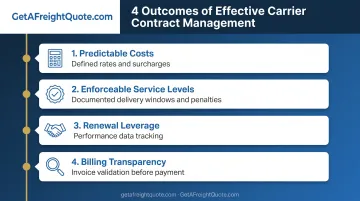
Effective carrier contract management delivers four critical outcomes:
- Predictable costs through clearly defined rate structures, fuel surcharges, and accessorial fees
- Enforceable service levels with documented delivery windows, claims resolution timelines, and performance penalties
- Renewal leverage built from months of tracked carrier performance data
- Billing transparency that catches discrepancies before payment, not during year-end audits
The 4 Stages of Carrier Contract Management
Every carrier relationship moves through four lifecycle stages. Value is gained or lost at each transition, and small businesses are most vulnerable during implementation and monitoring: the stages that happen after the contract is signed.
Stage 1: Contract Negotiation and Creation
Negotiation defines the financial and operational terms that will govern the relationship for the next 12-36 months. This stage typically covers:
- Rate structures (per-pound, per-mile, or zone-based)
- SLAs for delivery windows
- Accessorial charge definitions (liftgate, residential, inside delivery)
- Fuel surcharge formulas, liability limits, and claims procedures
- Termination clauses
Common mistakes small businesses make:
- Accepting the carrier's standard rate card without pushing for discounts or volume tiers
- Skipping SLA negotiations because "we trust our carrier"
- Ignoring accessorial fee structures until they appear on the first invoice
- Failing to cap fuel surcharges or tie them to published indexes
- Not defining what happens if the carrier misses delivery commitments
What to prioritize during negotiation:
- Rate structure clarity: Confirm base-plus-accessorials, all-in, or tiered pricing—and ask for a sample invoice.
- Performance metrics: Set on-time delivery, damage, and claims timelines, then attach credits, fee waivers, or termination rights to failures.
- Termination clauses: Add quarterly review rights and exit options if performance slips or market conditions change.
- Rate review schedules: Lock rates for a set period, with renegotiation triggers if fuel costs or capacity shift sharply.
enVista's carrier contract work involves building shipment-level cost baselines, benchmarking market variables, and modeling routing, service-level, and packaging scenarios before entering multi-round negotiations. Small businesses don't need enterprise consulting to apply the same logic. Historical shipment data, clear lane definitions, and a market-rate benchmark are enough to start.
Stage 2: Contract Implementation
The handoff from negotiation to operations is where many contracts break down. Negotiated terms don't automatically flow into the systems that select carriers, calculate freight costs, or pay invoices.
Rate tables must be entered or uploaded. Accessorial definitions must reach shipping clerks. SLA commitments must feed exception-monitoring workflows.
Implementation risks include:
- Rate entry errors (typing a $1.50/lb rate as $15.00/lb)
- Missing accessorial details (no one told the team that residential deliveries now cost an extra $75)
- Unclear SLA definitions (what counts as "on time"—carrier pickup, customer delivery, or business-hours delivery?)
- No validation step before rates go live
Oracle's rate-maintenance process shows how enterprise shippers handle this: negotiated rates are uploaded, verified, reviewed, approved, and finalized before they become operational. Each step includes version control and audit trails. Small businesses don't need Oracle's software, but they do need a controlled handoff: document contract terms in a structured format operations and finance can reference when questions arise.
Stage 3: Performance Monitoring and Compliance
This is the stage where most small businesses fail. Without real-time tracking tools or dedicated logistics staff, monitoring happens only when something goes visibly wrong—a late delivery, a damaged shipment, or an invoice that looks unusually high.
What should be monitored continuously:
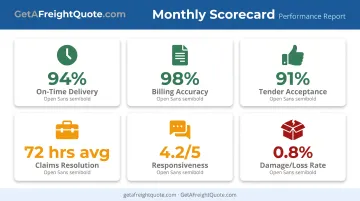
- SLA adherence: Are carriers meeting agreed-upon on-time delivery percentages? Are claims being resolved within the contracted timeline?
- Invoice accuracy: Do billed rates match contracted rates? Are accessorial charges authorized and correctly applied?
- Carrier responsiveness: How quickly do carriers respond to pickup requests, delivery issues, or claims?
- Damage and loss rates: Are shipments arriving intact, or is one carrier consistently generating claims?
SupplyChainBrain recommends a short scorecard covering on-time pickup/delivery, tender acceptance, billing accuracy, claims frequency/resolution, and responsiveness. The key is limiting the scorecard to 4-6 measures tied directly to cost, customer experience, or operational risk.
The cost of poor monitoring:
- Paying incorrect invoices for months before an audit catches the error
- Missing rebate or volume-discount thresholds because shipment data wasn't tracked
- Absorbing late deliveries or damage without recourse because performance wasn't documented
- Renewing with underperforming carriers because there's no evidence to support a switch
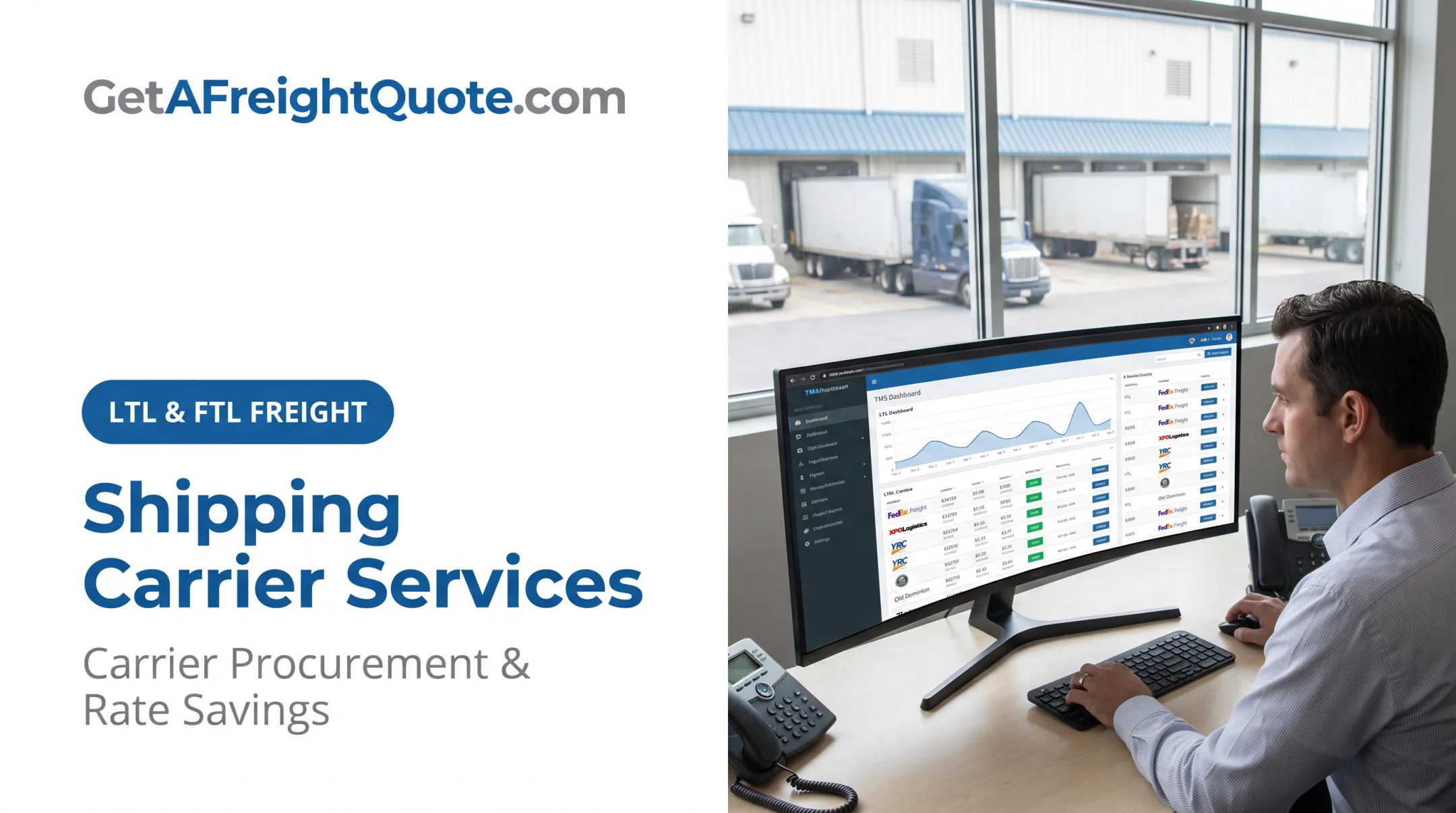
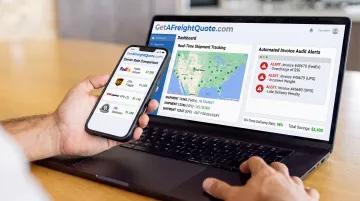
GetAFreightQuote.com addresses this gap by providing a TMS platform valued at $150,000-$250,000 at no additional cost to managed LTL customers. The system tracks shipments in real time across carriers, flags invoice discrepancies through automated auditing, and generates performance dashboards showing cost, service, and claims trends by lane, mode, or carrier.
Stage 4: Contract Renewal and Optimization
Most small businesses renew contracts on autopilot. The carrier sends a renewal notice 30 days before expiration, the rate looks "close enough" to last year, and the agreement is signed without evaluating whether the carrier earned another term.
How to prepare for renewal:
- Compile performance data: Pull 12 months of scorecards showing on-time delivery, billing accuracy, claims resolution speed, and responsiveness.
- Benchmark against market rates: Compare your current rates to market averages using tools like GetAFreightQuote.com's rate-shopping platform, which aggregates volume across hundreds of shippers to deliver Fortune 500-level pricing.
- Identify service gaps: Where did the carrier fall short? Which lanes consistently missed delivery windows? Which accessorials spiked unexpectedly?
- Negotiate from a position of evidence: Present performance data and market benchmarks. If the carrier underperformed, request rate reductions, fee waivers, or stricter SLA commitments.
When to switch carriers vs. renegotiate:
- Renegotiate if the carrier's performance meets baseline expectations but rates have drifted above market, or if service gaps are fixable through better communication or revised SLAs.
- Switch if the carrier consistently misses SLA commitments, refuses to address billing errors, or shows no willingness to adjust rates despite documented underperformance.
Renewal is also the time to revisit contract flexibility. Build in quarterly rate reviews, avoid long-term commitments without performance guarantees, and include exit clauses that protect against vendor lock-in if market conditions or your shipping profile change.
Why Carrier Contract Management Often Fails for Small Businesses
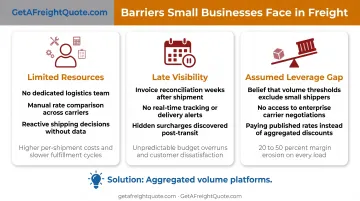
Three systemic challenges prevent small businesses from managing carrier contracts effectively:
- Limited resources: Most small businesses have no dedicated logistics manager, contract specialist, or enterprise TMS. Shipping falls to office managers, warehouse supervisors, or finance teams already wearing multiple hats, so contract oversight stays reactive.
- Late visibility: Carrier performance issues and billing discrepancies often surface months later in audits, not in real time. A 2023 FreightWaves survey found that only 20% of shippers were satisfied with shipment visibility, a gap that hits small businesses hardest.
- Assumed leverage gap: Many small shippers accept standard rates, treat accessorial fees as fixed, and skip SLA talks because they don't move Amazon-level volume and feel "not important enough" to push back.
Negotiation power does not come from volume alone. Consistency, route density, and partnership value count too. Small businesses can reach pre-negotiated enterprise rates through platforms that aggregate volume across many shippers.
How to Negotiate Carrier Contracts When You Lack Volume Leverage
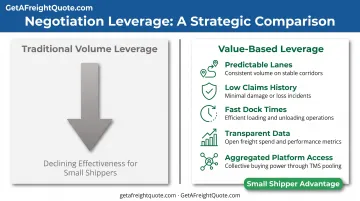
You don't need Fortune 500 volume to negotiate better carrier contracts. Strong shipping data, predictable freight patterns, and operational habits that lower carrier costs can put real leverage on the table.
Prepare with Historical Shipping Data
Gather 6-12 months of shipment records showing:
- Lanes: Origin-destination pairs and frequency
- Package characteristics: Weight, dimensions, freight class
- Seasonal patterns: Volume spikes, peak periods, and slow months
- Current spend: Total freight costs broken down by carrier, mode, and accessorial charges
This data establishes a baseline and shows carriers you're a predictable, manageable customer, not a one-time shipper or a high-risk account prone to claims.
Benchmark Against Market Rates
Compare your current rates to market averages. C.H. Robinson's research found that excessive dwell time is associated with higher transportation rates, meaning operational efficiency directly affects pricing.
If your facilities are easy to serve (short dock times, clear delivery instructions, low claims), you're often more valuable to the carrier than your volume alone suggests.
Identify Your Value to the Carrier
What makes you a "favored shipper"?
- Predictable volume: Weekly shipments on the same lanes create routing efficiency for carriers
- Easy-to-serve lanes: High-density routes between major metro areas cost less to serve than rural or remote destinations
- Low claims: Clean shipment records reduce carrier risk and administrative costs
- Fast turnaround: Short dock times and flexible pickup windows help carriers optimize their networks
Specific Negotiation Tactics
Request volume discounts with tiered thresholds: Even if you ship 50 LTL loads per month instead of 500, negotiate rate reductions at 60, 75, and 100 loads. This incentivizes growth while locking in savings as you scale.
Negotiate transparent accessorial fee structures: Demand a published schedule for liftgate, residential, inside delivery, appointment, and other common fees. Push carriers to waive fees when the charge results from carrier error (for example, reweighing a shipment you weighed accurately).
Include performance-based incentives or penalties: Tie rate adjustments to SLA adherence. If the carrier meets 95% on-time delivery for six consecutive months, lock rates for another year. If they miss 90% three months in a row, you gain the right to renegotiate or exit without penalty.
Leverage pre-negotiated enterprise rates: Platforms like GetAFreightQuote.com pool volume across hundreds of shippers, negotiate with FedEx, UPS, USPS, and 100+ LTL carriers, and unlock rates typically 20-50% below retail. That gives smaller shippers Fortune 500-level pricing without Fortune 500 volume.
Build Contract Flexibility
Avoid long-term commitments without performance guarantees: One-year terms with quarterly review windows give you leverage to address issues before renewal.
Include clear exit clauses: Define termination rights, notice periods, and relief from early-termination fees when service failures persist—so you are not locked into a poor-performing agreement.
Schedule rate reviews: Build in quarterly or semi-annual rate reviews tied to market conditions, fuel indexes, or capacity shifts.
Best Practices for Managing Carrier Contracts
Store contracts as structured, accessible data, not buried in email threads or file cabinets. Operations teams need to reference rates when booking shipments. Finance teams need to validate invoices against contract terms.
A shared repository (a TMS, contract management system, or version-controlled spreadsheet) ensures everyone works from the same source of truth.
Automate invoice validation wherever possible. Match invoices against contracted rates before payment. Flag discrepancies such as:
- Incorrect shipment weights or freight classifications
- Unauthorized accessorial charges
- Duplicate charges
- Outdated rate applications
- Missed discounts
- Fuel surcharge miscalculations
The GSA's transportation invoice audit guidance requires checking rates, tariffs, quotations, agreements, contracts, or tenders, along with fields such as freight class, weight, fuel, accessorials, and total charges. Small businesses can apply the same checklist even without government-level systems.
Monitor carrier performance continuously using dashboards or scorecards. Track on-time delivery, damage rates, billing accuracy, and responsiveness. Don't wait for quarterly reviews. Monthly scorecard distribution keeps performance visible and holds carriers accountable in real time.
GetAFreightQuote.com's platform supports this with 24/7 multi-carrier tracking, automated auditing, and performance dashboards for cost, service, and claims trends. You can compare existing UPS, FedEx, or LTL rates against the platform's negotiated rates on each shipment and choose the lower-cost option.
Technology and Tools for Contract Management
Small businesses don't need enterprise Contract Lifecycle Management (CLM) software to improve contract oversight. Structured spreadsheets, rate comparison tools, and invoice auditing processes can close significant gaps on their own.
Transportation Management Systems (TMS) centralize rate management, automate carrier selection, track shipments in real time, and reconcile invoices against contracted rates. Gartner defines a TMS as software supporting multimodal sourcing, planning, and execution of physical transportation.
Enterprise TMS platforms often cost $150,000–$250,000 to implement and need dedicated IT resources. That price tag puts full-featured systems out of reach for many smaller shippers.
GetAFreightQuote.com provides access to enterprise-grade TMS technology at small-business pricing. The platform consolidates live rates from UPS, FedEx, USPS, and 100+ LTL and FTL carriers in one dashboard. Users can:
- Compare carrier options by price, transit time, service level, and reliability
- Book shipments through self-service tools with full rate transparency
- Connect their own carrier accounts to compare contracted rates against GetAFreightQuote.com's negotiated rates
- Track shipments in real time across all carriers
- Validate invoices through automated auditing that flags discrepancies before payment
- Access spend analytics showing costs by carrier, mode, and time period
Pricing tiers scale with shipment volume:
- QuickShip: 0-3 shipments per week, no label fee
- Basic: 4-100 per week, 9¢ per label (most popular tier)
- Journeyman: 101-500 per week, 8¢ per label
- Enterprise: 501-1,000 per week, 7¢ per label
- Premiere: 1,001-2,500 per week, 6¢ per label
- Platinum: 2,501+ per week, 5¢ per label
The platform uses a no-contract, no-commitment model. Businesses can cancel anytime, change tiers as volume shifts, and ship as much or as little as needed. You keep access to Fortune 500-level rates without vendor lock-in.
Frequently Asked Questions
What does carrier management mean?
Carrier management means overseeing freight carrier relationships—contract negotiation, performance monitoring, and cost control. It keeps carriers accountable to service commitments while shippers manage transportation spend with clear data.
What does contract management do?
Contract management ensures negotiated carrier terms are executed, monitored, and enforced across the full contract lifecycle. It limits cost leakage and service failures through invoice validation, performance tracking, and evidence-based renewals.
What are CLM platforms?
CLM (Contract Lifecycle Management) platforms automate contract creation, monitoring, compliance, and renewals. Enterprises use them broadly; TMS tools cover similar ground for logistics contracts, including rates and shipment execution.
How can small businesses negotiate better carrier rates?
Show steady volume and predictable lanes, use pre-negotiated rate platforms like GetAFreightQuote.com, and insist on transparent pricing with no hidden fees. Shipment history and market benchmarks still give you bargaining power without Fortune 500 volume.
What's the difference between common carrier and contract carrier?
Common carriers offer standardized services to the public at published rates. Contract carriers work under customized agreements with specific shippers, with tailored rates, terms, and often dedicated capacity for that customer’s needs.
How often should carrier contracts be reviewed?
Review contracts at least annually before renewal, with quarterly check-ins on SLAs and rate accuracy. Use monthly scorecards for visibility; annual reviews should reset terms, pricing, and lane awards using a full year of results.
Carrier contract management matters for any business that ships products, not only large enterprises. The gap between negotiated rates and what actually gets billed can cost thousands of dollars a year. Treat contracts as living documents: monitor them, enforce them, and renew them with a full year of performance data behind you.