Many shippers default to whatever pallet is on hand, then get surprised by a rate adjustment. Others use non-standard footprints that waste trailer space or trigger dimensional weight pricing. Either mistake adds up fast across dozens or hundreds of shipments a year.
This guide breaks down standard pallet dimensions by region and industry, explains height and weight limits, and shows exactly how pallet sizing decisions affect what you pay to ship.
Key Takeaways
- The 48"x40" GMA/CBA pallet dominates North American freight, accounting for 35% of new pallets and 69% of recovered ones.
- Industry-specific sizes like 42"x42", 48"x48", 40"x40", and 48"x36" match specific product shapes and volumes.
- International standards diverge sharply: Euro pallets measure 1200mm x 800mm, while Australia uses a 1165mm x 1165mm footprint.
- Empty pallets typically run 5-6 inches tall, with total shipment height often capped between 48-60 inches depending on the carrier.
- Matching pallet size to freight class and trailer configuration cuts wasted space and avoids costly billing surprises.
What "Standard Pallet Size" Actually Means
A standard pallet size is an operational agreement: a footprint (width by length) that aligns with forklifts, pallet jacks, warehouse racking, and trailer or container dimensions used across the supply chain.
These dimensions function as physical infrastructure for your supply chain. The measurements you choose determine:
- Freight class assignment: density calculations depend on footprint and height
- Loading configuration: whether pallets fit in efficient rows or leave gaps
- Space utilization: how many units fit per trailer or container
Here's the part that trips people up: "standard" doesn't mean universal. There's no single pallet size that works for every industry or region. A grocery distributor and an automotive parts supplier each run different "standard" pallets, and both are correct for their use case.
Standard Pallet Dimensions by Region and Industry
Pallet dimensions vary by geography and by what's being shipped. Getting this right starts with knowing which standard applies to your freight.
North American Standard Pallet Sizes
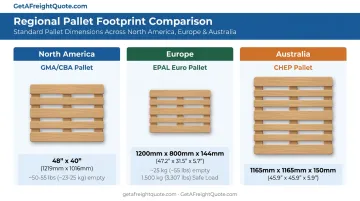
The 48"x40" GMA (Grocery Manufacturers Association) pallet, sometimes called a CBA pallet, is the North American benchmark.
A USDA Forest Service study found this size accounts for roughly 35% of new wood pallets manufactured and a much higher 69% of pallets recovered for reuse — evidence of how entrenched it is in the supply chain.
Beyond the 48"x40", several other footprints show up consistently across specific industries:
| Footprint | Common industry association |
|---|---|
| 42"x42" | Telecommunications, paint/coatings |
| 48"x48" | Drums (fits four 55-gallon drums) |
| 48"x42" | Chemicals, beverages |
| 40"x40" | Dairy and milk-crate loads |
| 48"x36" | Beverages, shingles, packaged paper |
| 48"x45" | Automotive (AIAG specification) |
| 44"x44" | Chemical drums, FIBC bulk bags |
| 36"x36" | Beverage distribution |
| 40"x24" | Half-pallet, retail end-cap displays |
These are common-use associations, not mandatory dimensions set by ANSI or a national standards body. Plenty of shippers deviate based on product needs.
International Pallet Size Standards
Cross the Atlantic and the standard changes entirely. The EPAL Euro pallet measures 1200mm x 800mm x 144mm (about 47.2" x 31.5" x 5.7"), weighs approximately 25 kg empty, and carries a safe working load of 1,500 kg according to EPAL's own specifications.
Here's the friction point: Euro pallets don't align cleanly with U.S. trailer or container loading patterns built around 48"x40" dimensions. That mismatch matters for anyone shipping internationally.
ISO 6780 recognizes six global pallet dimensions, including:
- 1200mm x 800mm (Europe)
- 1200mm x 1000mm (industrial)
- 1219mm x 1016mm (North American equivalent)
- 1067mm x 1067mm
- 1100mm x 1100mm
- 1140mm x 1140mm
Australia adds its own wrinkle. CHEP's Australian wooden pallet measures 1165mm x 1165mm x 150mm, a square footprint unlike anything used in North America or most of Europe. Businesses shipping to or from Australia need to account for this before quoting freight.
Industry-Specific Considerations
Product shape drives pallet choice more than habit does:
- Grocery/retail leans on 48"x40" for compatibility with standard racking
- Chemical/drum operations favor 48"x48" or 44"x44" to match drum diameters
- Beverage distributors often use 48"x36" or 36"x36" for case-stacking efficiency
- Dairy shippers use 40"x40" for crate compatibility
- Automotive parts suppliers use the 48"x45" AIAG specification for consistent handling across the supply chain
Pallet Height, Weight Limits, and Load Capacity
Footprint is only half the equation. Height and weight limits determine whether your shipment is safe, compliant, and priced correctly.
Standard Height and Stacking Limits
Empty pallets generally measure 5 to 6 inches tall. CHEP's North American wood pallet comes in at 5.6 inches, and iGPS plastic pallets run about 5.62 inches — close enough to call this a reliable benchmark.
Loaded height limits vary by carrier rather than following one universal rule. Estes Express, for example, caps its standard pallet shipments at 60 inches total height and 2,500 lbs. Many shippers use 48 inches as a practical double-stack convention, but this isn't a fixed national maximum. It depends on trailer interior height and load stability.
Important correction: the commonly cited "102-inch flatbed height limit" is actually a mix-up. According to the Federal Highway Administration, 102 inches is the federal maximum vehicle width, not a cargo height threshold.
There's no single national vehicle-height limit. Most states cap total vehicle-plus-load height between 13'6" and 14'0", with route-specific exceptions. If you're shipping tall flatbed freight, check state and route rules rather than assuming a flat number applies everywhere.
Weight Capacity by Pallet Material and Construction
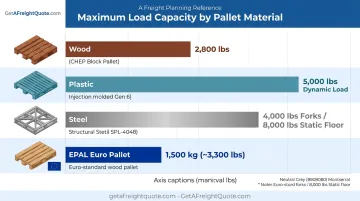
Height isn't the only limit that affects compliance and pricing; weight capacity matters just as much. Load capacity depends heavily on material and specific product design, not just pallet type in general. A few verified examples illustrate the range:
- Wood (CHEP block pallet): 2,800 lbs, evenly distributed
- Plastic (iGPS Gen 6): 5,000 lbs dynamic load
- Steel (Vestil SPL-4048): 4,000 lbs on forks, 8,000 lbs static floor load
- EPAL Euro pallet: 1,500 kg (about 3,300 lbs) safe working load
Empty pallet weight matters too, since it counts toward your total billed shipment weight. A wood pallet typically adds somewhere in the range of 50 to 55 lbs, while an EPAL Euro pallet weighs around 25 kg (roughly 55 lbs). That's not huge on its own, but it adds up across a full truckload.
Safe Margins: Overhang and Uneven Loading Risks
Weight limits aren't the only capacity concern: how evenly you load the pallet matters too. Letting boxes hang over the pallet edge feels harmless. It isn't. A 2023 study published in Packaging Technology and Science found that single-side overhang reduced corrugated box compression strength by up to 33.4%, while overhang on adjacent sides pushed losses as high as 40.4%.
That's nearly half the structural strength of your packaging, gone, just from a few inches of overhang. For stacked shipments, that compression loss directly increases the risk of crushed goods and rejected freight claims.
How Pallet Size Affects Freight Class, Cost, and Space Efficiency
Carriers price freight based largely on density and handling requirements, and pallet dimensions feed directly into that math.
Freight Class and Dimensional Weight Impact
The National Motor Freight Traffic Association evaluates classification using density, handling, stowability, and liability. Denser freight in a smaller footprint typically earns a lower, cheaper freight class.
An oversized or irregular pallet footprint does the opposite: it inflates cubic volume relative to weight, which can push a shipment into a higher class or trigger dimensional weight pricing.
This is exactly why accurate measurement matters before the truck ever shows up. Getting weight and dimensions right at booking, rather than discovering a discrepancy at the dock, is the single biggest factor in avoiding reclassification fees and rate adjustments.
GetAFreightQuote.com builds this verification into its pre-shipment process, checking weight, dimensions, and freight class before carrier commitment. That way, shippers aren't hit with surprise adjustments after pickup.
Maximizing Trailer and Container Space
Freight class isn't the only cost lever pallet dimensions pull. Standard-sized pallets also fit predictable trailer and container configurations, which keeps loading math simple:
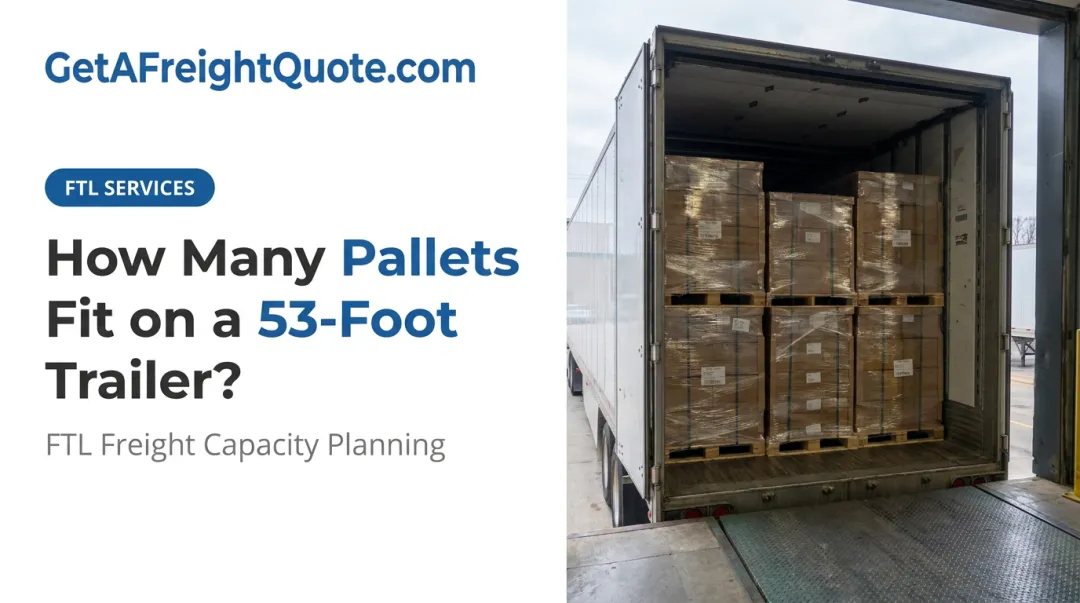
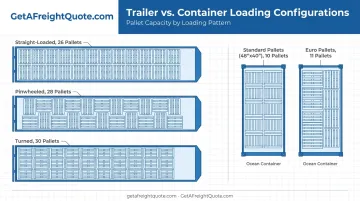
- A 53-foot dry van holds 26 pallets straight-loaded, up to 28 pinwheeled, or as many as 30 turned, depending on orientation
- A 20-foot ocean container fits roughly 10 standard 48"x40" pallets in a single tier
- The same 20-foot container fits about 11 Euro pallets, since their smaller footprint tucks in tighter
Custom or oversized footprints break that math. Gaps between pallets waste trailer space that a carrier still charges for, and irregular shapes can prevent double-row loading entirely.
Since pallet dimensions and freight class directly shape your quoted rate, it's worth comparing carrier pricing side by side rather than accepting the first number offered.
GetAFreightQuote.com's TMS platform supports that comparison directly. Its Bring Your Own Rates feature lets shippers check negotiated rates against their own carrier accounts, confirming they're getting a competitive price for their exact pallet configuration.
Choosing the Right Pallet & Avoiding Common Sizing Mistakes
Footprint isn't the only variable. Construction type affects strength independent of size:
- Stringer pallets use parallel wood boards for support — common and repairable, but generally lower weight capacity
- Block pallets use blocks at each corner and center, allowing forklift access from all four sides
- Solid deck pallets offer a continuous surface, useful for smaller or irregularly shaped products
One mistake shows up constantly: using "pallet" and "skid" interchangeably, as if they're the same thing. A pallet has both top and bottom deck boards, while a skid has only a top deck and no bottom support structure. That structural difference affects stacking stability and rack compatibility.
Another common error: treating the nominal weight capacity printed on a pallet as a fixed, guaranteed number, when it isn't. Real-world capacity drops with:
- Uneven load distribution across the deck
- Pallet wear from repeated use and repairs
- Environmental damage like moisture warping in wood pallets
Pallet condition matters just as much as the rating on paper.
Frequently Asked Questions
What is a standard shipping pallet size?
The 48"x40" GMA/CBA pallet (Grocery Manufacturers Association standard) is the North American standard, used across grocery, retail, and general freight. The 42"x42" and 48"x48" footprints are the next most common, typically for specific industries like coatings or drums.
How much does it cost to ship a 500 lb pallet?
Cost depends on origin, destination, freight class, and carrier selection — there's no single flat rate. Running your exact pallet dimensions and weight through GetAFreightQuote.com's online quoting tool gives you an accurate, carrier-compared rate for your specific shipment.
How tall is a standard pallet?
An empty standard pallet typically measures 5 to 6 inches tall. Total loaded shipment height is usually capped somewhere between 48 and 60 inches, depending on the carrier's specific policy.
How much weight can a standard pallet hold?
It varies by material and construction. Wood pallets often handle around 2,800 lbs, while plastic and steel pallets can exceed 4,000 to 5,000 lbs when weight is evenly distributed across the deck.
What's the difference between a pallet and a skid?
A pallet has both a top and bottom deck, giving it more stability and rack compatibility. A skid only has a top deck with no bottom support structure, making it simpler but less versatile for stacking.
How many pallets fit on a truck or in a shipping container?
A standard 53-foot dry van holds roughly 26 to 30 pallets in a single tier depending on loading orientation. A 20-foot container generally fits about 10 standard 48"x40" pallets, with counts varying by pallet type and whether double-stacking is used.