Here's the frustrating part: small businesses often pay more per shipment than their larger competitors, simply because they don't have access to the same rate-shopping tools, carrier relationships, or automation. That gap in technology translates directly into a gap in cost and delivery speed.
This guide breaks down the top logistics software options for small businesses in 2026, how to actually choose between them, and what separates a genuinely useful platform from a bloated enterprise tool you'll never fully use.
Key Takeaways
- Four software types exist: freight/TMS, parcel, routing, and inventory tools.
- Base your choice on your biggest pain point: cost, volume, routing, or visibility.
- Prioritize tracking, carrier rates, integrations, and fee-free pricing.
- This guide reviews five top 2026 platforms and a framework for choosing wisely.
Overview of Logistics Software in the Small Business Market
Logistics software is any digital tool that helps a business plan, book, track, or manage the movement of goods. That could mean a parcel headed to a customer's front door or a pallet of freight crossing state lines. For small teams juggling shipping alongside everything else, it's the difference between guessing and knowing.
That knowledge advantage matters more each year as the market shifts fast. Fuel costs, e-commerce growth, and rising customer expectations are pushing tools once reserved for large enterprises down into the small business market.
The numbers back this up:
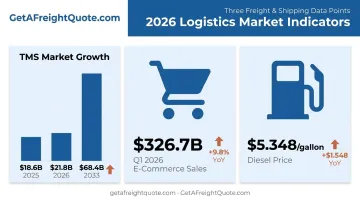
- The global transportation management system market was valued at $18.6 billion in 2025 and is projected to hit $21.8 billion in 2026, climbing to $68.4 billion by 2033, according to Grand View Research.
- U.S. retail e-commerce sales reached $326.7 billion in Q1 2026, up 9.8% year over year, representing 16.9% of total retail sales according to Census Bureau data.
- Diesel prices hit $5.348 per gallon in early August 2026, according to the U.S. Energy Information Administration, a full $1.548 higher than the year before.
More orders, higher fuel costs, tighter margins. That combination is exactly why small businesses are adopting tools that used to sit exclusively in enterprise budgets.
Top Logistics Software for Small Businesses in 2026
This list follows a simple filter: affordability, ease of setup, and a feature set that actually matches small business shipment volumes. Brand recognition didn't factor in.
GetAFreightQuote.com
GetAFreightQuote.com is an authorized reseller of a TMS platform, built to give small and mid-sized businesses access to negotiated freight rates and shipping technology normally reserved for Fortune 500-level shippers.
What sets it apart is the pricing math. LTL and FTL freight rates are typically tiered by volume, meaning a business shipping a few pallets a week pays more per shipment than one shipping hundreds. GetAFreightQuote.com pools volume across its customer base to unlock rates 20-50% below retail carrier pricing, with full rate transparency and no hidden fees before booking.
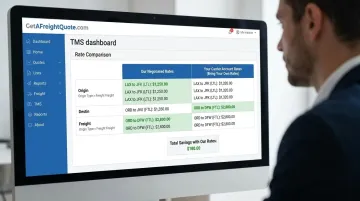
A standout feature is Bring Your Own Rates: businesses that already have UPS, FedEx, or LTL carrier accounts can plug those in alongside GetAFreightQuote.com's own negotiated rates. The platform then shops both simultaneously and surfaces whichever option is cheapest for that specific shipment.
| Category | Details |
|---|---|
| Best For | Small and mid-sized businesses shipping LTL/FTL freight who want Fortune 500-level rates without Fortune 500-level volume |
| Key Features | Negotiated carrier rates, TMS dashboard, Bring Your Own Rates comparison, full rate transparency, hands-on support with 24/7 customer service |
| Pricing Model | Self-funded through shipping savings; no upfront software fee, with a modest per-label fee typically recovered within the first few shipments |
ShipStation
ShipStation is a shipping and fulfillment platform aimed at online retailers managing parcel volume across multiple sales channels at once.
The platform advertises 400+ integrations and order imports from over 100 marketplaces, carts, and storefronts, with access to 200+ global carriers through its main product. For a seller running Shopify, Amazon, and eBay simultaneously, that's the difference between three separate shipping workflows and one.
| Category | Details |
|---|---|
| Best For | E-commerce retailers shipping parcels across multiple online sales channels |
| Key Features | Multi-channel order management, automated label creation, international customs and duties tools, branded tracking pages |
| Pricing Model | Tiered monthly subscription starting at $14.99/month, scaling up to $349.99/month based on shipment volume |
SmartRoutes
SmartRoutes is built for small delivery fleets, local couriers, and e-commerce businesses running their own last-mile drivers instead of outsourcing to a carrier.
It includes a driver mobile app, live GPS tracking, and electronic proof of delivery with timestamps, photos, and signatures. That's a meaningful upgrade for teams without a dedicated dispatcher or logistics coordinator on staff.
| Category | Details |
|---|---|
| Best For | Small businesses running their own local delivery drivers or fleets |
| Key Features | Route optimization, driver app, live tracking, automated customer notifications, electronic proof of delivery |
| Pricing Model | Per-vehicle monthly pricing starting at $32, with a 7-day free trial |
Cargoson
Cargoson is a transport management system built for shippers who already manage relationships with multiple carriers and want a single dashboard to compare them.
It advertises access to 1,000+ plug-and-play carrier integrations, though users upload their own negotiated price lists rather than getting automatic live quotes from every carrier. The tracking dashboard and CO2 reporting are useful additions for businesses reporting on sustainability metrics.
| Category | Details |
|---|---|
| Best For | Small businesses shipping B2B freight across several existing carrier relationships |
| Key Features | Multi-carrier rate comparison, carrier tracking and milestones dashboard, CO2 emissions reporting |
| Pricing Model | Subscription-based, starting at $199/month for 100 shipments, scaling to $599/month for 3,000 |
Zoho Inventory
Zoho Inventory is a cloud-based inventory and order management tool for small businesses selling across multiple channels who need visibility before investing in a full TMS or ERP.
It supports barcode and RFID tracking, reorder points, low-stock alerts, and native integrations with Shopify, WooCommerce, Amazon, and accounting tools like QuickBooks Online and Xero.
| Category | Details |
|---|---|
| Best For | Small businesses needing centralized inventory and order tracking across sales channels |
| Key Features | Real-time stock tracking, multi-channel order sync, accounting integrations |
| Pricing Model | Freemium (free for 50 orders/month), with paid tiers from $29/month to $249/month based on volume |
How to Choose the Right Logistics Software for Your Small Business
Before you compare a single platform, map your actual pain point. Is it freight cost? Delivery routing? Inventory accuracy? Order visibility? The "best" software depends entirely on which problem is costing you the most right now.
Non-negotiable evaluation factors:
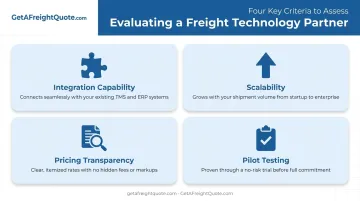
- Integration capability: The tool should connect with your existing accounting, e-commerce, and carrier systems instead of creating a new data silo.
- Scalability: Pick software that handles growth in order volume or shipment complexity without forcing a painful migration later.
- Pricing transparency: Look for clear rate visibility before booking, since hidden fees and freight billing errors can quickly erode thin margins.
- Pilot testing: Run real orders through the platform with your actual staff before full rollout. If it doesn't save time in week one, it won't improve later.
A common mistake: picking software based on brand reputation rather than fit. A platform built for enterprise volume will feel clunky and overpriced for a business shipping a few dozen packages a week.
This is exactly the gap platforms like GetAFreightQuote.com were built to close. Instead of forcing small shippers into enterprise-scale software or leaving them stuck with retail carrier rates, it applies negotiated pricing and TMS technology to businesses regardless of their shipping volume.
Conclusion
The best logistics software for your small business matches your actual shipment volume, your budget, and the specific pain point costing you money today, not the one with the most features.
Revisit your logistics stack periodically as your order volume grows. A tool that worked well shipping 50 orders a month may not hold up at 500.
If freight costs and carrier access are your biggest headache, GetAFreightQuote.com offers access to enterprise-grade TMS technology and negotiated carrier rates. You won't need enterprise-level shipping volume to get there.
Frequently Asked Questions
Which shipping software is best for small businesses?
It depends on shipment type. ShipStation works well for parcel-heavy e-commerce sellers, while SmartRoutes fits businesses running their own delivery fleet. For LTL/FTL freight, GetAFreightQuote.com gives shippers access to negotiated carrier rates.
What is the difference between a TMS and a WMS?
A Transportation Management System (TMS) handles freight planning, carrier selection, and rate management between locations. A Warehouse Management System (WMS) manages inventory, picking, and packing inside a single facility.
How much does logistics software typically cost for a small business?
Pricing ranges from free tiers on inventory tools to subscription-based TMS platforms costing hundreds monthly. Watch for hidden fees, especially accessorial charges, that can inflate the real cost beyond the sticker price.
Can small businesses really get the same shipping rates as large enterprises?
Yes, through platforms like GetAFreightQuote.com, which pool negotiated carrier rates typically reserved for high-volume shippers and make them accessible to smaller businesses through an authorized TMS reseller model.
Does logistics software integrate with accounting and e-commerce platforms?
Most modern logistics tools integrate with platforms like Shopify, QuickBooks, and WooCommerce. This avoids duplicate data entry and keeps inventory, orders, and financials in sync automatically.
Is cloud-based logistics software better than on-premise for small businesses?
Generally, yes. Cloud-based tools offer lower upfront costs, easier scalability, and automatic updates, making them a better fit for most small businesses than on-premise systems requiring dedicated hardware.