Introduction
Weight is the single number that decides whether your shipment ships as standard LTL freight or gets bumped into a pricier category. Get it wrong, and you'll likely see a surprise charge on your invoice weeks after pickup.
Here's the problem: there's no single "weight limit" in LTL shipping. According to NMFTA's published guidance, the range spans roughly 100 to 10,000 lbs, with some carriers accepting shipments up to 20,000 lbs.
That's a massive spread. It varies by carrier, freight class, pallet count, and how much trailer space your freight occupies.
This article breaks down the real weight ranges carriers use today, what pushes a shipment out of standard LTL pricing, and how to avoid costly re-rates or refused pickups.
Key Takeaways
- Standard LTL shipments range from 100–150 lbs minimum to 15,000–20,000 lbs maximum, per carrier tariffs
- Per-pallet weight caps vary by carrier and program, not by a fixed national-versus-regional formula
- Density, freight class, and linear feet can trigger a re-rate even when total weight looks fine
- Exceeding a limit usually means a shift to volume LTL or truckload pricing, not an outright refusal
- Comparing quotes across shipping modes near breakpoints prevents overpaying on borderline shipments
What "Weight Limit" Really Means in LTL Shipping
An LTL weight limit isn't one number. It's a set of carrier-defined boundaries, minimum acceptance thresholds, maximum shipment weight, per-pallet caps, that determine whether your freight qualifies for standard LTL handling and pricing.
Weight works two ways in LTL freight. First, it's an eligibility filter: does this freight even qualify for LTL mode? Second, it's a direct pricing input, feeding into the rate alongside freight class and density.
Here's the part many shippers miss: these limits aren't federal regulations. There's no government-mandated LTL weight ceiling. Federal rules only govern vehicle safety, capping gross vehicle weight at 80,000 lbs and per-axle limits separately.
Everything below that is set by individual carrier tariffs, which is exactly why figures vary so widely from one carrier to the next.
Factors That Cause Weight Limits to Vary by Carrier
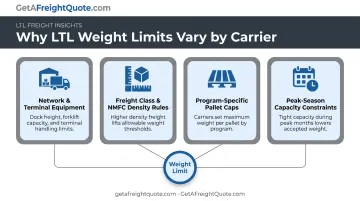
The commonly cited "150–15,000 lbs" range is a decent starting point, but it rarely matches what you'll actually encounter booking with a specific carrier. Several factors drive the difference:
- Network and terminal equipment: trailer capacity, dock height, and forklift capabilities set the practical ceiling on what a carrier will physically handle
- Freight class and NMFC density rules: these affect how much space your weight is "allowed" to occupy before pricing shifts
- Program-specific pallet caps: Old Dominion, for example, publishes a 3,000-lb maximum per pallet under its dedicated pallet-rate program, though this doesn't apply to every ODFL service
- Peak-season capacity constraints: during high-volume periods, carriers may temporarily tighten what they'll accept for heavy or oversized freight
There's no verified industry-wide rule stating national carriers always allow heavier pallets than regional carriers. What's actually true is that caps are tied to specific tariffs and service programs, so the only reliable way to know your limit is to check the carrier's current published rules before booking.
The LTL Weight Limit Range: Minimums, Maximums & Per-Pallet Caps
Think of the "weight limit" as four separate thresholds stacked together: a minimum, a maximum, a per-skid cap, and a space-based limit like linear feet. Missing any one of these can change your rate.
Minimum Weight Thresholds
NMFTA's general guidance places the low end of LTL at around 100 lbs, though this isn't a mandatory minimum every carrier enforces. Transport Topics notes that most LTL shipments actually fall between 500 and 15,000 lbs, meaning very light freight is technically eligible but less common in practice.
For genuinely small shipments, many shippers find parcel carriers more cost-effective once you drop below roughly 50 lbs — though that break-even point isn't fixed. It shifts based on your package dimensions, density, and any negotiated carrier discounts. Below that range, it's worth running a parcel quote alongside your LTL quote before committing.
Maximum Weight & Per-Skid Caps
Standard LTL pricing generally tops out somewhere in the 15,000–20,000-lb range, but the exact cutoff depends entirely on the carrier's tariff:
| Carrier | Published LTL/Capacity Threshold |
|---|---|
| FedEx Freight | LTL under 20,000 lbs; freight over 15,000 lbs treated as a capacity load |
| XPO | LTL/AQ applies up to 19,999 lbs; truckload begins at 20,000 lbs |
| Estes | LTL fuel treatment applies through 19,999 lbs; capacity load above 20,000 lbs |
| Southeastern Freight Lines | LTL maximum of 20,000 lbs; capacity-load pricing above that |
Per-pallet caps follow a similar pattern of carrier-specific rules rather than a universal national-versus-regional split. Old Dominion's pallet-rate program caps individual pallets at 3,000 lbs, while Dayton Freight applies a 3,500-lb per-handling-unit limit specifically tied to liftgate service, not a general pallet maximum. The takeaway: pull the current tariff for your specific carrier and service type rather than assuming a blanket figure applies.
Safe Operating Margin & Break Points
Experienced shippers rarely book right at the ceiling. They build in margin, because operating close to a breakpoint invites rate re-classification, appointment delays, or even refusal for oversized single pieces.
Estes Express applies its Time Critical Volume LTL pricing once a shipment exceeds 10,000 lbs or 12 linear feet, while FedEx's capacity-load rule kicks in above 15,000 lbs. Other carriers, like Southeastern, don't apply similar treatment until 20 linear feet. There's no single universal breakpoint, but the 10,000–15,000-lb zone is where pricing tiers most commonly shift.
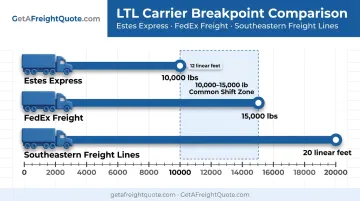
If your shipment sits anywhere near these numbers, don't guess. Run LTL, volume LTL, and truckload quotes side by side before you book.
This is exactly where a platform like GetAFreightQuote.com adds practical value. It layers negotiated multi-carrier rates on top of a rate-shopping tool that pulls quotes across parcel, LTL, and truckload in one screen, and it lets shippers connect their own existing carrier accounts for a true side-by-side comparison.
How Weight Interacts With Density, Freight Class & Space
Weight limits never operate in isolation. NMFC density calculations can push a shipment into a higher-cost freight class even when it's comfortably under the weight cap.
Density is simply weight divided by the cubic space your freight occupies. NMFTA's current density scale assigns freight classes from 400 down to 50 based on a sliding scale of breakpoints. Key thresholds include:
| Pounds per Cubic Foot | Class |
|---|---|
| Under 1 | 400 |
| 1–2 | 300 |
| 6–8 | 125 |
| 15–22.5 | 70 |
| 30–35 | 60 |
| 50 or more | 50 |
Lower density generally means a higher (more expensive) class, though handling difficulty, stowability, and liability risk can override the density-based number entirely.
Linear feet matter just as much as weight. Space-based rules vary considerably by carrier:
- Estes triggers volume pricing above 12 linear feet
- FedEx and Dayton Freight apply their rules at 15 linear feet
- Southeastern's threshold sits at 20 linear feet
A shipment can look "under weight" on paper and still get re-rated because it eats up too much trailer length for its weight class.
One more wrinkle: the weight you estimate at booking rarely matches the weight a carrier's certified terminal scale produces. These weight and inspection (W&I) reweighs happen after pickup and can adjust your invoice, sometimes significantly, if the actual weight or class differs from what was quoted on the bill of lading. A freight audit service, like the invoice recovery support built into GetAFreightQuote.com's managed LTL programs, can flag these discrepancies before they inflate your final bill.
What Happens When You Exceed the Weight Limit
Exceeding a carrier's weight limit almost never means outright refusal. What actually happens is a re-rate, most often a shift to volume LTL or spot truckload pricing, which changes your cost structure substantially.
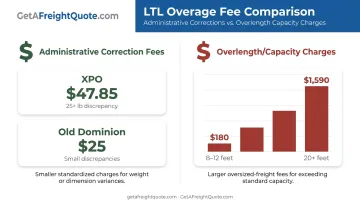
Two distinct fee types come into play here, and shippers often confuse them:
- Administrative correction fees — smaller, standardized charges for reweighing or verifying freight details. XPO charges $47.85 when actual weight differs from the bill of lading by 25 lbs or more; Old Dominion charges $25 for similar corrections.
- Overlength/capacity charges — much larger fees tied to oversized or overweight freight. Published examples range from roughly $180 at 8–12 feet up to $1,590 at 20-plus feet, depending on the carrier's tariff.
Beyond cost, there are operational risks worth planning around:
- Terminal delays while dock staff reassess handling requirements
- Rescheduled delivery appointments when equipment doesn't match the freight
- Liftgate or forklift mismatches if oversized freight arrives without advance notice to the carrier
The financial hit from a re-rate is usually bigger than any correction fee, which is why catching errors before dispatch matters more than most shippers realize. GetAFreightQuote.com's TMS rate-shopping platform checks weight and dimension entries against carrier tariffs during the quoting process, flagging mismatches before the freight ever leaves the dock.
Common Mistakes Shippers Make With LTL Weight Limits
Most costly surprises trace back to a handful of avoidable habits:
- Treating the generic "150–15,000 lbs" range as gospel instead of confirming the actual tariff for the carrier you're booking
- Quoting with estimated weight instead of certified scale weight, which sets up a reclassification and a surprise charge after pickup
- Ignoring linear feet and density, wrongly assuming a lighter shipment automatically dodges extra fees
- Defaulting to a familiar carrier out of habit rather than comparing LTL, volume LTL, and truckload quotes when a shipment sits near a breakpoint
That last one is where a lot of unnecessary spend hides. GetAFreightQuote.com lets shippers add their own existing carrier accounts alongside its negotiated rates. Every quote gets compared in one place before you commit, not after the invoice arrives.
These habits share a common thread: treating a published weight range as fixed rather than as a starting point. Verify the actual tariff, scale weight, and density before you book, and most of the surprise freight bills disappear.
Frequently Asked Questions
How much to ship 300 lbs?
A 300-lb shipment typically qualifies for standard LTL pricing without issue. The actual cost depends on freight class, pallet count, your origin/destination lane, and any accessorial fees, so get a specific quote for an accurate number.
What is the maximum weight limit for an LTL shipment?
Standard LTL maximums generally fall between roughly 15,000 and 20,000 lbs, depending on the carrier's tariff. Per-pallet caps also vary by carrier and service program, so always check the specific tariff you're booking under.
What is the maximum load size for LTL and FTL shipping?
LTL generally tops out around 15,000–20,000 lbs or roughly 12 linear feet before volume pricing applies. Full truckload can carry far more weight, though federal law caps the entire rig at 80,000 lbs gross vehicle weight.
What is the minimum weight for LTL shipping?
Most carriers accept shipments starting around 100–150 lbs. Shipments under roughly 50 lbs are often cheaper to send via parcel carriers instead, though the exact break-even point depends on dimensions and density.
What happens if my shipment exceeds the carrier's weight limit?
Carriers typically re-rate the shipment to volume LTL or spot truckload pricing rather than refusing it outright. This can change your final invoice, so it's worth quoting all three modes in advance.
How do I know if my shipment should ship as LTL, volume LTL, or truckload?
Compare quotes across all three modes once your shipment nears roughly 10,000 lbs, 10 pallets, or 12 linear feet. Costs often converge near those breakpoints, making a side-by-side comparison the only way to know for sure.