This guide explains what cross-border freight shipping is, why businesses pursue it, the documentation and methods involved, common challenges, and proven strategies to reduce costs and streamline operations—especially for shippers without Fortune 500-level volume.
Key Takeaways
- Competitive cross-border rates and clear pricing level the field for small and mid-sized shippers
- Complete docs—commercial invoice, packing list, certificate of origin—stop customs delays and penalties
- Duties, taxes, and customs rules checked upfront prevent surprise charges at the border
- Mode and carrier choice (LTL, FTL, intermodal) drive both cost and transit time
- Compare your own carrier accounts with negotiated third-party rates to lock in best pricing
What is Cross-Border Freight Shipping?
Cross-border freight shipping is the process of moving commercial goods (pallets, LTL shipments, full truckloads, or containers) across international borders. Unlike domestic shipping, it requires customs clearance, compliance with import/export regulations, and coordination with carriers and authorities in multiple countries.
Key differences from domestic shipping:
- Additional documentation (commercial invoices, certificates of origin, import permits)
- Customs inspections and regulatory compliance at border checkpoints
- Duties, taxes, and government processing fees
- Delay risk from documentation errors or inspections
- Coordination with customs brokers and freight forwarders
Cross-border freight vs. international parcel shipping:
This article focuses on freight—palletized goods, LTL/FTL shipments, and containerized cargo used by manufacturers, distributors, and wholesalers. International parcel shipping (small packages for e-commerce) follows different pricing models and documentation requirements.
Most common cross-border freight lanes for U.S. businesses:
- U.S.-Mexico: The most active lane by value, reaching $872.8 billion in 2025
- U.S.-Canada: A mature lane valued at $712.8 billion in 2025
- Overseas routes: Asia, Europe, and Latin America for ocean and air freight
Proximity doesn't guarantee simplicity. Each lane has unique documentation requirements, customs procedures, and carrier networks.
Key parties in cross-border freight:
| Party | Role |
|---|---|
| Shipper | You, the business sending goods |
| Carrier | Trucking company, railroad, ocean line, or airline that physically moves the freight |
| Freight forwarder | Coordinates multi-leg shipments and carrier relationships |
| Customs broker | Handles clearance, compliance, and documentation filing with customs authorities |
| Consignee | The receiver of the goods |
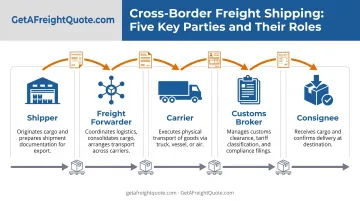
Clear roles among these parties keep documents accurate and border crossings on schedule.
Why Businesses Ship Cross-Border
Businesses pursue cross-border shipping to grow revenue, lower supply risk, and improve landed cost—not only to move freight farther.
Market expansion and revenue diversification:
Cross-border shipping lets you serve international customers without standing up physical operations abroad. Census Bureau data shows that 270,731 small and medium U.S. exporters generated $609.976 billion in known-value goods exports in 2023.
Supplier diversification and cost optimization:
Sourcing raw materials or finished goods internationally can cut costs, improve quality, or unlock specialized products unavailable domestically. A 2025 IMF working paper notes that spreading sourcing across multiple origins enhances supply chain resilience by reducing reliance on concentrated suppliers.
Competitive edge from logistics capability:
Many rivals skip cross-border shipping because it looks complex. Teams that master the process can offer better pricing, faster delivery, or unique products others cannot match.
Trade agreements and favorable economics:
The USMCA (United States-Mexico-Canada Agreement) reduces or eliminates tariffs on qualifying goods produced in North America. USMCA-eligible shipments can claim preferential duty rates and improve landed-cost competitiveness. CBP confirms that goods must be produced in the USMCA region to qualify for duty-free treatment, and importers must complete the required certification of origin.
Cross-Border Shipping Methods & Transportation Options
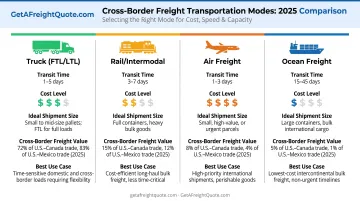
Shippers moving freight across U.S. borders choose among truck, rail, air, and ocean based on cost, speed, and shipment size. Here’s how the main modes compare on North American and overseas lanes.
Truckload (FTL) and Less-Than-Truckload (LTL)
Truck is the dominant method for U.S.-Mexico and U.S.-Canada freight due to speed, flexibility, and established border infrastructure. In 2025, trucks carried 73.6% of U.S.-Mexico freight value ($642.2 billion) and 55.7% of U.S.-Canada freight value ($396.8 billion).
- FTL (Full Truckload): Dedicated truck for a single shipper; faster transit, no intermediate terminal handling, ideal for large shipments
- LTL (Less-Than-Truckload): Shared truck space with other shippers; cost-effective for smaller loads (typically 1-6 pallets), longer transit due to terminal handling
Intermodal (Rail + Truck) and Rail Freight
Intermodal combines rail and truck to balance cost and speed. Rail works well when you don’t need immediate delivery. In 2025, rail moved $184.5 billion in cross-border freight across both borders (12.6% of U.S.-Canada freight and 10.9% of U.S.-Mexico freight).
Recent rail infrastructure improvements have strengthened cross-border service:
- CPKC Laredo bridge expansion: A second cross-border bridge span opened in February 2025, doubling freight capacity at the Laredo crossing
- CPKC-CSX Southeast Mexico Express: Launched December 1, 2024, this partnership speeds automotive, intermodal, and carload service between the U.S. Southeast and Mexico
Air and Ocean Freight
Air freight suits urgent, high-value, or time-sensitive shipments. It is more common on overseas lanes (Asia, Europe, Latin America) than on U.S.-Canada or U.S.-Mexico routes. In 2025, air carried $66.1 billion in U.S.-Canada/Mexico freight combined.
Ocean freight fits high-volume, non-urgent, cost-sensitive shipments, typically on overseas lanes. Ocean moved $101.4 billion in U.S.-Canada/Mexico freight in 2025, primarily bulk and containerized goods.
Documentation Required for Cross-Border Freight
Complete, accurate documentation is the #1 factor in avoiding border delays and customs penalties. Missing or incorrect paperwork can hold shipments for days or result in significant fines.
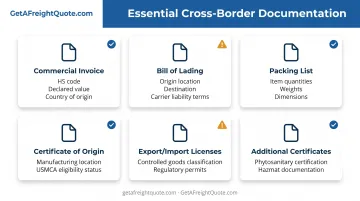
Commercial Invoice
The commercial invoice is a legal document for customs, detailing:
- Buyer and seller information
- Goods description and HS (Harmonized System) code
- Quantity, unit price, and total value
- Country of origin
- Terms of sale (Incoterms such as DAP or DDP)
Critical: Accurate HS codes determine duty rates. Misclassification can trigger penalties. Canadian border authorities assess penalties beginning at C$150 per inaccurate document, with uncorrected tariff-classification errors escalating to maximums of C$200,000 or higher.
Bill of Lading (BOL)
The BOL is the contract between shipper and carrier, outlining freight details, origin, destination, and liability. Cross-border BOLs often require additional customs-related fields not present in domestic versions, such as port of entry, consignee details for customs clearance, and declared value for duty assessment.
Packing List
The packing list is a detailed inventory of shipment contents:
- Item descriptions
- Quantities
- Weights and dimensions
- Packaging type (pallets, boxes, crates)
Customs uses the packing list to verify the commercial invoice. Discrepancies can cause delays or inspections.
Certificate of Origin (CO)
The CO certifies where goods were manufactured or substantially transformed. It's often required to claim preferential duty rates under trade agreements like USMCA. Some countries require COs to be notarized or issued by a chamber of commerce.
Other Common Documents
Additional documents may be required depending on commodity and destination:
- Shipper's Letter of Instruction (SLI): Directs freight forwarder on handling and routing
- Export/import licenses: Required for controlled goods
- USMCA certification: Supports preferential tariff claims
- Phytosanitary certificates: Required for agricultural products
- Dangerous goods declarations: Required for hazmat shipments
Consult with customs brokers or freight forwarders to confirm requirements for your specific shipment and lane.
Understanding Customs, Duties, and Taxes
Duties (tariffs) are taxes imposed by the destination country on imported goods. Taxes (such as VAT or GST) are consumption taxes applied at the border. Rates vary by product (HS code), country of origin, and eligibility for trade agreements.
Who pays those costs depends on the Incoterm you choose. Two options come up most often in cross-border freight:
DDP vs. DAP (formerly DDU):
- DDP (Delivered Duty Paid): The seller pays all duties, taxes, and import clearance fees so the buyer receives goods with costs settled. Local law may still require a local importer of record.
- DAP (Delivered at Place): The seller handles export and transit clearance; the buyer handles import clearance and related fees. More common in B2B—clarify responsibilities upfront to avoid disputes or refused shipments.
Estimating landed costs:
Research duty rates using the USITC Harmonized Tariff Schedule before quoting customers or committing to shipments. Factor in:
- Duty rates based on HTS classification
- Destination-country taxes (VAT, GST)
- Government processing fees (CBP's FY2026 Merchandise Processing Fee ranges from a $33.58 minimum to a $651.50 maximum)
- Customs broker fees (vary by broker and shipment complexity)
Common Challenges in Cross-Border Freight Shipping
Cross-border freight hits friction that domestic shipping rarely sees. These three issues drive most delays and margin leaks.
Documentation errors and delays:
Incomplete or inaccurate paperwork is a leading cause of customs delays. Canadian border authorities levy penalties starting at C$150 per document, with escalating fines for repeat offenses. Maintain a checklist and double-check all forms before submission.
Unexpected duties, taxes, and fees:
Surprise costs (duties, taxes, storage fees, demurrage) erode profit margins. Estimate total landed cost upfront and clarify who pays (shipper or consignee). The FMC's 2024 rule requires ocean carriers to invoice demurrage and detention charges within 30 calendar days, providing shippers more transparency and dispute rights.
Transit time variability and border congestion:
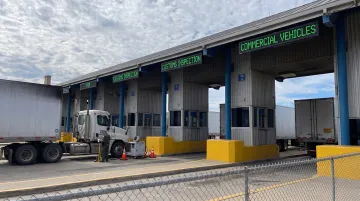
Cross-border transit times are less predictable than domestic due to customs inspections, border wait times, and carrier handoffs. Laredo processed more than 3 million incoming trucks from Mexico in 2024, up 3.1% from 2023. Build buffer time into delivery promises and communicate realistic expectations to customers.
Best Practices for Cost-Effective Cross-Border Shipping
Compare carrier rates and negotiate pricing:
Don't accept the first quote. Research and compare rates from multiple carriers. Consider platforms that let you compare your own carrier accounts alongside negotiated third-party rates to identify the best pricing for each shipment.
Use a TMS or rate comparison platform for transparency:
Technology platforms speed up cross-border quoting, provide real-time rate comparisons, and eliminate hidden fees. For shippers without massive volume, platforms with pre-negotiated carrier rates level the playing field.
GetAFreightQuote.com's TMS platform, for example, lets businesses compare negotiated FedEx, UPS, and LTL rates alongside their own carrier accounts, with typical savings of 20–50% below retail pricing. It also supports cross-border LTL to and from Canada and Mexico, with local import/export contacts and customs broker partners for clearance.
Work with experienced customs brokers and freight forwarders:
Brokers handle customs clearance and compliance, reducing the risk of costly errors and penalties. Forwarders coordinate multi-leg shipments and carrier relationships. For complex or high-value shipments, professional support is worth the cost.
Optimize shipment consolidation and timing:
- Consolidate smaller shipments into full pallets or LTL loads to reduce per-unit costs
- Avoid peak shipping seasons (holidays, harvest periods) when capacity is tight and rates spike
- Schedule shipments to avoid known border congestion periods
Stay informed on trade regulations and tariff changes:
Monitor changes in trade agreements, tariff schedules, and customs regulations. Subscribe to industry newsletters, work with brokers who provide updates, and periodically review HS code classifications to stay compliant and control costs.
Frequently Asked Questions
What are cross-border shipments?
Cross-border shipments are freight that moves across international borders, requiring customs clearance, compliance with destination country regulations, and documentation such as commercial invoices, packing lists, and certificates of origin.
What items cannot be shipped internationally?
Restricted or prohibited items often include hazmat (without permits), weapons, certain chemicals, and country-specific limits on agricultural goods, pharmaceuticals, and controlled substances. Always check destination and carrier rules before you ship.
What is the most cost-effective way to ship freight cross-border?
Cost-effectiveness depends on size, urgency, and lane. LTL and intermodal usually cost less for non-urgent freight; FTL adds speed and security for larger loads. Comparing carrier rates and negotiated platform pricing can lower costs.
Do I need a customs broker for cross-border freight?
U.S. exporters can self-file some paperwork, but a licensed customs broker is highly recommended, and often legally required, for imports into the U.S., Canada, Mexico, and other countries. Brokers help with compliance, faster clearance, and lower penalty risk.
How long does cross-border freight shipping take?
Times vary by lane and mode. U.S.–Canada and U.S.–Mexico truck moves often take 2–5 days; intermodal or rail may take 5–10. Air is typically 3–7 days and ocean 2–6 weeks—build in buffer for customs inspections.
What's the difference between DDP and DAP in freight shipping?
Under DDP (Delivered Duty Paid), the shipper covers all duties, taxes, and clearance fees. Under DAP (Delivered at Place), the consignee pays. DAP is more common in B2B freight, but terms must be agreed upon in advance to avoid disputes or refused shipments.