Here's the catch: there's no single "cheapest" option. A 2 lb parcel and a 200 kg pallet shipment need completely different strategies to minimize cost. What works for an ecommerce seller mailing gifts won't work for a distributor moving inventory.
This guide breaks down the cheapest carriers for small parcels, the levers that actually move your shipping costs, what customs and GST will cost you, and what to do once your shipments outgrow what USPS, UPS, or FedEx can handle affordably.
Key Takeaways
- USPS First-Class Package International Service is cheapest for parcels under 4 lbs, though delivery isn't guaranteed.
- DHL Express Worldwide and UPS Worldwide Expedited cost more but add speed and full end-to-end tracking.
- Most US-origin goods clear Australian customs duty-free under AUSFTA, but a 10% GST still applies.
- Dimensional weight, not actual weight, inflates costs on oversized-but-light packages.
- For pallets or recurring bulk volume, freight forwarding beats parcel carriers on cost per kilogram.
Cheapest Shipping Carriers for Small Packages to Australia
The right carrier depends on weight, how badly you need tracking, and how fast the package has to land. Rates below are current list/retail benchmarks. Always verify with a live rate calculator, since fuel surcharges and origin zip code can shift the final number.
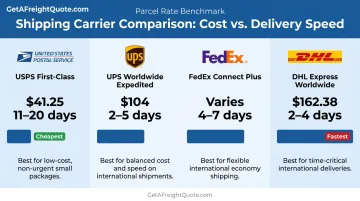
USPS First-Class Package International Service
This is the lowest-cost entry point for parcels under 4 lbs. USPS hands the package to Australia Post for final-mile delivery, which sometimes creates a short tracking gap once it lands in-country.
| Metric | Detail |
|---|---|
| Estimated Cost (1 lb) | $41.25 retail |
| Delivery Time | 11–20 business days (not guaranteed) |
| Best For | Lightweight, non-urgent shipments where tracking detail isn't critical |
Source: USPS Notice 123 rate schedule, effective July 2026.
UPS Worldwide Expedited / Worldwide Saver
UPS keeps the package on its own network the entire way, with no handoff to a local postal service. That means consistent tracking from pickup to doorstep, which matters once reliability is worth paying for.
| Metric | Detail |
|---|---|
| Estimated Cost (1 lb) | $104.00 (Worldwide Expedited) / $109.00 (Worldwide Saver) |
| Delivery Time | 2–5 business days (Expedited); 1–3 business days (Saver) |
| Best For | Time-sensitive shipments needing guaranteed tracking |
FedEx International Economy / Connect Plus
FedEx's Connect Plus service targets ecommerce sellers specifically, competing closely with UPS and DHL on price for small parcels. FedEx doesn't publish a flat public rate for this lane, so you'll need to run its online calculator with your exact weight and dimensions.
| Metric | Detail |
|---|---|
| Estimated Cost (1 lb) | Varies by account; check FedEx rate tool |
| Delivery Time | 4–7 business days (Economy); as few as 2 days in some ecommerce markets |
| Best For | Ecommerce sellers wanting a balance of cost and moderate speed |
DHL Express Worldwide
DHL runs the shipment end-to-end on its own global network, which generally means faster customs clearance and the most consistent transit times among the express carriers.
| Metric | Detail |
|---|---|
| Estimated Cost (1 lb) | $162.38 list rate |
| Delivery Time | 2–4 business days |
| Best For | Urgent shipments where speed and clearance reliability outweigh cost |
Checking all four carriers by hand eats up time better spent running your business. A multi-carrier rate-shopping platform like GetAFreightQuote.com's TMS tool pulls live USPS, UPS, FedEx, and DHL quotes side by side, so the cheapest compliant option surfaces automatically instead of requiring four separate lookups.
Factors That Affect Shipping Costs & Money-Saving Tips
Weight isn't the only thing driving your quote. Dimensional (volumetric) weight often matters more than actual weight. Carriers calculate (length × width × height) / 139 and bill whichever number is higher. An oversized box holding a lightweight item can trigger a much higher charge than expected.
Beyond box size, service level is usually the biggest lever you control. Express options like DHL Express or UPS Saver frequently cost two to three times more than economy tiers for just a few days of speed. If the shipment isn't urgent, economy service is where the real savings live.
Customs duties and GST can also add to landed cost depending on shipment value (more on that below).
Practical ways to cut costs on every shipment:
- Use the smallest snug packaging possible; skip excess void fill that inflates dimensional weight
- Consolidate multiple items into fewer shipments: each parcel carries its own base fee regardless of contents
- Rate-shop across carriers every time you ship, since the cheapest option shifts by weight, origin zip code, and season
- Weigh and measure accurately before booking, since rounding errors on dimensions push you into a higher billing tier
Multi-carrier rate-shopping tools remove the guesswork here. Instead of manually checking USPS, UPS, FedEx, and DHL rate pages one by one, a platform like GetAFreightQuote.com's TMS pulls live rates side-by-side and flags the cheapest option in seconds. That matters because the "winner" changes shipment to shipment.
Shipping Larger or Bulk Orders to Australia: When Freight Beats Parcel Carriers
Parcel carrier pricing works fine until it doesn't. Once a shipment grows past standard parcel thresholds (multiple boxes, pallets, or 20kg+), the cost per kilogram with USPS, FedEx, or UPS climbs sharply. At that point, freight forwarding becomes the more economical route.
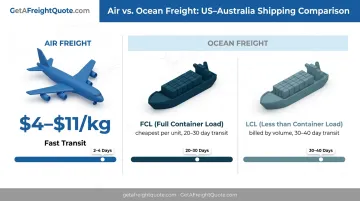
Air freight on the US-Australia lane typically runs $4–$11 per kg, while ocean freight is generally more economical above 500 kg, according to Freightos's route data. Ocean shipping breaks down into two options:
- FCL (Full Container Load): cheapest per unit for large volumes filling a pallet or container, though transit runs 20–30 days to major ports like Sydney
- LCL (Less than Container Load): works for partial loads, billed by volume with roughly a 1 CBM minimum, though transit stretches to 30–40 days due to consolidation
Here's a pattern worth knowing: small and mid-sized businesses have historically been quoted higher freight rates than large-volume shippers. Carriers simply reserve their best pricing for high-volume accounts, and that gap is exactly why rate-pooling platforms exist.
This is where GetAFreightQuote.com fits in. As an authorized reseller of a Transportation Management System, the platform gives smaller shippers access to negotiated carrier rates typically reserved for Fortune 500-level freight volumes. Every quote comes with full rate transparency and no hidden fees before booking.
A few things that make this practical for growing shippers:
- You can add your own existing carrier accounts alongside GetAFreightQuote.com's negotiated rates for direct comparison
- Rates cover LTL, FTL, and air/ocean international freight, not just one mode
- There's no need to hit enterprise volume first; the aggregated rate pool works from smaller shipment counts too
For a business shipping recurring pallets to Australia, that means consistently choosing whichever option is cheapest as volume scales. You're never stuck on a single carrier's rate card.
Customs, Duties, and GST for Shipping to Australia
Most US-origin goods enter Australia duty-free thanks to the Australia-US Free Trade Agreement (AUSFTA), provided they meet rules-of-origin requirements. That doesn't mean shipments are tax-free, though.
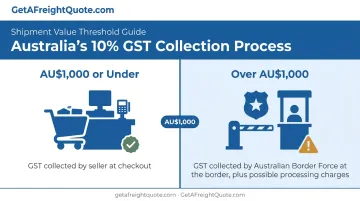
A 10% GST generally applies regardless of duty-free status. According to Australian Border Force guidance, collection depends on shipment value:
| Shipment Value | GST Collection Point |
|---|---|
| AU$1,000 or under | Collected by the seller/marketplace at checkout |
| Over AU$1,000 | Collected at the border by Australian Border Force, plus possible processing charges |
Customs delays rarely stem from the tax itself; paperwork problems cause most holds at the border. The biggest factors preventing delays include:
- Accurate commercial invoices with itemized values
- Correct HS codes for each product category
- Specific, detailed item descriptions
Vague labels like "gift" don't identify the actual goods and often trigger a manual review instead of speeding things up.
Conclusion
There's no single cheapest way to ship to Australia — it depends on your shipment's weight, urgency, and volume.
- USPS or economy postal options win for light, non-urgent parcels
- UPS and DHL justify their higher cost when speed and tracking reliability matter
- Freight and negotiated rates become cheaper once volume outgrows what parcel carriers handle efficiently
The mistake most shippers make is picking one carrier and sticking with it regardless of how their shipment profile changes. Re-compare rates regularly instead.
If your business ships growing or recurring volume to Australia, get a freight quote from GetAFreightQuote.com to see enterprise-level rates without needing enterprise-level volume.
Frequently Asked Questions
What is the cheapest way to ship to Australia?
For parcels under 4 lbs, USPS First-Class Package International Service is generally cheapest. DHL and UPS economy services offer better value once speed or heavier weights are involved, and freight forwarding wins at bulk/pallet volumes.
How much to send 1kg to Australia?
A 1kg parcel falls outside USPS's lowest tier and gets billed at the 3 lb rate bracket. Expect roughly $88 with USPS Priority Mail International, $129–$139 with UPS, and over $200 with DHL Express.
Does USPS ship to Australia?
Yes. USPS ships via First-Class Package International Service, Priority Mail International, and Priority Mail Express International, with Australia Post handling final-mile delivery.
Is DHL or FedEx cheaper to ship to Australia?
Pricing is typically close between the two for small parcels, with the cheaper option shifting based on weight and service level. A rate-shopping platform like GetAFreightQuote.com lets you compare both carriers side-by-side before booking, so you always know which one wins for that shipment.
How long does shipping to Australia take?
Economy options like USPS First-Class International can take 11–20 business days. Express options like DHL Express Worldwide or UPS Worldwide Saver typically arrive in 2–5 business days.
Do I have to pay customs duty when shipping to Australia?
Most US-origin goods are duty-free under AUSFTA, but a 10% GST usually applies. It's collected at checkout for shipments under AU$1,000, or at the border for higher-value shipments.